Why does the harmonic series diverge?

My Precalculus students have been asking me this question. I don’t really have a great answer, except that it’s true. Granted it’s not very intuitive. But nothing about infinite series is intuitive. For those not in my class or not familiar with the harmonic series, the question is:

Does \sum_{n=1}^{\infty}\frac{1}{n}=1+\frac{1}{2}+\frac{1}{3}+\frac{1}{4}+\cdots converge?

And the answer is no.  This is surprising, because the terms of the series approach zero.

The proof that it diverges is due to Nicole Oresme and is fairly simple. It can be found here. There are at least 20 proofs of the fact, according to this article by Kifowit and Stamps.

Interestingly, the alternating harmonic series does converge:

\displaystyle \sum_{n=1}^{\infty}\frac{(-1)^n}{n}=1-\frac{1}{2}+\frac{1}{3}-\frac{1}{4}+\cdots =\ln{2}

And so does the p-harmonic series with p>1. For instance:

\displaystyle  \sum_{n=1}^{\infty}\frac{1}{n^2}=1+\frac{1}{2^2}+\frac{1}{3^2}+\frac{1}{4^2}+\cdots  =\frac{\pi^2}{6}

Besides looking at the sequence of partial sums, I’m not sure I can help you with the intuition on any of these facts. Can you?

Really Fun Limit Problem (revisited)

I posted this problem a few weeks ago:

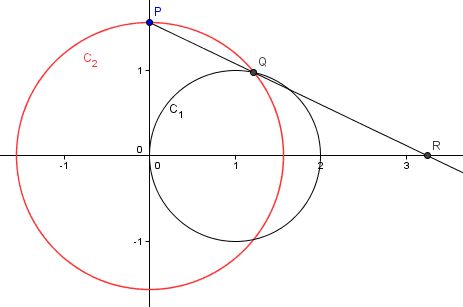
The figure shows a fixed circle C_1 with equation \left(x-1\right)^2+y^2=1 and a shrinking circle C_2 with radius r and center the origin (in red). P is the point (0,r), Q is the upper point of intersection of the two circles, and R is the point of intersection of the line PQ and the x-axis. What happens to R as C_2 shrinks, that is, as r\rightarrow 0^{+}?

And I also posted this applet, so you could investigate it yourself.

Now, I post the solution. Initially, I thought that the x-coordinate of R would go off to infinity or zero, I wasn’t sure which. The equation for C_2 is x^2+y^2=r^2. Solving for the intersection of the two circles, Q, we find it has coordinates

Q=\left(\frac{r^2}{2},\sqrt{r^2-\frac{r^4}{4}}\right)

Remembering that P=(0,r), we now find the equation of line PQ in point-slope form.

y-r=\left(\frac{r-\sqrt{r^2-\frac{r^4}{4}}}{0-\frac{r^2}{2}}\right)(x-0)

Now, we seek to find the coordinates of R, the x-intercept of the line. Letting y=0 in the above equation, we solve for x and find

x=\frac{\frac{r^2}{2}}{1-\sqrt{1-\frac{r^2}{4}}}

We now take the limit of x as r\rightarrow 0.

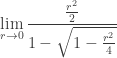
\displaystyle\lim_{r\rightarrow 0}\frac{\frac{r^2}{2}}{1-\sqrt{1-\frac{r^2}{4}}}

If we try to evaluate this limit by plugging in 0, we get an indeterminant form 0/0. We can either use L’hopital’s Rule or evaluate it numerically. Either way, we find.

\displaystyle\lim_{r\rightarrow 0}x=4

I have to say, this result surprised me. Like I said, I expected this limit to evaluate to 0 or infinity–but 4?? I had to get a bit more of an intuitive understanding, so I built that Geogebra applet.

Also, I was told afterward, by the student who brought this to me, that there’s a straight-forward geometric way of deriving the answer, based on the observation that point Q and point R and the point (2,0) (0,2) form an isosceles triangle for all values of r. The observation isn’t trivial. Can you prove it’s true? Once you do realize this fact, though, the above result is clear.


Math in the News

Here are a few recent things I’ve come across I thought everyone might enjoy:

Okay, I think you’re all caught up on the math world :-).

Really Fun Limit Problem

Here’s a great problem that a student brought to me today. For those who’ve been wanting a ‘problem of the month,’ here you go:

The figure shows a fixed circle C_1 with equation \left(x-1\right)^2+y^2=1 and a shrinking circle C_2 with radius r and center the origin (in red). P is the point (0,r), Q is the upper point of intersection of the two circles, and R is the point of intersection of the line PQ and the x-axis. What happens to R as C_2 shrinks, that is, as r\rightarrow 0^{+}

The Saint Louis Arch and y=coshx

NPR’s Science Friday had an episode highlighting the mathematics behind the Saint Louis Arch. You can watch a little video on the subject at their website, here.

The shape of the arch is the same shape of a hanging chain, called a catenary. “Catenary” is another name for the hyperbolic cosine function,

\cosh {x} = \frac {e^{x}+e^{-x}} {2}

It’s not the world’s most riveting video, but it does highlight this important function that doesn’t get much press in our high school math curriculum. If you watch the video, you’ll learn something about this function, and you’ll learn that the catenary is not only the shape of a hanging chain but also the shape of the most stable arch. For more on the mathematics of the Saint Louis Arch, visit the wikipedia article.

In particular, the Saint Louis Arch has the equation

y = 693.8597 - 68.7672\cosh {(0.0100333x)}

Now, of course you want to know about the hyperbolic sine function, too. I’ll let you look it up yourself (or maybe you can take a guess, first?). Then ask yourself some questions you might be dying to know: Which functions are odd/even? What trig identities are associated with these functions? For Calculus students: What is the derivative of each of these functions? What is the power series? And there are some exciting connections with these functions and complex numbers, too. Go play, and tell me what you learn!

Who am I? (hint)

I posted the following problem back on December 3. I thought I’d post the solution, but then I decided maybe to just give you a hint. I’ve emboldened each true statement. The other statement in each pair is false. I did a lot of trial and error, making lists of numbers and crossing things off, narrowing it down. I didn’t have a great strategy, so see if you can do better. Can you figure out the number now?

There are five true and five false statements about the secret number. Each pair of statements contains one true and one false statement. Find the trues, find the falses, and find the number.

1a. I have 2 digits
1b. I am even

2a. I contain a “7”
2b. I am prime

3a. I am the product of two consecutive odd integers
3b. I am one more than a perfect square

4a. I am divisible by 11
4b. I am one more than a perfect cube

5a. I am a perfect square
5b. I have 3 digits