More Press

Another math blog has featured one of my recent posts. Go check out the 66th Carnival of Mathematics at the Wild About Math blog.

In reading through the carnival, I was especially interested in (as a math teacher), JSXGraph, an interactive graphing application that you can easily embed in webpages using javascript. I’ve also been meaning to point you to Dave Richeson’s recent blog post about the volume of n-Dimensional balls.  I would also be remiss to not mention the recent passing of world famous, and well-loved mathematician and puzzle-creator, Martin Gardner. The aforementioned carnival points us to a post here, which honors his memory (among hordes of other posts on math blogs around the web that have honored him recently).

π is Transcendental

Passing on a post from my dad…I think some of the math is accessible for my readers. In fact, for my precalculus students, it ties together some of the nice stuff we’ve studied this semester (infinite series, complex numbers).

Teaching History of Math this past semester gave me an excuse to read carefully two Dover Publications books that I have owned since high school, but only skimmed then. Imagine my delight to discover that if you are given a theorem that is hard to prove beforehand, you can prove that \pi is transcendental in just a couple of lines. The hard theorem gives many other corollaries too, corollaries that I’ve known in my gut but never had a handle on how to prove.

Here are the details, from p. 76 of Felix Klein’s book Famous Problems of Elementary Geometry. You can read it on-line at Google Books.

(more)

Go check it out!

Functions of a Complex Variable

My precalculus classes just finished a unit on polar coordinates and complex numbers. When I teach about complex numbers,  I mention functions of a complex variable in passing, but we don’t really give it much thought. We do complex arithmetic and that’s all; that is, problems like these:

Evaluate.

\frac{i^5(2-i)}{1+3i}

\left(2+2i\sqrt{3}\right)^{10}

\sqrt[4]{40.5+40.5i\sqrt{3}}


In our precalculus class, we also understand how to plot complex numbers. Complex numbers must be plotted on a two-dimensional plane because complex numbers are…well…two dimensional! The real number line has no place for them. For instance, we represent the complex number w=2-3i as the point (2,-3)

But we don’t ask questions about complex functions. This is sad! Because functions of a complex variable are fairly accessible.  That is, we want to consider functions like

f(z)=z+1

f(z)=z+4i

f(z)=3z

f(z)=iz

f(z)=z^2

The first thing you’ll notice is that I’ve written these functions in terms of z, to indicate that they take complex arguments and (possibly) return complex values. Here’s where the problem comes. Take for instance, f(x)=x+1. We’re used to visualizing it this way:

y=x+1

Notice we’re wired (because of schooling, perhaps) to understand the x coordinate as being the “input” to the function and the y coordinate as being the “output” from the function. Now, think about f(z)=z+1 where z is complex. Do you see the problem? Remember, complex numbers are two-dimensional.  A function f(z) that operates on complex numbers has two-dimensional input and two-dimensional output. For example, take the function f(z)=z+1. If we try putting a few complex numbers into the function for z, what happens? If z=-2+4i, then f(z)=-1+4i. Geometrically, what is happening to a complex number on the complex plane when we apply f(z)? If you thought “the function translates complex numbers to the right by one unit in the complex plane,” you’re right!

I’ve built another Geogebra applet to help you visualize this kind of function. Make sure you use it with purpose, rather than just dragging things around randomly. Try making predictions about what will happen before revealing the result. Read the directions.

Have fun, and I hope you learn something about complex functions! I’m sure to post more on them someday. There’s a lot more to say.


Soda Mixing Problem (revisited)

I posted a problem back in December that I never got back to answering. Sorry about that. The problem statement was:

Two jars contain an equal volume of soda. One contains Sprite, the other Coca Cola. You take a small amount of Coca Cola from the Coca Cola jar and add it to the Sprite jar. After uniformly mixing this concoction, you take a small amount out and put it back in the Coca Cola jar, restoring both jars to their original volumes. After having done this, is there more Coca Cola in the Sprite jar or more Sprite in the Coca Cola jar? Or, are they equally contaminated?

I have had the worked out solution for a while, just haven’t posted it until now. I’m relatively new with \LaTeX, but I’ve typed up the solution here, if you want all the gory details :-).  And yes, Peekay, you got the right answer!

College Readiness in Math

Passing on an interesting article. For the full article, go here.


A Math Paradox:
The Widening Gap Between High School and College Math

By Joseph Ganem

We are in the midst of paradox in math education. As more states strive to improve math curricula and raise standardized test scores, more students show up to college unprepared for college-level math. The failure of pre-college math education has profound implications for the future of physics programs in the United States. A recent article in my local paper, the Baltimore Sun: “A Failing Grade for Maryland Math,” highlighted this problem that I believe is not unique to Maryland. It prompted me to reflect on the causes.

The newspaper article explained that the math taught in Maryland high schools is deemed insufficient by many colleges. According to the article 49% of high school graduates in Maryland take non-credit remedial math courses in college before they can take math courses for credit. In many cases incoming college students cannot do basic arithmetic even after passing all the high school math tests. The problem appears to be worsening and students are unaware of their lack of math understanding. The article reported that students are actually shocked when they are placed into remedial math.

(more)

Heat Conduction in a Rod

I’m currently taking a grad class in differential equations. I just had a homework problem that asked about the heat conduction in a long, thin rod. It inspired me to create another GeoGebra applet, and I thought I’d share. The math might be a bit inaccessible, but the results are fairly straightforward.

Image credit: http://www.citycollegiate.com/heatxa.htm

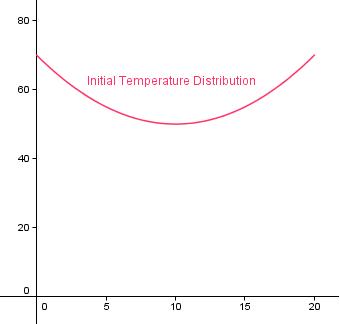
Consider a solid rod of some kind of uniform material (maybe aluminum or cast iron). Say it’s 20 cm long. And say, for whatever reason, the temperature at a given place in the bar is initially given by this distribution:

Notice the bar is 70 degrees at each end and 50 degrees in the middle. (This is arbitrary…I just picked this distribution, just for fun.)

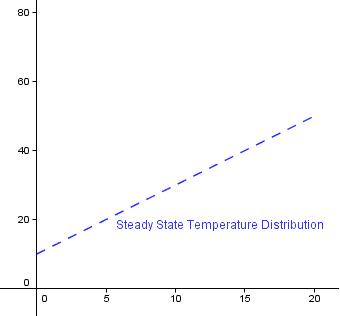
Now, let’s say the sides of the bar are insulated, and we just apply heat to the ends. If we maintain a temperature of 10 degrees at one end and 50 degrees at the other end, after a long time, we would expect the temperature throughout the bar to be evenly distributed, ranging from 10 degrees to 50 degrees. It would look something like this:


Now, the question is, what is the temperature throughout the bar after 1 second? It should be pretty close to the original distribution still, right? Right. What about after 10 seconds? 30 seconds? 30 days? Eventually it will look like the above distribution. That’s why we call this the “steady-state” distribution.

Here’s what the temperature throughout the bar looks like after 30 seconds, for instance.

Notice that the temperature distribution is still very similar to the initial distribution, but that the ends are changing temperature. This will happen more and more over time.

The applet I constructed lets you change everything about this situation: the length of the bar, the type of material, the temperature we apply to each end, and the initial temperature distribution. Like I said, the math is a bit nasty, but the results are intuitive, I hope. If you want to see some more of the math, feel free to do some reading!