Benford’s Law & Infinite Primes

At the risk of sounding like a broken record: Dave Richeson has had some more great posts recently. These two in particular left me in awe of mathematics. Both results I had seen before, but not proved in these ways. These two proofs are so unique. Unfortunately, for my students, both of these particular proofs also require math typically not covered in high school. But that shouldn’t stop you from checking them out. In fact, both results have much simpler and more accessible proofs that I’ve linked to.

1. Irrational rotations of the circle and Benford’s law. Benford’s law is amazing. It predicts, for instance, that in a large list of spread out data, approximately 30.1% of the data will start with a “1”. The other digits have predictable frequency as well. This law allows analysts to detect fraud in data. Cool! Richeson proves Benford’s law for the powers of 2 (so…not a full proof of Benford’s) using irrational rotations of a circle. For more on Benford’s and a more straightforward justification, read the wikipedia article or one of the other sources Richeson links to.

2. Hillel Furstenberg’s proof of the infinitude of primes. There are infinite primes. For other proofs, see this page, especially the classic number-theoretic proof by Euclid. Euclid’s proof is definitely accessible to high school mathematicians, and it’s pretty elegant and exciting if you haven’t seen it before.

The Earth, in Perspective

If you’re like me, you have trouble putting the heights of objects and land features in perspective–tall buildings are 1000 feet or more, tall mountains are 20,000 feet or more (though they rarely have a prominence of half that height), and airplanes fly at 30,000 feet. All of these features are nicely synthesized in the info-graphic below, thanks to ouramazingplanet.com. I especially appreciate all the under-water features that have been included. The creators of this image have another new info-graphic that deals with even larger distances here.

[Hat tip: Division by Zero]

Asymptote Misconceptions

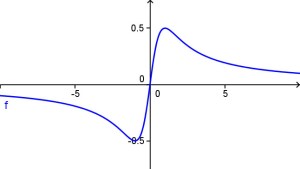
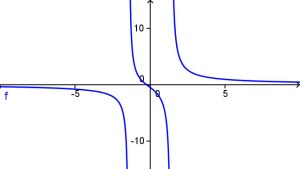
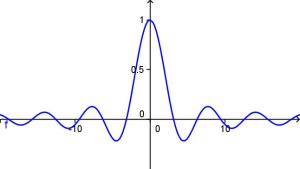
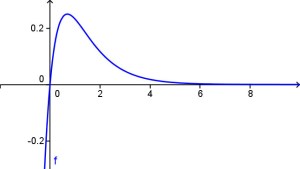
Can a function cross its horizontal asymptote? Can it be defined on its vertical asymptotes? Most students say no to both questions. But the answer to both questions is actually yes. At the beginning of every year I have to clear up this common misconception. So, let me write it all out so it’s cut and dry. We’ll start by examining a bunch of examples.

Functions that cross their horizontal asymptotes

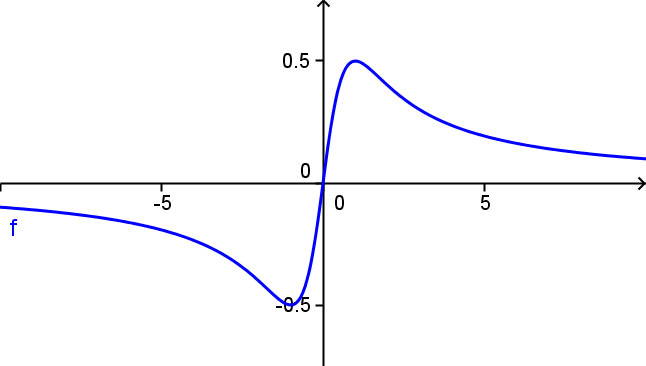
f(x)=\frac{x}{x^2+1} (also try f(x)=xe^{-x^2})

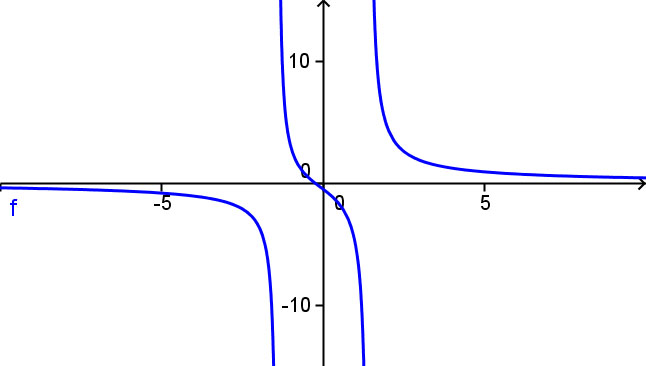
f(x)=\frac{4x+1}{x^2-2}

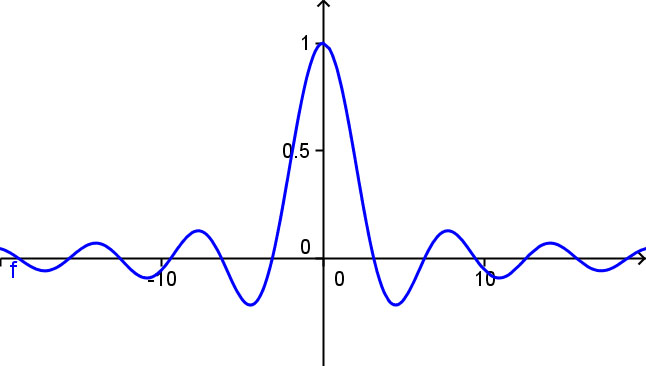
f(x)=\frac{\sin{x}}{x}

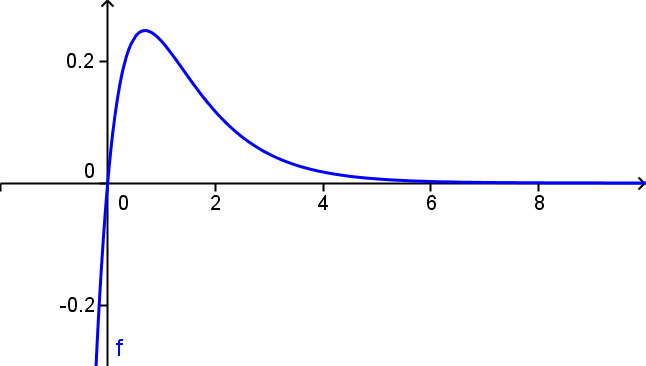
f(x)=-e^{-2x}+e^{-x}

Functions that are defined on their vertical asymptote

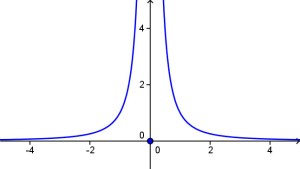
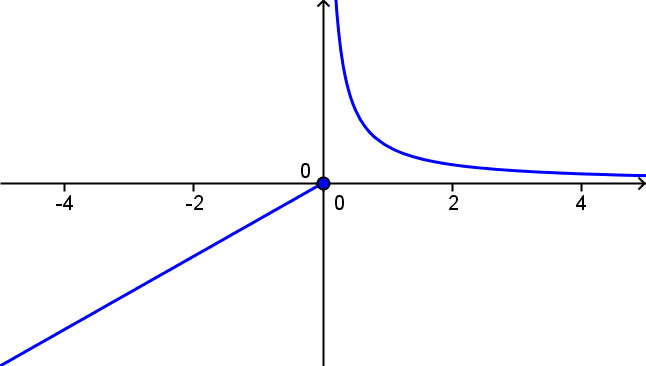
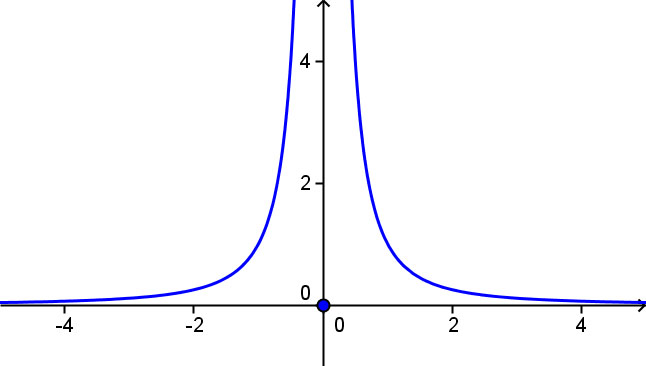
Functions defined on their vertical asymptotes are a bit more contrived, but they are completely legitimate and still pass the “vertical line test.” These functions must be defined piece-wise, like so:
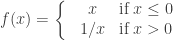
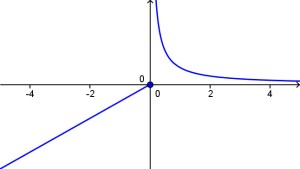
f(x)=\left\{\begin{matrix}&x   &\text{if}\;  x\leq0\\ &1/x &\text{if}\; x> 0\end{matrix}\right.

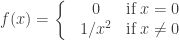
f(x)=\left\{\begin{matrix}&0   &\text{if}\;  x=0\\ &1/x^2 &\text{if}\; x\neq 0\end{matrix}\right.

What IS an asymptote?

Said loosely, an asymptote is a line that a curve gets closer to as it tends toward infinity (whereby we mean, anywhere on the outskirts of the coordinate plane). Feel free to read the wikipedia entry for all the gory details. It even mentions ‘curvilinear’ asymptotes–asymptotes that aren’t lines. Our Precalculus text mentions them too, but we don’t make a big deal about it.

The most rigorous definition of an asymptote our students see involves limits. And even then, we show you how to evaluate limits but don’t prove limits (with \epsilon\delta proofs!). That’s a bit different than when I took Calculus in high school. I remember learning the proofs. For those who miss them in high school, though, have no fear–a college course in elementary real analysis will feed your hunger! 🙂

So, to my students: I hope this helps clear up some issues you might have with asymptotes and frees your mind from the prototypical examples of asymptotes you might be used to!

Glen Whitney Speaking at RM

Richard Montgomery High School will be hosting mathematician Glen Whitney on Friday, October 22. I’ll say more about it as the date approaches, but I thought I’d advertise early. He will be doing a walking ‘math tour’ of downtown Rockville. Some of our higher-level math students will be invited (students in Calculus or those who have taken it). I’m really looking forward to his talk!

Glen is the executive director of the Mathematics Museum on Long Island NY. For more information about Glen, or about the math museum, here’s an article about him. Or, visit the math museum’s website.

Here’s the article that’s on the RM website:

Continue reading

First Week Fun

It’s so good to be back. I love summer, but unlike Calvin, I always enjoy returning to the school year. And I really like getting to know all of my students.

Just for fun, here’s a problem I came up with today. It combines some nice Algebra 2/Precal skills, and provides a nice exercise in analysis of functions. No calculator needed. Feel free to give answers in the comments below. In fact, feel free to suggest other similar problems.

Find the range of f(x)=2^{x^2-4x+1}.

Summer Odds and Ends

I promise I’ve been mathematically active this summer, despite my little blogging vacation (I do get the summers off, you know!). So, in one post, let me highlight some of the nice stuff I’ve seen around the web recently:

  • The left-handed boy problem. Another post by Dave Richeson (can you tell I’m a fan of his blog?). The post is inspired by this kind of probability question:

Given a randomly selected family that has two children, one of whom is a boy, what is the probability that the other is a boy?

The post is great, but the conversation in the comments is just as great. You’ll notice that I’m a heavy participant. I really liked thinking about this class of problem. It highlights some of the most treacherous territory in mathematics, probability theory. I’ll probably end up devoting an entire post to this topic sometime in the future.

  • P ≠ NP. The Math Less Traveled blog hosted this announcement of a possible proof that P ≠ NP, by Vinay Deolalikar. It’s a Clay Mathematics Institute Millennium Problem, which has a $1 million prize attached to its (vetted) solution. Unfortunately, fatal flaws have already been found. Oh well. So it’s still an open problem and perhaps one of my students will solve it someday!
  • Stars and Stripes. Slate.com has a fun US flag generator, given any almost number of stars between 1 and 100. It’s great fun to play with the little interactive flag. And the task might provide you countless hours of entertainment, coming up with these arrangements on your own, without its help. A mathematician developed this, so that makes it appropriate for this blog :-).

And now for a bunch of books I read this summer which are all good, all of which I recommend.

  • The Mathematical Universe, by William Dunham. It’s not new, I know. But I finally finished reading it this summer and I highly recommend it. I love his lighthearted tone and all the wonderful anecdotes sprinkled throughout the book. It’s the perfect mix of fascinating history and little mathematical facts & puzzles that will make you hungry for more! Feel free to come and borrow it from me.
  • Outliers, by Malcolm Gladwell. It’s not purely mathematical–I call these books “pop research” books. Very good read. Tons of great tidbits that you can bring up in conversation, sure to fascinate your next dinner guests.
  • Freakonomics, by Steven Levitt & Stephen Dunbar. Another book that’s not really new but that I’ve only recently read. It’s also a “pop research” book–mind candy, if you will.
  • Godel, Escher, Bach, by Douglas Hofstadter.  Actually, I’m only half way through this book. But I can already tell you it’s absolutely classic; truly brilliant. Maybe someone will write another book, Godel, Escher, Bach, Hofstadter, someday. Citing books within books would be the kind of recursion that Hofstadter loves. Can’t wait to finish the book…I’m sure to post about again later, and in more detail.

An island on an island on an island

Interesting Cube Problem

If the cube has a volume of 64, what is the area of the green parallelogram? (Assume points I and J are midpoints.)

Go ahead, work it out. Then, go here for a more in depth discussion, including a video explanation. Also, see my very simple solution in the comments on that page. (My Precalculus students should especially take note!)

And, welcome, SAT Math Blog, to the internet! Thanks for pointing us to this great problem and creating the nice diagram above.

Happy Last Day of School!!

Honestly, I wouldn’t mind year-round schooling. I really like teaching, I really like math, and I really like my students. But, it’s also nice to do some traveling, get some projects done around the house, and catch up on reading, too.

To all my students, HAVE A GREAT SUMMER! And we’ll see you in the fall. Seniors, come back and visit often, okay?

Very Nice Java Applets

I’m always on the look out for nice java applets (or flash, or javascript, or whatever) that help visualize tough math concepts. The best applets are not merely gimmick, but truly make the mathematics more accessible and invite you to explore, predict, and play with the concepts.

Most recently, my dad pointed me to this website.  At this site, you’ll find well over one hundred very nice applets that show things I haven’t seen around the web before. For instance, play around with your favorite polyhedra in 3d, then let the applet truncate or stellate the polyhedron, all with nice animation. And of course, you’ll want to mess with all the settings on the drop down menus, too! Additionally, you can see a mobius strip, klein bottle, cross cap, or a torus. Also, I was just recently blogging about complex functions. Some of these applets allow you to visualize with animation and color various complex functions. Having just completed a grad class in differential equations, I was also interested in these ODE applets. You may also have fun with fractals, like this one.

There are lots of other nice applet websites out there. As you know, I’m a huge fan of GeoGebra (free, open source, able to be run online without installation, easy to use, powerful). Someday maybe I’ll post more extensively about its merits. In the meantime, you can check it out here.  Many of these applets use GeoGebra. This site has a lot of nice applets too.  And here. This one’s rather elementary, but fun for educators. These are great, too. These are all sites I’ve used in class. Like I said, I think they’re more than just ‘cool’–they really do help elucidate hard-to-understand topics.

Feel free to share other applet sites you like.