Bedtime Math


This math website has a great idea: If we can read bedtime stories to our children each night to increase literacy, shouldn’t also be reasonable to do a math problem before bed each night too? My sister and brother-in-law already do this, and it’s great fun. But this website does all the work for you and you can even sign up for a daily problem in your email. All of this is thanks to website creator, Laura Bilodeau Overdeck. Check it out here.

When my little daughter is a bit older, I’ll definitely be giving her some daily math problems.


[HT: Tim Chase, via Geekdad]

Pi R Squared

[Another guest blog entry by Dr. Gene Chase.]

You’ve heard the old joke.

Teacher: Pi R Squared.
Student: No, teacher, pie are round. Cornbread are square.

The purpose of this Pi Day note two days early is to explain why \pi is indeed a square.

The customary definition of \pi is the ratio of a circle’s circumference to its diameter. But mathematicians are accustomed to defining things in two different ways, and then showing that the two ways are in fact equivalent. Here’s a first example appropriate for my story.

How do we define the function \exp(z) = e^z for complex numbers z? First we define a^b for integers a > 0 and b. Then we extend it to rationals, and finally, by requiring that the resulting function be continuous, to reals. As it happens, the resulting function is infinitely differentiable. In fact, if we choose a to be e, the \lim_{n\to\infty} (1 + \frac{1}{n})^n \, not only is e^x infinitely differentiable, but it is its own derivative. Can we extend the definition of \exp(z) \, to complex numbers z? Yes, in an infinite number of ways, but if we want the reasonable assumption that it too is infinitely differentiable, then there is only one way to extend \exp(z).

That’s amazing!

The resulting function \exp(z) obeys all the expected laws of exponents. And we can prove that the function when restricted to reals has an inverse for the entire real number line. So define a new function \ln(x) which is the inverse of \exp(x). Then we can prove that \ln(x) obeys all of the laws of logarithms.

Or we could proceed in the reverse order instead. Define \ln(x) = \int_1^x \frac{1}{t} dt . It has an inverse, which we can call \exp(x) , and then we can define a^b as \exp ( b \ln (a)). We can prove that \exp(1) is the above-mentioned limit, and when this new definition of a^b\, is restricted to the appropriate rationals or reals or integers, we have the same function of two variables a and b as above. \ln(x) can also be extended to the complex domain, except the result is no longer a function, or rather it is a function from complex numbers to sets of complex numbers. All the numbers in a given set differ by some integer multiple of

[1] 2 \pi i.

With either definition of \exp(z), Euler’s famous formula can be proven:

[2] \exp(\pi i) + 1 = 0.

But where’s the circle that gives rise to the \pi in [1] and [2]? The answer is easy to see if we establish another formula to which Euler’s name is also attached:

[3] \exp(i z) = \sin (z) + i \cos(z).

Thus complex numbers unify two of the most frequent natural phenomena: exponential growth and periodic motion. In the complex plane, the exponential is a circular function.

That’s amazing!

Here’s a second example appropriate for my story. Define the function on integers \text{factorial (n)} = n! in the usual way. Now ask whether there is a way to extend it to (some of) the complex plane, so that we can take the factorial of a complex number. There is, and as with \exp(z), there is only one way if we require that the resulting function be infinitely differentiable. The resulting function is (almost) called Gamma, written \Gamma. I say almost, because the function that we want has the following property:

[4] \Gamma (z - 1) = z!

Obviously, we’d like to stay away from negative values on the real line, where the meaning of (–5)! is not at all clear. In fact, if we stay in the half-plane where complex numbers have a positive real part, we can define \Gamma by an integral which agrees with the factorial function for positive integer values of z:

[5] \Gamma (z) = \int_0^\infty \exp(-t) t^{z - 1} dt .

If we evaluate \Gamma (\frac{1}{2}) we discover that the result is \sqrt{\pi} .

In other words,

[6] \pi = \Gamma(\frac{1}{2})^2 .

Pi are indeed square.

That’s amazing!

I suspect that the \pi arises because there is an exponential function in the definition of \Gamma, but in other problems involving \pi it’s harder to find where the \pi comes from. Euler’s Basel problem is a good case in point. There are many good proofs that

1 + \frac{1}{2^2} + \frac{1}{3^2} + \frac{1}{4^2} + ... = \frac{\pi^2}{6}

One proof uses trigonometric series, so you shouldn’t be surprised that \pi shows up there too.

\pi comes up in probability in Buffon’s needle problem because the needle is free to land with any angle from north.

Can you think of a place where \pi occurs, but you cannot find the circle?

George Lakoff and Rafael Núñez have written a controversial book that bolsters the argument that you won’t find any such examples: Where Mathematics Comes From. But Platonist that I am, I maintain that there might be such places.

When cars collide

[Another guest column from Dr. Gene Chase.]

Suppose two equally weighted cars collide in a head-on collision, each traveling at 50 miles per hour.  Do you think that the impact for one car will be more severe on the car and driver than the impact of that car’s hitting a brick wall?

To be fair, we have to assume that neither the cars nor the wall compress at all.  If the wall is as soft as a pillow, I’ll take the wall every time.

Marilyn vos Savant’s recent column in Parade Magazine says that hitting an oncoming car in that way is no more severe than hitting a solid wall.   They both stop dead, whether the wall or the other car causes it.

Each experiences a momentum change that is the same as if they hit a wall, not twice as much. That’s clear when I think of it now, using the law that momentum = impulse (that is, mass * velocity = force * time) but I’ve been mistaken when I’ve only thought about it casually, thinking it must be a 100 mph impact..

If a bike hits a car head-on, the situation is different, because the “bike-car” combination will continue to move in the direction of the car, so my intuition is correct in that case:  The bike driver fares worse than the car driver.  Comments at Marilyn vos Savant’s blog say as much.

I used to think that car bumpers that collapse at the slightest impact were poorly made.  In fact, if momentum is constant, extending the time of impact will decrease the force, to keep force * time constant.

Give me “cheap” bumpers and a wall made of pillows every time.

STEM

It stands for “Science, Engineering, Technology, and Mathematics” and it’s a buzz word in education circles these days. This is especially true because programs advancing the cause of STEM may be eligible for federal funds (through the National Science Foundation). I benefit directly from such programs, since the masters degree I am currently getting is fully funded because I am a ‘secondary STEM teacher.’

The term is abused, since everyone wants to call what they’re doing “STEM.”

NCTM President J. Michael Shaughnessy hits the nail on the head in this great article (I just posted one of his articles the other day). I’ve included a few snippets here, but I encourage you to read the whole article.

STEM: An Advocacy Position, Not a Content Area

by NCTM President J. Michael Shaughnessy

More and more these days, in educational meetings, conferences, and policy arenas, the talk is that “it’s all about STEM.” STEM is an acronym for science, technology, engineering, and mathematics, and it has rapidly become a driving force in educational policy and funding decisions in the United States. I find both strengths and problems with the current STEM discussions across our professional communities.


He provides a balanced critique of the STEM label as it’s used nationally and locally.

As a political advocacy position, STEM—that is, STEM funding and STEM initiatives—is of critical importance to the health of the mathematics and science education communities. In this arena, STEM makes perfect sense. It is when the term “STEM” filters down to states, districts, schools, and pre-K–12 teaching that the waters can become muddled.

The Problem with STEM

The translation from national policy to the rhetoric of state and local politics can give rise to generalist discussions about STEM programs and STEM schools, which in turn can lead to the dilution of important mathematics content. Terms such as “STEM program,” “STEM school,” and “STEM curriculum” are proliferating in our educational jargon. The acronym is shifting from a noun that represents four crucial content areas to an adjective that is used to describe just about anything and everything that anyone is doing related to science or mathematics. STEM is becoming the word du jour, because that’s where the funding lies. One can almost hear the cry in the halls of state departments of education, school district offices, principals’ offices, and school corridors: “We do STEM!” But what exactly does that mean? What are the specific innovations in the teaching and learning of mathematics and science that states, districts, and schools are implementing when they refer to themselves as “STEM intensive” or as having “a STEM program?” We should ask our leaders exactly what they mean when they use the word “STEM.” We deserve more than a generalist blanket response that represents a grouping for funding without specific content or pedagogical substance.


And of course, with an obvious bias (with which I agree!), Shaughnessy goes on to say,

With all due respect to our colleagues in the other disciplines, we assert that the letters in STEM are not all of equal importance in the pre-K–12 education of our students. Mathematics is paramount, mathematics is primal, mathematics is the most important STEM discipline.


Read the whole article here.


.

Rationalization Rant

Every high school math student has been taught how to rationalize the denominator. We tell students not to give an answer like

\frac{1}{\sqrt{2}}

because it isn’t fully “simplified.” Rather, they should report it as

\frac{\sqrt{2}}{2}.

This is fair, even though the second answer isn’t much simpler than the first. What does it really mean to simplify an expression? It’s a pretty nebulous instruction.

We also don’t consider

\frac{12}{1+\sqrt{5}}

to be rationalized because of the square root in the denominator, so we multiply by the conjugate to obtain

2-2\sqrt{5}.

In this particular example, multiplying by the conjugate was really fruitful and the resulting expression does indeed seem much more desirable than the original expression.

But here’s where it gets a little ridiculous. Our Algebra 2 book also calls for students to rationalize the denominator when (1) a higher root is present and (2) roots containing variables are present. Let me show you an example of each situation, and explain why this is going a little too far.

Rationalizing higher roots

First, when a higher root is present like

\sqrt[5]{\frac{15}{2}},

the book would have students multiply the top and bottom of the fraction inside the radical by 2^4 so as to make a perfect fifth root in the denominator. The final answer would be

\frac{\sqrt[5]{240}}{2}.

Simpler? You decide.

This becomes especially problematic when we encounter sums involving higher roots. It’s certainly possible, using various tricks, to rationalize the denominator in expressions like this:

\frac{1}{2-\sqrt[3]{5}}.

But is that really desirable? The result here is

\frac{1}{2-\sqrt[3]{5}}\cdot\frac{4+2\sqrt[3]{5}+\sqrt[3]{25}}{4+2\sqrt[3]{5}+\sqrt[3]{25}}=\frac{4+2\sqrt[3]{5}+\sqrt[3]{25}}{3},

which is, arguably, more complex than the original expression. Can anyone think of a good reason to do this, except just for fun?

Rationalizing variable expressions

Now, let’s think about variable expressions. Here is a problem, directly from our Algebra 2 book (note the directions as well):

Write the expression in simplest form. Assume all variables are positive.

\sqrt[3]{\frac{x}{y^7}}

The method that leads to the “correct” solution is to multiply the fraction under the radical by \frac{y^2}{y^2}, and to finally write

\frac{\sqrt[3]{xy^2}}{y^3}.

This is problematic for two reasons. (1) This isn’t really simpler than the original expression and (2) this expression isn’t even guaranteed to have a denominator that’s rational! (Suppose y=\sqrt{2} or even y=\pi.) Once again I ask, can anyone think of a good reason to do this, except just for fun??

So how far do we take this?

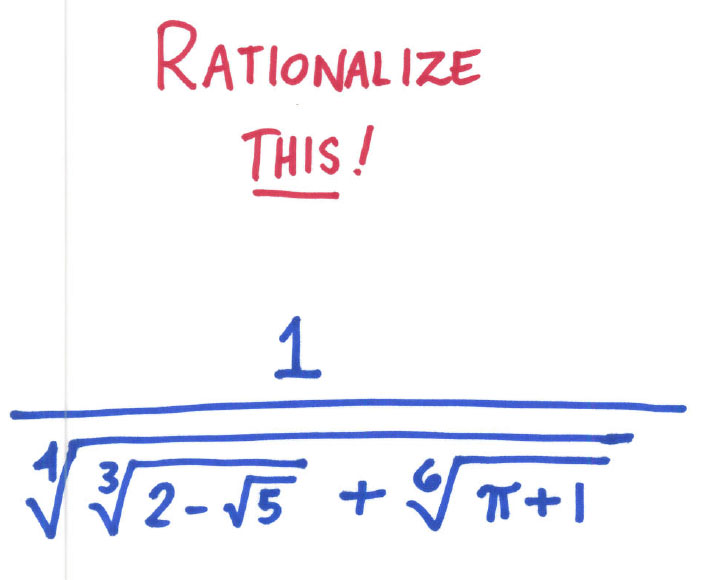
Is it reasonable to ask someone to rationalize this denominator?

\frac{1}{2\sqrt{2}-\sqrt{2}\sqrt[3]{5}+2\sqrt{5}-5^{5/6}}

You can rationalize the denominator, but I’ll leave that as an exercise for the reader. So how far do we take this? I had to craft the above expression very carefully so that it works out well, but in general, most expressions have denominators that can’t be rationalized (and I do mean “most expressions” in the technical, mathematical way–there are are an uncountable number of denominators of the unrationalizable type). All that being said, I think this would make a great t-shirt:

And I rest my case.

Minnesota Senator loves math!

I really enjoy reading J. Michael Shaughnessy’s column. He’s the president of the NCTM and always has interesting, timely things to say about math and math education. Here’s an excerpt from this week’s column, where he recounts his recent conversation with Senator Al Franken (D-Minn) as he eagerly shared a proof with President Shaughnessy. Go check it out!


Seen Any Good Proofs Lately? Raising the Social Currency of Mathematics

We all probably have had a friend or acquaintance, or even a perfect stranger, raving about a book she has just read, or a movie he has recently seen, and then saying, “Oh, you must read this book!” or, “You must see that film!” But how many of us have had this kind of experience in a social occasion where the person exclaimed, “Oh, you must see this proof!” So it was indeed refreshing to meet someone who really likes mathematics, as I did several weeks ago, in what might seem like a very unlikely setting—the Hart Senate Office Building in Washington, D.C.

On Wednesday mornings when Congress is in session, Senator Al Franken (D-Minn.) holds a breakfast gathering in his office for his constituents. Visitors to the breakfast consist primarily of people from Minnesota, but I received an invitation from a mathematics teacher who is spending the year working on the senator’s staff. A famous hearty porridge is served up at these breakfasts, and once guests have begun to circulate, Senator Franken drops in and greets everyone. I had been misinformed and thought that the Senator had been a mathematics major in college. When I asked him about this, he said that the rumor was false, but he agreed that his good grades in math had probably helped him get admitted to college.

After breakfast, the visitors were escorted to a terrace area in the hallway outside the office, where the senator spoke for a few minutes about events being debated in Congress and answered questions. Guests then lined up to have their pictures taken with the senator. I was at the end of the line, and as I shook his hand and introduced myself as the president of NCTM, he said, “Let me show you my geometric proof of the Pythagorean theorem!” Senator Franken then proceeded to grab scratch paper and a pen from one of his staffers and plopped down cross-legged on the hallway carpet. As I sat next to him, he began to sketch out his proof. He explained what he was doing, and why it worked, and I paraphrased each move he made so that it was clear to both of us how he was thinking and what he was doing.

(more)


Mathematical Pasta

Geek mom author Helene McLaughlin reviews this great geeky book about the mathematics of 92 (!!) different kinds of pasta [hat tip to Tim Chase]:


When mixing flour, egg, salt and water to make pasta, I’d guess the only math you consider is how many minutes you have left before the kids will be begging for dinner. I’d guess that you never really contemplated the mathematical beauty of that rigatoni or cavatappi that you are eating. Thats not the way George L. Legendre eats pasta.

In an effort to bring order to the possible chaos of cooking, George L. Legendre takes cooking geek to the next level with his unique book, “Pasta by Design“. Legendre takes 92 of the most familiar types of pasta, categorizes them, determines the complex mathematical equation describing the shape and shows us incredibly intricate computer models for each type of pasta.

(more)

LaTeX in HTML using a Perl script

From Hackaday:

Writing a paper in LaTeX will always result in beautiful output, but if you’d like to put that document up on the web you’re limited to two reasonable options: serve the document as a .PDF (with the horrors involves, although Chrome makes things much more palatable), or relying on third-party browser plugins like TeX The World. Now that [Todd Lehman] has finally cooked up a perl script to embed LaTeX in HTML documents, there’s no reason to type e^i*pi + 1 = 0 anymore.

(more)


There are a few other options for getting \LaTeX into your webpages, but they all feel like hacks. In particular, I like the Code Cogs Equation Editor which is a WYSIWYG \LaTeX editor. But of course, if you have a WordPress blog like this one, you can include code inline without much work at all (though WordPress hasn’t implemented a full-fledged interpreter, it’s still pretty decent).

Leap Day Birthday Math

Happy leap day!!!

Here are some leap-day birthday thoughts I discussed with my colleagues and students today:

What’s the probability of a leap year birthday?

The probability that someone is born on a leap day is \frac{1}{365\cdot 4+1}=\frac{1}{1461}\approx 0.000684. Oh wait, that’s not completely true. Leap years don’t really occur every four years. Years divisible by 100 are not leap years, unless also divisible by 400. So, the actual probability is

\frac{100-4+1}{365\cdot 400+100-4+1}= \frac{97}{146097}\approx 0.000639.

What’s the probability of having triplets on a leap day?

One of our RM students is a triplet, born today. What are the chances of that occurring? Well, the statistics on triplets are pretty hard to get right. But let’s say the occurrence of a triplet birth is 1 in 8000. (That’s my informal estimate based on this site and this site.) I think we can say that the probability of being a triplet is 3 times that (right?). Then, the probability of being a triplet born on a leap day is

\left(\frac{100-4+1}{365\cdot 400+100-4+1}\right)\left(\frac{3}{8000}\right)= \frac{291}{1168776000}\approx\frac{1}{4016412} \approx 0.249 \times 10^{-7}.

The current US population is 311,591,917, so that means there are roughly 77 triplets in the US with leap day birthdays. Happy birthday to all of you!

Bonus thought question: Iif you have quadruplets born on a leap day, you get to celebrate 4 birthdays every four years, so doesn’t that average out to one birthday a year?

Half-birthday for those born on August 29

One of my other colleagues has a birthday on August 29th. So today is her half birthday! But it only comes around every four years (roughly). Hooray!

But then that got us thinking about half birthdays: Some people, like those born on August 30th or 31st NEVER have a half birthday. How sad!! This happens to anyone born on August 30th, August 31st, March 31st, October 31st, May 31st, or December 31st. That’s a lot of people without half birthdays.

But wait. When is your actual half birthday? Shouldn’t it be 182.5 days before/after your birthday? That’s not necessarily the same date in the month. For instance, my birthday is May 15. So my half birthday should be November 15, right? Wrong. My half birthday is (May 15 + 182.5 days), which is November 13th or November 14th, depending on if you round up or down. Even accounting for a leap year, it’s still not quite right.

Who else is miscalculating their half birthday? Unless your birthday is in June, April, October, or December, you’re half-birthday isn’t what you think it is. To calculate your half birthday, use this amazing half birthday calculator I just discovered!