Pearls Before Swine

Pearls Before Swine
I’ve mentioned Khan Academy lots of times before, and other resources that allow teachers (math teachers in particular) to “flip the classroom.” Here’s a nice graphic that summarizes the model and provides a bit of research in favor of it. I haven’t been bold enough to try it, but I’d like to experiment in the next few years. It seems like you wouldn’t have to buy into the model 100%; you could use the flipped classroom model sometimes, and the traditional model other times.
Also, it occurs to me that this discussion is most relevant and most revolutionary in the math classroom. English and History classes have always used this flipped classroom model, to some extent–you read outside of class, then come to class to discuss the material. Historically, it’s math teaching that has been lecture-based. So maybe we’re just catching on to something that English and History teachers have known all along: the real thinking and learning happens when the student is involved–talking, speaking, doing, practicing, experimenting.

I have a small problem with the following language in our Algebra 2 textbook. Do you see my problem?
Horizontal Line Test
If no horizontal line intersects the graph of a function f more than once, then the inverse of f is itself a function.
Here’s the issue: The horizontal line test guarantees that a function is one-to-one. But it does not guarantee that the function is onto. Both are required for a function to be invertible (that is, the function must be bijective).
Example. Consider 

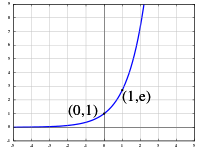
Wrong. The mapping given is not invertible, since there are elements of the codomain that are not in the range of 


This might seem like splitting hairs, but I think it’s appropriate to have these conversations with high school students. It’s a matter of precise language, and correct mathematical thinking. I’ve harped on this before, and I’ll harp on it again.
Am I blundering fool? You decide!
It turns out the trapezoid construction I posted earlier today is trivial. Thanks to Alexander Bogomolny for pointing out my error. The construction is quite easy (and it does not require the height), and I quote Alexander:
No, you do not need the height.
Imagine a trapezoid. Draw a line parallel to a side (not a base) from a vertex not on that side. In principle, there are two such lines. One of these is inside the trapezoid. This line, the other side (the one adjacent to the line) and the difference of the bases form a triangle that could be constructed with straightedge and compass by SSS. Next, extend its base and draw through its apex another base. That’s it.
So I redid my Geogebra Applet and posted it here. It’s not really worth checking out, though, since it’s indistinguishable from my previous applet. (In truth, you can reveal the construction lines and see the slight differences.) But I did it for my own satisfaction, just to get the job done correctly :-). Anyway, three cheers for mathematical elegance, and for Alexander Bogomolny*.
*check out Alexander’s awesome blog & site, a true institution in the online math community!
Lloyd left a comment on a post of mine yesterday, asking:
how do you draw a Irregular quadrilateral trapezoid with fixed dimensions for the two parallel bases and the two legs with no angles given using geometry tools?
top base= 328
bottom base= 223
left leg =220
right leg= 215
How would you answer this question? It’s not trivial. You’ll quickly find that if you do a straight-edge and compass construction, you’ll need the height of the trapezoid.
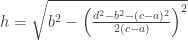
If we let a, b, c, and d be the side lengths of a trapezoid with a and c as the bases, can we express the height h as
This number is constructable, but would take some work to actually construct it on paper. Perhaps we can return to that particular question later. For now, we can let GeoGebra show us the general idea. I’ve made this applet in which you can change the side lengths and the trapezoid will be constructed. I used the height formula above to calculate the height, and the applet shows this value.

Footnote:
Just to hit home my usual point one more time, the figure above is ALWAYS a trapezoid, even when sides b and d just happen to be parallel. Just remember that a parallelogram is a special case of a trapezoid!!

Certain Uncertainty: Schrödinger Equation
From Wired.com…
9 Equations True Geeks Should (at Least Pretend to) Know
By Brandon Keim
Even for those of us who finished high school algebra on a wing and a prayer, there’s something compelling about equations. The world’s complexities and uncertainties are distilled and set in orderly figures, with a handful of characters sufficing to capture the universe itself.
For your enjoyment, the Wired Science team has gathered nine of our favorite equations. Some represent the universe; others, the nature of life. One represents the limit of equations.
We do advise, however, against getting any of these equations tattooed on your body, much less branded. An equation t-shirt would do just fine.
The Beautiful Equation: Euler’s Identity
Also called Euler’s relation, or the Euler equation of complex analysis, this bit of mathematics enjoys accolades across geeky disciplines.
Swiss mathematician Leonhard Euler first wrote the equality, which links together geometry, algebra, and five of the most essential symbols in math — 0, 1, i, pi and e — that are essential tools in scientific work.
Theoretical physicist Richard Feynman was a huge fan and called it a “jewel” and a “remarkable” formula. Fans today refer to it as “the most beautiful equation.”
I was glad to see that the first “must have” equation was Euler’s Identity (note that “Euler’s Identity” is the accepted name for this, not to be confused with Euler’s Formula or Euler’s Polyhedron Formula or any of the other amazing facts named for Euler). I think there’s large consensus in the math community that this is, indeed, a breathtaking equation. It may not be the most fundamentally important, but it definitely showcases why mathematicians delight in math.
I’m ashamed to say it, but I hardly knew any of the other equations. I knew Boltzman’s equation; Maxwell’s equations and Schrödinger’s equation have come up in some of my graduate coursework, but the others I hadn’t ever seen. One might argue that the other equations are not so important. (If you like arguing about such things, join those commenting on the article). You should still look through the list yourself; how many of these equations do you know?
Granted, this was a general article that encompased all “true geeks” not just math geeks. But still, don’t we all want to be a true geek?
(Oh, and happy birthday to Johan (III) Bernoulli, who had no notable equations named for him :-))

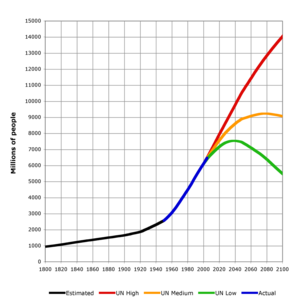
Looks like by all accounts, there are now 7 billion people in the world today. At least that’s what wikipedia says. Here are two blog posts on the subject from the math blogging community. I have to say, I was surprised to see that wolframalpha doesn’t know anything about this important event (I’m sure it won’t be the last time alpha disappoints me). Anyway, I hope everyone feels humbled to be just one of the crowd.
And, happy birthday to Karl Weierstrass!
Love this.
In honor of Bernard Bolzano, I share this old-but-good rap, from Dr. Sawin of Fairfield University:
[youtube:=http://www.youtube.com/watch?v=dfO18klwKHg]

 Random Walks