
Stellated Icosahedron

I’ve been motivated by George Hart and Zachary Abel to make my own mathematical sculpture with found objects :-). A few former students dropped by to visit me this afternoon and I put them to work making this (they had no where to be, right!?):
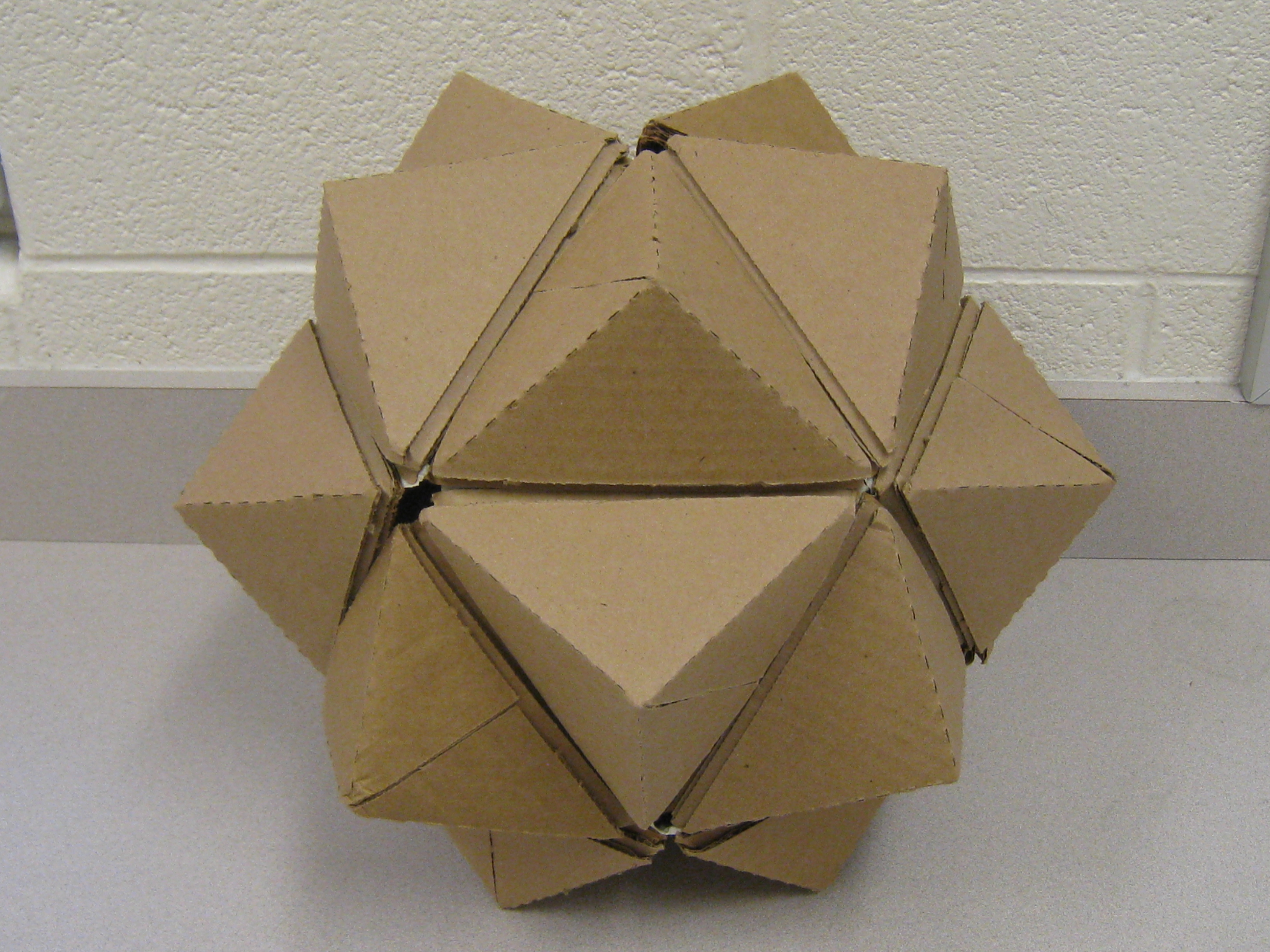
A cardboard stellated icosahedron

It’s a stellated icosahedron, made out of these little triangular pyramids. I did not make the pyramids, they came to me this way. Can you guess what their original purpose was?

Pop quiz: What do you think this is??

My wife and I redid our kitchen a few years ago, and I saved twenty of these from (did you guess it yet?) the packaging our cabinets came in. For each cabinet, there are 8 of these keeping the corners safe. The construction process was pretty straight forward, but here are some photos documenting the event.
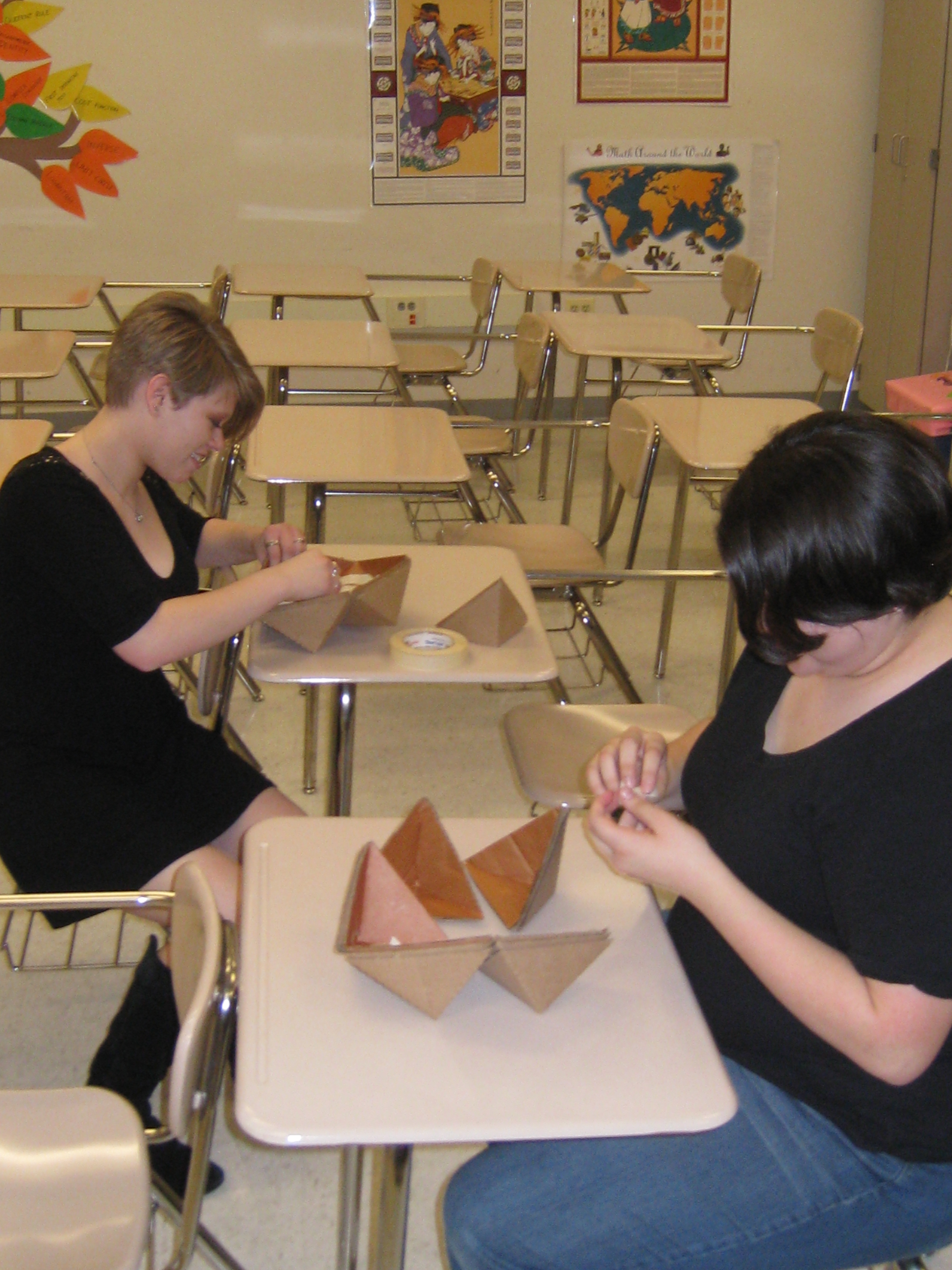
Construction begins

Every vertex looks like this on the inside.

Almost done!

The last piece goes on.

Here are some more views of the icosahedron. The icosahedron has a symmetry group of size 60.

There are 15 pairs of opposite edges, each with 2-fold symmetry (for a total of 15 orientations, not counting the identity)

There are 10 pairs of opposite faces, each with 3-fold symmetry (for a total of 20 orientations, not counting the identity)

There are 6 pairs of opposite vertices, each with 5-fold symmetry (for a total of 24 orientations, not counting the identity)

So (1 identity) + (15 edge symmetries) + (20 face symmetries) + (24 vertex symmetries) = 60 total orientations.
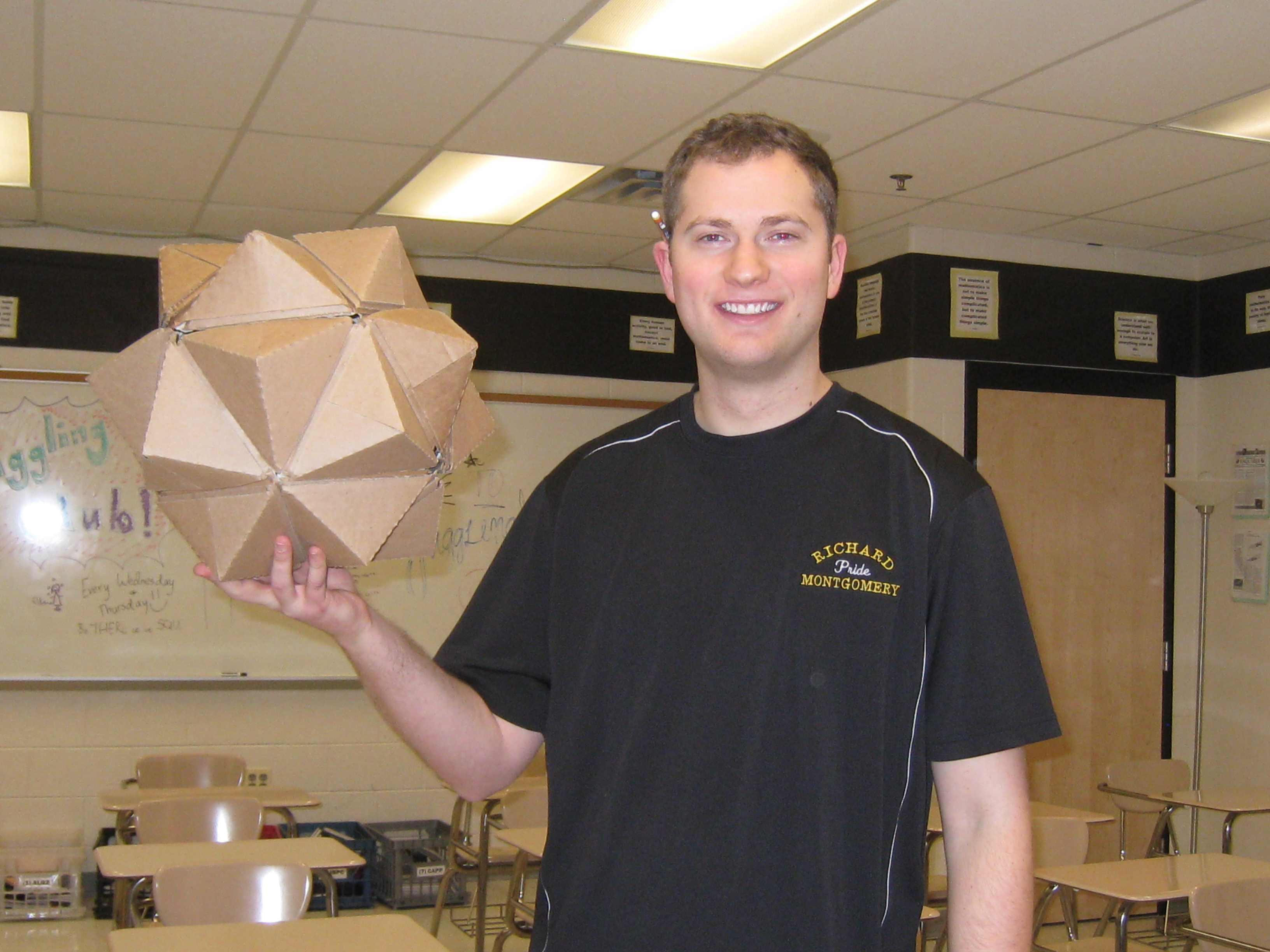
Now I just need to find a large enough Christmas tree upon which to put this giant star!

Square One

I was raised on this show, and it’s so fun that you can find clips of it on youtube, including these three gems. At the end of every episode of Square One there was a mathematical music video. I just showed my Precalculus class this first video, but I spared them the other two. If you’ve never seen Square One, these will give you a little bit of a feel for the show, or if you know and loved the show, these will help you take a walk down memory lane.

Binder clips!

While daughter Vi Hart is off making crazy videos, including this one she posted today, father George Hart  points us to these incredible scupltures with binder clips, by Zachary Abel. (George Hart is also a mathematical scupltor.) Check out this incredible binder clip sculpture by Zachary, a piece called “Impenetraball”:

He has three sculptures with binder clips, and I thought I’d try my hand at making his simplest one, called “Stressful.”

After doing that, I have a HUGE appreciation for his larger binder clip sculptures. This was not easy to make!

Sporcle quizzes

I mentioned Sporcle the other day in a post, and I just assume everyone’s already addicted to Sporcle quizzes. But if not, I guess here’s your news-flash. These timed quizzes, most of which are user-generated, are quite fun and very unique. I urge you to try the thousands of quizzes available on their website and see how you stack up against the competition (currently there are over 200,000 quizzes). There is also a Sporcle app for the iPhone and Android. I actually invested in the pay-for version of it, since it continually updates with new quizzes.

Some of the quizzes on their website include straight-forward tasks like naming all 50 states in 10 minutes or naming all of Queen’s albums. But they have more unique ones like naming all the words of the 23rd Psalm in the King James version (in any order) or words that end in “gue”, as well.

In particular, here are a few math quizzes:

And here are 352 more math quizzes on Sporcle. Enjoy!


Calculus for Infants

My wife and I are expecting our first child in February, so these are definitely items that should be on our registry, wouldn’t you agree?

I saw these first on thinkgeek.com. Introductory Calculus for Infants is currently out of stock, but Amazon.com has it! I haven’t seen any legitimate reviews of these books yet (no reviews on amazon.com), so I’ll have to provide a review once I get them. Introductory Calculus is a Calculus book, Andre Curse is about infinite recursion, as the cover subtly suggests.

This is the most important thing to be thinking of as I prepare for fatherhood, right?

Running out of letters?

Actually, I have this feeling all the time when I’m doing my grad work. If you’ve dabbled in higher-level math at all, you probably have had this feeling too. That’s why we like Greek letters, capital letters, italic letters, script letters, and even a few Hebrew and Danish letters (can you think of which Danish character I’m thinking of?). I know all my Greek letters, not because I know any Greek, but because I’ve been exposed to every single one of them through mathematics. Do you think you could name them all too? If you think you’ve got what it takes, go ahead and try this sporcle quiz :-).


On a more serious note, I do always take the time to introduce new Greek letters, just like any other new notation students haven’t seen before. We practice drawing the symbol, I discuss the difference between the lowercase and capital version of that letter, and we appropriately name the symbol. I go to great lengths to do this because I’ve been in a lot of grad classes where the teacher assumed you knew what his/her squiggles meant on the board. I think it’s the nice thing to do to stop and explain your notation.

[Hat tip: Gene Chase]