USA Science & Engineering Festival

I went down to the USA Science & Engineering Festival yesterday. There were thousands of people there, including our science teacher Mr. Martz at the QuarkNet booth, and our distinguished guest Glen Whitney with the Math Museum exhibit. (I also saw a few of you, too!)

A kid tries to build an unsupported arch of overlapping rectangular bricks.


At the Rockville Science Center‘s booth (the Rockville Science center doesn’t exist yet), I stopped because I immediately recognized an application of the harmonic series! The goal is to stack thin 8″ rectangular bricks in such a way that they span a gap of 22″. This girl needed a bit of my help to get started, but as you can see in the photo, now she’s doing marvelously. As I remember, the literature at the table gave instructions to overlap the top brick by half, the next by a quarter, the next by an 8th and so on. But the mathematicians in the crowd know that this overlapping strategy would limit us to a spanning distance of 16″, even given an infinite number of bricks (do you remember why?). It actually turns out that you can build this kind of stack with an infinite overlap. The overlaps are proportional to the harmonic series, which is divergent. Here’s a nice paper about it.
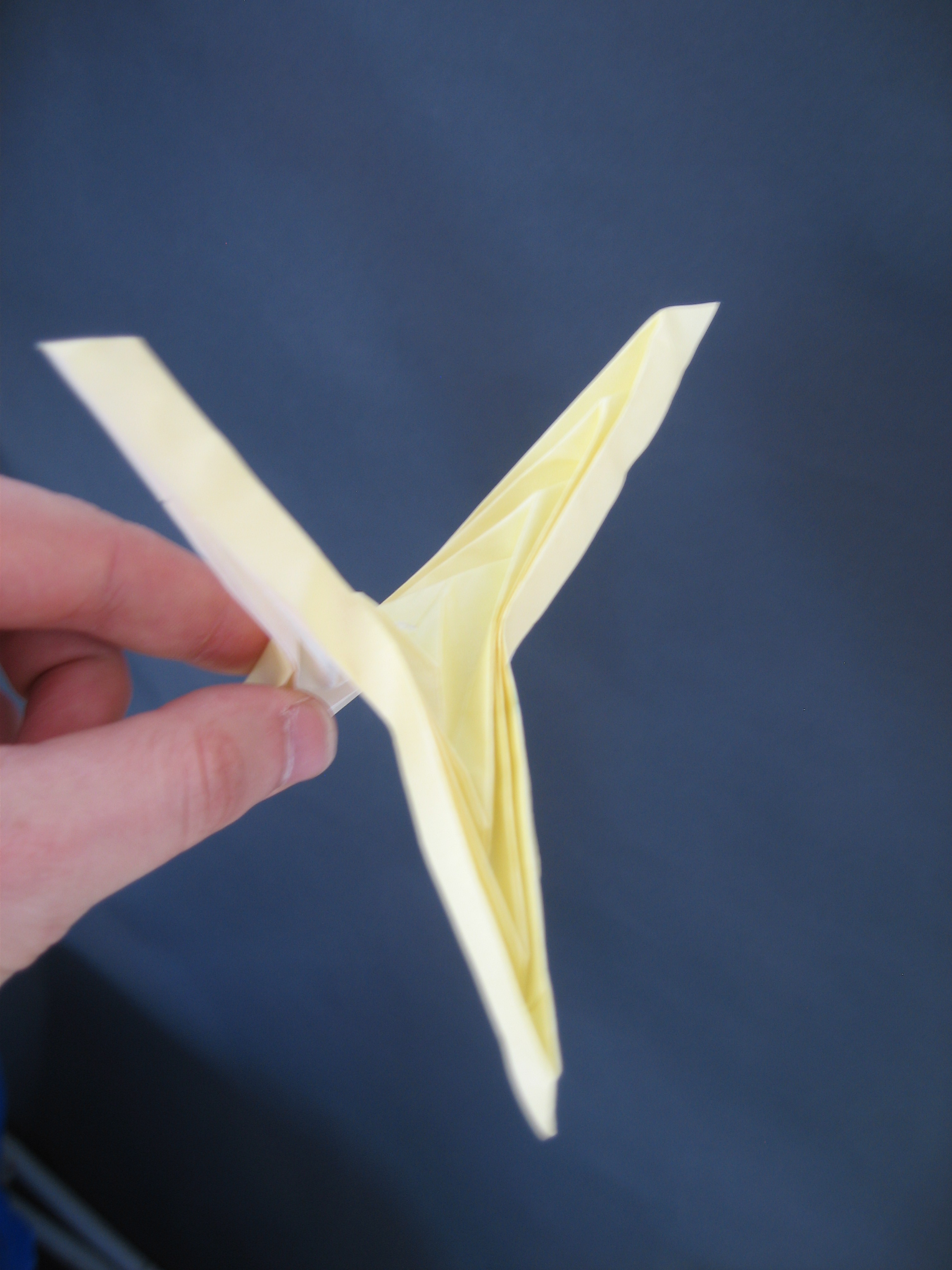
 

My origami-approximation to the hyperbolic paraboloid.


I stopped by the MAA’s booth long enough to make this origami hyperbolic paraboloid. You can learn to make your own here.


Me and Glen Whitney


Right next to the MAA’s booth was the Math Museum‘s booth. I stopped by to say hi to Glen, our speaker from the previous day. And while I was there I made a tetraflexagon (directions on their website). And I made my own Math Museum logo. Cool! Also, they have this circular laser array that allows you to see slices of solid figures. Check out my slices:


A triangular slice of the dodecahedron.


A pentagonal slice of the dodecahedron.


A slice of Mr. Chase :-).


I played around with the dodecahedron. With it you can get slices that are regular triangles & hexagons (by moving through a vertex), regular pentagons & decagons (by moving through a face), or squares & octagons (by moving through an edge). Remind anyone of Flatland? It made me curious to try some other platonic solids. My intuition is that the dual of each platonic solid would yield the same regular cross sections. But I have no idea. Anyone else know?

Here are some other things I saw:


Giant Newton's Cradle
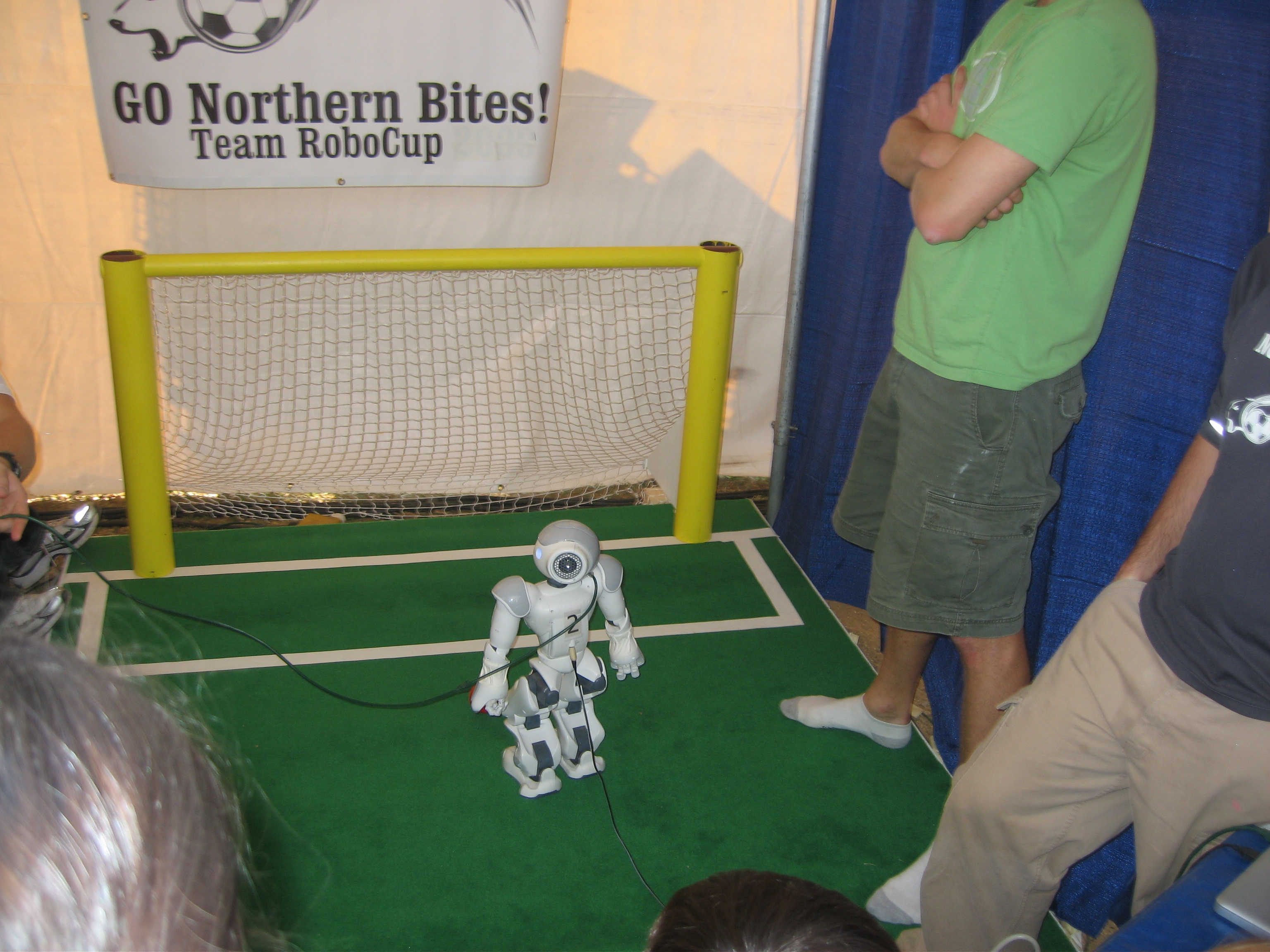
 

Autonomous robot soccer player.


I also saw this giant person-operated spider robot. Very cool :-).


Mr. Chase is approximately 2 billion nanometers tall.


The last thing I did yesterday was the Nano Brothers Juggling Show. Very cool. I’ve actually seen them perform before. Those of you who know me, know I’m an avid juggler. The juggling was fun, but even more fun was the way they incorporated science into the show.
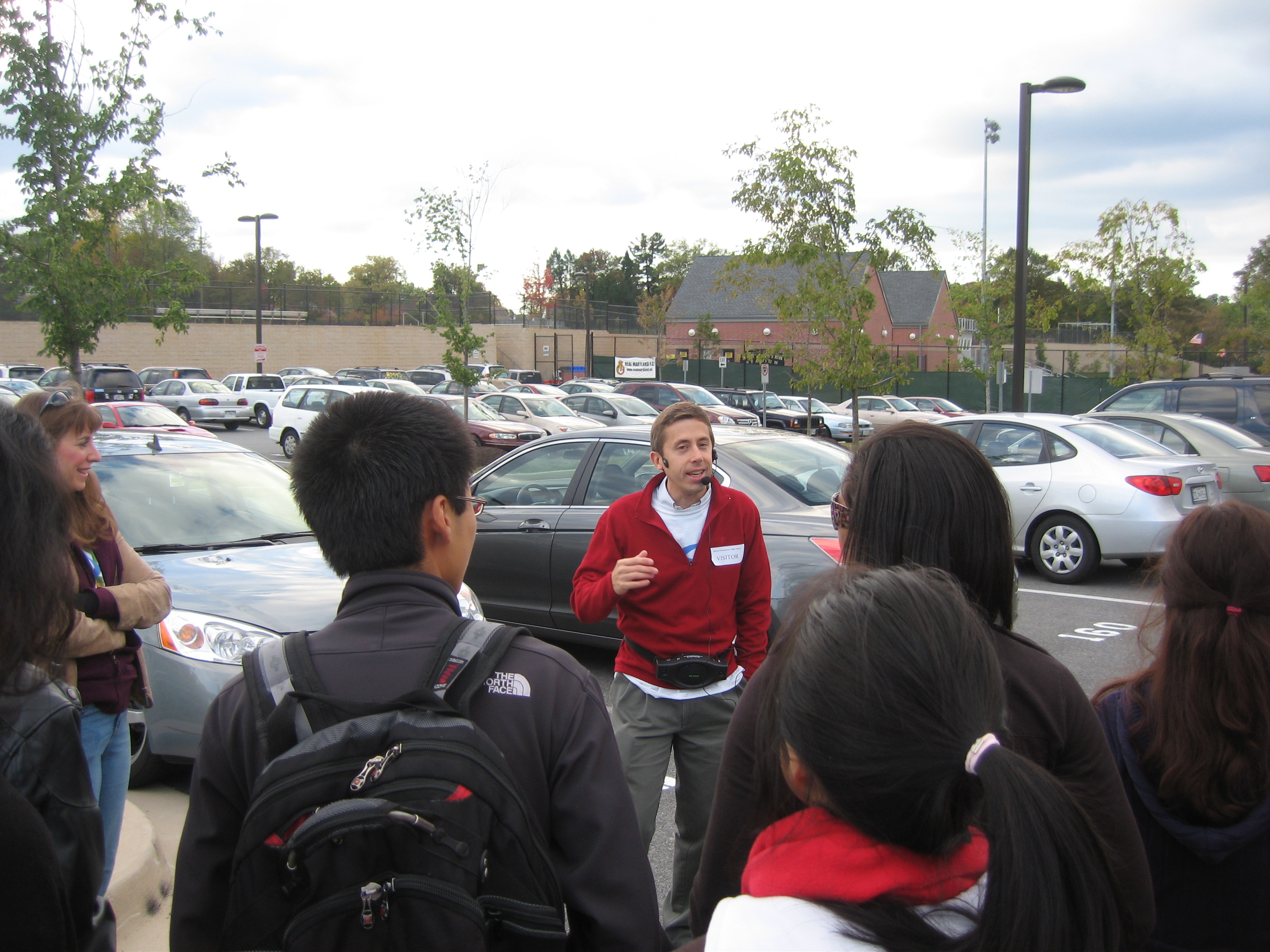
Thanks, Glen!

Today we had a real treat. We hosted speaker Glen Whitney at our school.  Glen Whitney is the executive director of the Math Museum which will open in the Spring of 2012 in Manhattan, if all goes well. Twenty-three of our students joined Glen for a tour around the neighborhood, looking for math (Calculus, specifically) in the world around us. Thank you, Glen! And thank you to the USA Science & Engineering Festival and its sponsors for making it all possible.

We made four stops on our trip today:

  1. We stopped in the parking lot to look for Calculus. Some astute students noticed our Rocket with tangential trajectory to its curved support; the cars all around us that brought to mind position, velocity, and acceleration; the weather patterns (a continuous differentiable function on the globe!); the rate of student arrival/departure at school–an important consideration for those planning parking/drop-off patterns; and the chemical changes that cause leaves to fall off of trees.
  2. Then we moved up to the sidewalk by the baseball field. We did two different experiments simultaneously. Some students rolled PVC pipe down inclined sidewalks, and some bounced balls and measured the height of the bounce against time. In both cases we saw the affects of constant acceleration on the velocity and the position of the objects under consideration.
  3. Our third stop was at a set of telephone polls with a high-tension wire stretched between them. The wire formed a curve as it hung down and we wondered what that curve might be. Glen, with help from our students, derived the equation for the catenary/hyperbolic cosine (a favorite topic of mine!). The derivation involves a differential equation, the arc length formula, and some mathematical modeling–free body diagrams and all!
  4. Lastly, we stopped outside a church with a steeple and wondered about the mass of the steeple. We couldn’t climb up, take it down and weigh it. So we had to figure out some ways to make assumptions and gather data from the ground. We assumed it was a hollow cone, 10 cm thick. We used some Calculus to get a formula for the surface area. And we used some trig and inclinometers that we made to figure out the height. From that, we plugged into our equations and estimated the mass of the steeple to be approximately 8 metric tons.

When we came back some of us had lunch with Glen and spoke with him some more. For those that missed him, go visit him on the mall this weekend in DC. Everyone needs to go to the USA Science & Engineering Festival. I’ll be there, so you can come hang out with me :-).

Eventually I’ll post a few photos from our little field trip. So stay tuned.

Many thanks Glen, for all the good times!

Glen Whitney @ RM!

As I advertised over a month ago, Glen Whitney will be joining us on Friday, October 22 for a walking math tour of Rockville. I’m excited to hear what he has to say (and to steal all his good ideas!). If you’re a Calculus student, or if you’ve taken it, and you’re not yet signed up for the field trip, stop by my room and we’ll talk. There are currently four slots left.

Reposting some of the info:

Richard Montgomery High School will be hosting mathematician Glen Whitney on Friday, October 22. He will be doing a walking ‘math tour’ of downtown Rockville.

Glen is the executive director of the Mathematics Museum on Long Island NY. For more information about Glen, or about the math museum, here’s an article about him. Or, visit the math museum’s website.

And here’s the article that’s on the RM website.


Self-organizing Classrooms

I asked recently if your (math) teacher could be replaced by video. I was kind of serious. Now, I ask, could your teacher be replaced by the internet?

This TED talk is fascinating. For my students reading this, would you like to learn this way? In some ways, you probably already do. What would you think if I just let you loose and said, “Here are the objectives of the course. Go learn them.”? In what ways would that be better or worse than what I’m doing now?

Google awards $2 million to AIMS

News from the TED Prize blog:

Congratulations to the African Institute for Mathematical Sciences (AIMS) and 2008 TED Prize winner Neil Turok on winning $2 million in funding from Google’s Project 10^100. Project 10^100 (10 to the 100th power) was a call for ideas to divide a $10 million fund into five pieces that would help as many people as possible around the world. AIMS’ piece of the prize will be used to expand its network of science and math academies that promote graduate-level study in Africa.

Interestingly, Khan Academy, which I raved about in this post, has also been awarded a TED Prize. Click here for more info, and a nice video about it (sorry the news is a bit old!).

What’s Algebra Good For?

Learning high school math (Algebra included) is actually good for three reasons.

  1. Some students will actually use it (mathematicians, engineers, scientists, programmers, architects, etc.) Granted, this is probably less than 5% of students.
  2. It’s part of a liberal education. What will you ever “use” your history, biology, English, or art for? Most students will never directly use any of these. So what are we trying to pull on high school students? We’re trying to liberally educate you, so you can have intelligent conversation with the world around you.
  3. It’s fun. Math is a big game. And there’s nothing more satisfying then working on a problem that’s just perfect for you (not too hard, not too easy).

Could your math teacher be replaced by video?

Before I get to the titular topic, let me share some links. I’ve been meaning to post links to a couple of online resources that are astonishingly thorough. I strongly encourage you to check all these out.

  • Drexel Math Forum — This site has been around for years, I’m just getting around to posting about it now. But if you’ve never been there, I highly recommend it. Almost any math question high school students could asked has been answered and cataloged on this site (including misconceptions about asymptotes like I posted about the other day).
  • Interact  Math — When you first link to this page you’ll be unimpressed. But select a book from the drop down menu and then pick a chapter and set of exercises. Then, click on an exercise and prepare to take an interactive tour of that problem. The site let’s you graph lines, type math equations, do multiple choice problems, and more. If you have trouble with the problem, it will interactively walk you through each step, asking you simpler questions along the way. What a fantastic resource! Unfortunately, almost none of our books are on the drop down list. That doesn’t keep it from being useful. Just find problems similar to what you’re struggling with and try those.
  • Khan Academy — A nonprofit organization started by Sal Khan, this site has 1800+ youtube instructional videos, nicely organized by course and topic. You can go learn everything from basic arithmetic to college level Calculus (and Differential Equations, Linear Algebra, Statistics, Biology, Chemistry, Physics, Economics…). Sal’s mission is to provide a world class education to anyone in the world for free. It’s very exciting to see how this site will grow, and possibly change how we do education.

Math Teaching by Video

Some of these sites, especially the Khan Academy, make me wonder how long our modern American school system will remain in its present form.  Will we always have a teacher in the front of the math classroom delivering instruction?

I’m not afraid of the idea that we (teachers) could be partially replaced by video lessons. It’s actually a pretty good idea. The very best instructional practices could be incorporated into a flawlessly edited video. Teachers wouldn’t make frustrating, careless mistakes, students could replay the videos at any time, and substitute teachers could easily run the class. Every school, even the poorest and most marginalized would be able to deliver top-notch, world class instruction.

And what would teachers do, then? Qualified teachers could turn their efforts toward more of “coaching” and “discussion leading” role, concentrating on one-on-one sessions, remediation, reteaching, providing feedback, grading, seminars, open forums, field trips, and inquiry-based instruction that supplements the more formal video presentations. And don’t forget blogging! 🙂 So much of a teacher’s time is currently spent preparing lessons and teaching them that they have very little time for all those other (more?) important aspects of teaching. All this time devoted to preparation is being spent by teachers everywhere. Imagine the possibilities if we devoted the bulk of our time to these other aspects instead of preparing instruction. Sounds really great to me.

Glen Whitney Speaking at RM

Richard Montgomery High School will be hosting mathematician Glen Whitney on Friday, October 22. I’ll say more about it as the date approaches, but I thought I’d advertise early. He will be doing a walking ‘math tour’ of downtown Rockville. Some of our higher-level math students will be invited (students in Calculus or those who have taken it). I’m really looking forward to his talk!

Glen is the executive director of the Mathematics Museum on Long Island NY. For more information about Glen, or about the math museum, here’s an article about him. Or, visit the math museum’s website.

Here’s the article that’s on the RM website:

Continue reading

First Week Fun

It’s so good to be back. I love summer, but unlike Calvin, I always enjoy returning to the school year. And I really like getting to know all of my students.

Just for fun, here’s a problem I came up with today. It combines some nice Algebra 2/Precal skills, and provides a nice exercise in analysis of functions. No calculator needed. Feel free to give answers in the comments below. In fact, feel free to suggest other similar problems.

Find the range of f(x)=2^{x^2-4x+1}.