Why I hate the definition of trapezoids

I should have made this post a long time ago, because it’s a bone of contention I’ve always had with trapezoids. Or…not with trapezoids–I like trapezoids–but a bone of contention I have with the definition of trapezoids. In my humble opinion, it’s a major problem with Geometry as it’s currently taught. Here’s the usual definition of a trapezoid (taken from our school’s Geometry text book, by Holt Rinehart and Winston):

“A quadrilateral with one and only one pair of parallel sides.”

I’ve emphasized the words “one and only one,” which is what I want to comment about in this post. (Here’s another source and another source and another source that say it that way, too.) Sometimes it’s also said, “a quadrilateral with exactly one pair of parallel sides.”

I’ve prepared a simple GeoGebra applet and posted it here. It allows you to play with the trapezoid, moving its vertices and edges. As you drag it around, at all times, one pair of sides will be parallel. But wait, it’s not always a trapezoid, is it? According to the Geometry book, there’s one moment, as you’re dragging it around, that it stops being a trapezoid and for that one second is exclusively a parallelogram. Here’s the moment I’m talking about:
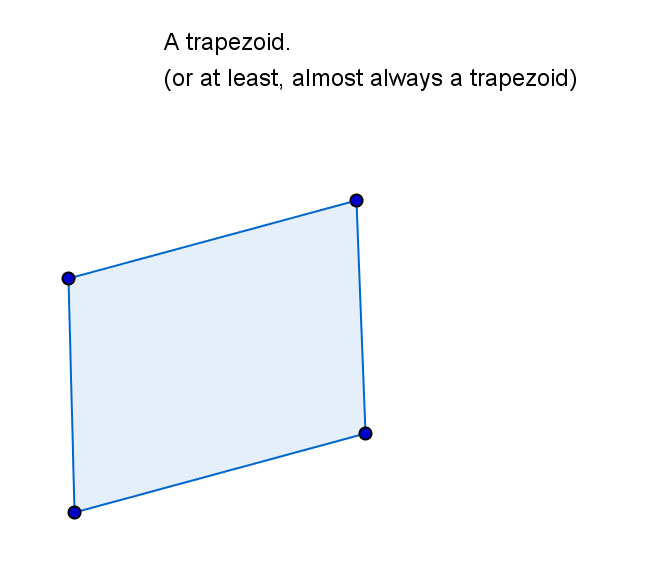
Is this still a trapezoid?

That’s right, using the Geometry textbook’s definition of a trapezoid, if both pairs of opposite sides of the quadrilateral happen to be parallel,  it’s not a trapezoid anymore. At this point, the mathematical reader should be crying, “Foul! How did we ever let this happen? This definition of a trapezoid is so inelegant!!” And I couldn’t agree more.

We don’t do this with the definition of any other quadrilateral. Why do it with a trapezoid? If I were to make another little applet that lets you drag around a rectangle, would we say “it’s not a rectangle” at the moment you make the four sides equal? No! That would be absurd.

The definition of a trapezoid, in my opinion (and thankfully in the opinion of some others) should read:

“A quadrilateral with at least one pair of parallel sides.”

And the hierarchical diagram should look like this one, I found online (taken from a mathematically enlightened author):
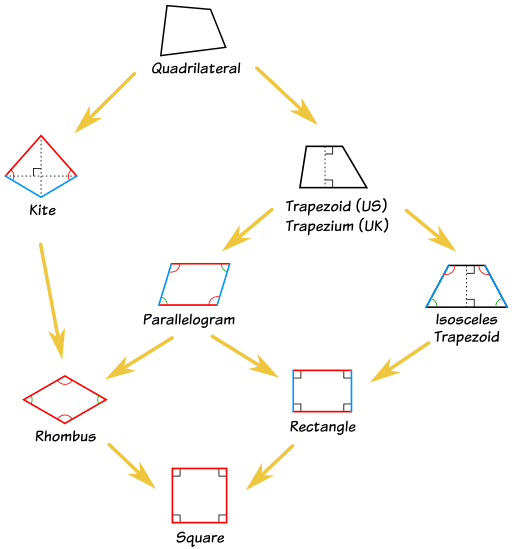
from mathisfun.com

Here’s a nice paragraph from the wikipedia entry on trapezoid:

There is also some disagreement on the allowed number of parallel sides in a trapezoid. At issue is whether parallelograms, which have two pairs of parallel sides, should be counted as trapezoids. Some authors[2] define a trapezoid as a quadrilateral having exactly one pair of parallel sides, thereby excluding parallelograms. Other authors[3] define a trapezoid as a quadrilateral with at least one pair of parallel sides, making the parallelogram a special type of trapezoid (along with the rhombus, the rectangle and the square). The latter definition is consistent with its uses in higher mathematics such as calculus. The former definition would make such concepts as the trapezoidal approximation to a definite integral be ill-defined.

This site and this site also get it right. So there’s hope for the Geometry community and for teachers everywhere. But please, let’s work hard to eradicate the “exclusive” definition from ALL the textbooks. It’s hideous.

For more posts on this topic, visit here and here.

PEMDAS Problems

Inspired by this post at Education Week, by David Ginsburg, and a fruitful discussion in the comments, I thought I’d make my own post about the order of operations. I feel the need to do this because of my own experiences teaching Algebra 1 and correcting the habits of Algebra 2, Precalculus, and Calculus students. The problem is often with their misunderstanding of the ubiquitous “PEMDAS” approach to order of operations (parentheses, exponentiation, multiplication, division, addition, subtraction).

The classic example given by those who have discussed this before is an expression like the following. This example shows the problem with instructing students to simply “add then subtract”:

8-4+1

You can easily see that blindly following PEMDAS would give you an answer of 3, not 5. In reality, addition and subtraction can be done in any order, provided that you think of the expression this way:

8+(-4)+1

I have to constantly reinforce in my students the notion that the “-” goes with the 4. It owns it. That’s the right way to think of it, since subtraction (and division) are just shorthand for addition by the additive inverse (and multiplication by the multiplicative inverse). That’s right kids, subtraction is an illusion. The typical Real Analysis approach is to use the field axioms to define the properties of addition. Here they are:

  1. If x and y are in the field, so is x+y (closure).
  2. x+y=y+x (commutativity)
  3. (x+y)+z=x+(y+z)=x+y+z (associativity)
  4. There exists an element 0 such that 0+x=x for all x (identity)
  5. For each x there is an element called -x such that x+(-x)=0 (inverse)

There are almost identical ones for multiplication, and then one more axiom for distribution. Just listing the field axioms for addition  helps us in the discussion of order of operations. As I said above, subtraction is never really mentioned. We only later define x-y to mean x+(-y).

Similarly, division is an illusion. Or more precisely, it is defined in terms of multiplication. We define x/y to mean x\cdot(1/y).

The other important thing to notice is that addition and multiplication are binary operations, meant to be functions of two variables. So the expression x+y+z is defined to mean (x+y)+z=x+(y+z).

But the problems with PEMDAS don’t stop with multiplication and addition. There are many other issues with the order of operations as well. We lie to students when we just tell them they’ll encounter those limited operations in tidy situations. Here’s a perfectly legitimate expression with which PEMDAS would flounder:

-2^{3^2}+\left|\frac{2\sin{0}+3!}{2-\sqrt{9}}\right|\pmod{3}

The reason the expression is so difficult for PEMDAS is because PEMDAS doesn’t acknowledge the existence of other functions or grouping symbols, and ignores the possibility of nested exponentiation.

As another somewhat related example, I often have Calculus students who evaluate the following expression incorrectly (because they misuse their calculator):

e^{(0.05)(10)}

And some high school students at every level still struggle with evaluating these expressions:

  • -2^2
  • Given f(x)=-x^2+x, evaluate f(-2).

The wikipedia article on Order of Operations is very clear on all this, but I wanted to just highlight some of the common misconceptions. For more, feel free to check out that article. I’m in no way recommending that PEMDAS be removed from math curriculum, but that it be used with great care. And by the way, the expression above evaluates to 1.


MathOverflow

I’m sure most of the mathematical community already knows all about  mathoverflow.net, but just in case, thought I’d post a link here. It was news to me…perhaps just because I’m not really in the collegiate academic math community. (Though the wikipedia article says it was created in 2009, so it’s still in its infancy.) But it’s definitely a resource I’ll be using as I do my own mathematical investigations and my grad coursework. I’ve enjoyed the original stackoverflow.com for looking up answers to questions, and in two instances so far, asking my own. StackOverflow and sites like them fill a vital role in the online community–quick, thorough answers to pointed questions.

Geogebra has new skills

A new version of Geogebra has been released, in beta. It’s called Geogebra 5.0, and you can see the news about it here. Or, here’s a direct link to launch it right away. Thanks to The Cheap Researcher for the lead on this. As readers of this blog may already know, I love Geogebra!

One of the main highlights is that Geogebra now supports 3D manipulations. Awesome! However, don’t get too excited–it doesn’t let you graph anything except planes. No surfaces. It will do geometric constructions, like spheres and prisms. Using parametric equations and the locus feature, you can coax it into rendering spirals or other space curves. [edit: I figured this was possible, but it actually wasn’t. Not sure why.]

Another highlight, which I find even more exciting, is that Geogebra now has a built in CAS. Here’s a screen shot of me playing around with a few of its features. It also has a ways to go, especially for those who are used to more robust systems like Mathematica/Maple/Derive/TI-89. But this is a great step in the right direction, and 10 points for the open-source camp!

Notice that it can work with polynomials in ways you would expect, it can symbolically integrate and derive (simple things), perform partial fraction decomposition, evaluate limits, and find roots. Here are a few more things it can do. Strangely, it had problems finding the complex roots of a quadratic (easy), but not a cubic (hard). Just take a look at my screen shot. Seeing that it did okay finding the complex roots, I wondered if it could also plot them for me. I started by entering (copying and pasting) the complex zeros as points in Geogebra, which worked. But then I discovered the new ComplexRoot[] function which approximates the roots and plots them on the coordinate plane all at once. Cool! Here’s the screenshot:

The seven complex roots of f(z)=z^7+5z^4-z^2+z-15

As you can see, I asked for the roots of a 7th degree polynomial. Since the polynomial had real coefficients, notice that every zero’s conjugate is also a zero, as we’d expect. And we also expect that at least one solution of an odd-degreed polynomial will be real (notice this one has only one real root, approximately 1.22).

That’s all I’ve discovered so far. I’ll let you know if I come across anything else exciting. Keep in mind that this is beta, so the final release will likely have all the bugs worked out and more features.

Learning from Mistakes

Watch this inspiring TED talk:

As a teacher, I know I’m succeeding when students feel free to take risks in the classroom. But letting students take risks is risky for a teacher. I’m a bit OC, and that’s the thing that keeps me from letting students take on more creative tasks. There’s also a good argument for teaching with a more systematic approach in such a way that all necessary topics get covered with a reasonable amount of depth in a reasonable amount of time. This reminds me of the discussion surrounding Paul Lockhart’s essay (my response here).

What if we Graded Toddlers?

From techdirt.com

What If We Gave Toddlers An ‘F’ In Walking?

from the rethinking-education dept

theodp writes “To improve math and science education, Physics prof Dr. Yung Tae Kim thinks professors and teachers should take a page from skateboarding. ‘The persistence and the dedication needed in skateboarding — that’s what we need to be teaching,’ explains Kim. ‘No one says to a toddler, ‘You have ten weeks to walk, and if you can’t, you get an F and you’re not allowed to try to walk anymore.’ It’s absurd, right? But the same thing is true with math and science education. If you want to learn trig or calculus, it’s set at such a pace in schools that it guarantees that only the absolutely best students will learn it.’ Kim says it’s possible to ‘polish the turd’ of high school and college education, and lays out his plan for doing so in Building A New Culture Of Teaching And Learning (YouTube: parts 123), a video drawn from a farewell talk he gave to his Northwestern students. There’s more on The Way of Dr. Tae at DrTae.org and PhysicsOfSkateboarding.com.”

I was just discussing the same point with my father in law this past week. Our education system needs to change in fundamental ways if we want students to truly learn at their own pace. We do a bit of a disservice to students who need to take the material a little slower. There’s nothing wrong with taking things slowly. Likewise, we do disservice to students who could complete the coursework in half the time.

[Hat tip: Tim Chase, as usual :-)]


Google Ngram

This is super fun. Google has just released this tool for playing with word frequency data from a huge amount of scanned literature (5 million books dating as far back as 500 years). You can read more about it here, including some nice research that’s already being done with the full data set that’s also been released. (also here)

For example, here’s a graph of the appearance of the word “homeschool” in the collective Google corpus.

You can also compare the appearance of words. For example, here’s informal evidence that we care less about ancient Greek mathematicians (BC) and more about European mathematicians (17th and 18th century) than we did 100 years ago.

Not very rigorous, I’ll admit. But it’s an example of what kind of interesting trends can be instantly teased out. As this article quotes Erez Lieberman-Aiden of Harvard University, “It’s not just an answer machine. It’s a question machine.” I think that’s a nice way to put it.


The Lecture

The Lecture. Is it so bad? This recent post by Dr. John Fea at his history blog addresses this question (be sure to check out the links at the bottom too). And I’d like to weigh in on the issue too.

The trendy education gurus would tell tell you ‘lecturing is bad.’ As my students know, I use a mixture of lecture, guided practice, group work, games, etc. Even though I’d love to say I do mostly creative out-of-the-box activities, the truth is that I mostly lecture. I’m not sure that’s entirely bad, though.

When I was in college, I really enjoyed a good lecture–key word good. Dr. Fea was one of my history professors and he was a fantastic lecturer. He would get into it, he moved around, he was well-spoken, and he knew his stuff. I enjoyed many of my other professors for the same reasons (one of my philosophy professors, in particular). And I still enjoy listening to good lectures when I get the chance. A good lecture captures the audience like any other good performance would. Why do you think the lectures on TED.com are so popular?

I’m going to keep lecturing. In fact, I have a great lecture planned for my Precalculus class tomorrow and I’m excited to give it. I’ll be presenting a beautiful proof, and I’ve got a well-planned powerpoint to go with it. In fact, for this particular lecture, I tell the students they don’t even have to take notes…just soak it in!

Three cheers for the lecture! 🙂

