I’ve been enjoying following this youtube channel about math, LaTeX, and juggling. It’s authored by an acquaintance of mine (Joe) that I know from the juggling community, actually. Here’s one Joe posted this week that I particularly liked:

I’ve been enjoying following this youtube channel about math, LaTeX, and juggling. It’s authored by an acquaintance of mine (Joe) that I know from the juggling community, actually. Here’s one Joe posted this week that I particularly liked:

….Groan…!
The math carnivals are in full swing. I’ll be hosting one here at Random Walks in June, so get excited for that! 🙂 If you haven’t had a chance to check out Math Carnival #85 hosted by Aperiodical, go do it now. I especially like the idea of Math Busking, since I’ve done plenty of street performing as a juggler. Maybe I need to try adding math to my show!

Here’s another article from NCTM president, J. Michael Shaughnessy. He makes a point that Art Benjamin has made before, that Calculus should not be the goal of high school mathematics. I think I agree too. In general I agree with his article, but there are a few points on which I disagree.
In particular, he says, “If calculus is to be taught in high school, it should be taught at a college level.” I don’t think it hurts to teach non-AP Calculus. I say this because “Calc with Apps” is a course I teach, and I find the students really benefit from the more relaxed pace. There’s no pressure from an AP test at the end. Many come to my class lacking confidence, and leave having their confidence restored.
Shaughnessy goes on to say, “Whenever students enroll in calculus, they should have a solid mastery of algebra, geometry, and trigonometry.” I only agree with this in part. My kids have already taken Algebra 1 and 2, and Precalculus. There are definitely some algebraic rough spots that need to be smoothed out as we go through the course. But again, I find my course the perfect place to do it–since those algebraic skills are routinely needed for the Calculus. And in the end, they say they like math again.
I’ve heard from lots of kids who have gone on to take more Calculus in either high school (AP) or college and have really appreciated the informal foundation that we provided in our lower-key course.
This is Shaughnessy’s final president’s message. President-Elect Linda Gojak will be taking over. I’ll be sure to highlight some of her articles, too!
Just had to share my Easter Egg honoring the school at which I teach:

(front) Richard Montgomery

(back) Ritchie the Rocket
Compare with the eggs from last year. I think I’m improving my egg-decorating skills!
Your comic relief for the day :-).

If you haven’t yet checked out Stephen Wolfram’s blog post from March 8th, you absolutely need to. I was impressed with how many categories of data he kept, not just his presentation and analysis of it. He analyzed his email, walking, phone time, keystrokes, and calendar events. And he did this for all of the last decade! Wow. Here are his averages from over that time, shown against the hours in the day.

This was also a nice chance for him to advertise the incredible power of all of his software!
As for email, you can do an analysis on your gmail account from the past year by using this free utility from toutapp.com. I did it and really enjoyed seeing who my top contacts were, learning that I reply to 18% of the emails I receive, and that 47% of the emails I send get responses. Each month on average I received 240 emails and sent 69 emails. And in 2011, I had to deal with a total of 3299 emails. All of this is just in my personal email account, too! I have two other email accounts as well. Go get your analysis!
Today at our school we had to have the obligatory π day celebrations. Here are the ways we observed π at RM:
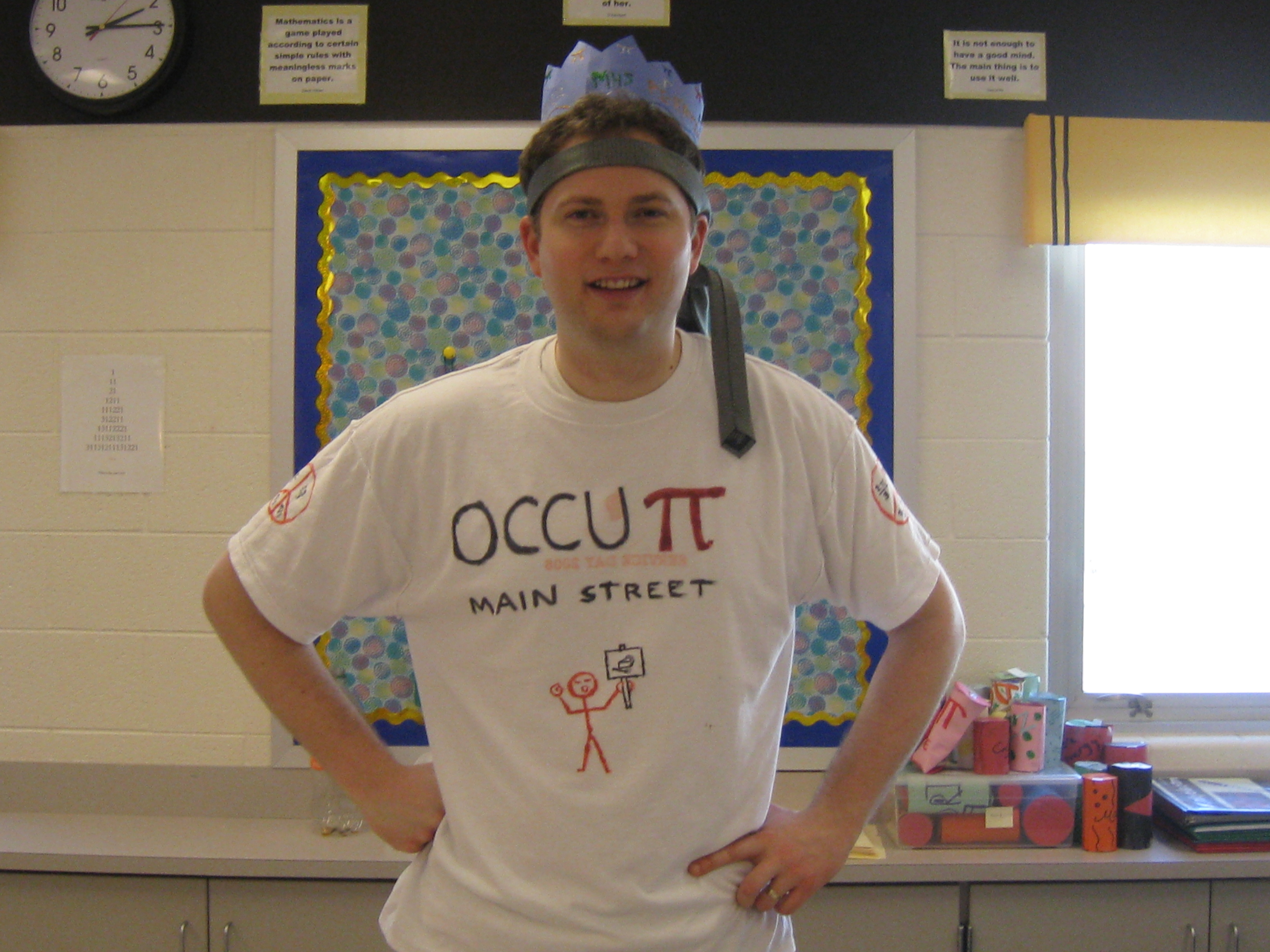
Get the joke?? On the back it says "We are the 3.14%."

Action shot

Mr. Chase wins!


One more thing you can still do, if you haven’t yet observed π day:
Also, on an unrelated note, today’s Google logo is great. If you’re interested in the mathematics of origami, you probably know who Robert Lang is. Today’s Google logo is an origami piece created by Lang in honor of the late Akira Yoshizawa, world famous origami artist.
I really enjoy reading J. Michael Shaughnessy’s column. He’s the president of the NCTM and always has interesting, timely things to say about math and math education. Here’s an excerpt from this week’s column, where he recounts his recent conversation with Senator Al Franken (D-Minn) as he eagerly shared a proof with President Shaughnessy. Go check it out!
Seen Any Good Proofs Lately? Raising the Social Currency of Mathematics
We all probably have had a friend or acquaintance, or even a perfect stranger, raving about a book she has just read, or a movie he has recently seen, and then saying, “Oh, you must read this book!” or, “You must see that film!” But how many of us have had this kind of experience in a social occasion where the person exclaimed, “Oh, you must see this proof!” So it was indeed refreshing to meet someone who really likes mathematics, as I did several weeks ago, in what might seem like a very unlikely setting—the Hart Senate Office Building in Washington, D.C.
On Wednesday mornings when Congress is in session, Senator Al Franken (D-Minn.) holds a breakfast gathering in his office for his constituents. Visitors to the breakfast consist primarily of people from Minnesota, but I received an invitation from a mathematics teacher who is spending the year working on the senator’s staff. A famous hearty porridge is served up at these breakfasts, and once guests have begun to circulate, Senator Franken drops in and greets everyone. I had been misinformed and thought that the Senator had been a mathematics major in college. When I asked him about this, he said that the rumor was false, but he agreed that his good grades in math had probably helped him get admitted to college.
After breakfast, the visitors were escorted to a terrace area in the hallway outside the office, where the senator spoke for a few minutes about events being debated in Congress and answered questions. Guests then lined up to have their pictures taken with the senator. I was at the end of the line, and as I shook his hand and introduced myself as the president of NCTM, he said, “Let me show you my geometric proof of the Pythagorean theorem!” Senator Franken then proceeded to grab scratch paper and a pen from one of his staffers and plopped down cross-legged on the hallway carpet. As I sat next to him, he began to sketch out his proof. He explained what he was doing, and why it worked, and I paraphrased each move he made so that it was clear to both of us how he was thinking and what he was doing.
Geek mom author Helene McLaughlin reviews this great geeky book about the mathematics of 92 (!!) different kinds of pasta [hat tip to Tim Chase]:

When mixing flour, egg, salt and water to make pasta, I’d guess the only math you consider is how many minutes you have left before the kids will be begging for dinner. I’d guess that you never really contemplated the mathematical beauty of that rigatoni or cavatappi that you are eating. Thats not the way George L. Legendre eats pasta.
In an effort to bring order to the possible chaos of cooking, George L. Legendre takes cooking geek to the next level with his unique book, “Pasta by Design
“. Legendre takes 92 of the most familiar types of pasta, categorizes them, determines the complex mathematical equation describing the shape and shows us incredibly intricate computer models for each type of pasta.
Here are some leap-day birthday thoughts I discussed with my colleagues and students today:
The probability that someone is born on a leap day is 

One of our RM students is a triplet, born today. What are the chances of that occurring? Well, the statistics on triplets are pretty hard to get right. But let’s say the occurrence of a triplet birth is 1 in 8000. (That’s my informal estimate based on this site and this site.) I think we can say that the probability of being a triplet is 3 times that (right?). Then, the probability of being a triplet born on a leap day is

The current US population is 311,591,917, so that means there are roughly 77 triplets in the US with leap day birthdays. Happy birthday to all of you!
Bonus thought question: Iif you have quadruplets born on a leap day, you get to celebrate 4 birthdays every four years, so doesn’t that average out to one birthday a year?
One of my other colleagues has a birthday on August 29th. So today is her half birthday! But it only comes around every four years (roughly). Hooray!
But then that got us thinking about half birthdays: Some people, like those born on August 30th or 31st NEVER have a half birthday. How sad!! This happens to anyone born on August 30th, August 31st, March 31st, October 31st, May 31st, or December 31st. That’s a lot of people without half birthdays.
But wait. When is your actual half birthday? Shouldn’t it be 182.5 days before/after your birthday? That’s not necessarily the same date in the month. For instance, my birthday is May 15. So my half birthday should be November 15, right? Wrong. My half birthday is (May 15 + 182.5 days), which is November 13th or November 14th, depending on if you round up or down. Even accounting for a leap year, it’s still not quite right.
Who else is miscalculating their half birthday? Unless your birthday is in June, April, October, or December, you’re half-birthday isn’t what you think it is. To calculate your half birthday, use this amazing half birthday calculator I just discovered!
 Random Walks