
Every high school math student has been taught how to rationalize the denominator. We tell students not to give an answer like

because it isn’t fully “simplified.” Rather, they should report it as

This is fair, even though the second answer isn’t much simpler than the first. What does it really mean to simplify an expression? It’s a pretty nebulous instruction.
We also don’t consider

to be rationalized because of the square root in the denominator, so we multiply by the conjugate to obtain

In this particular example, multiplying by the conjugate was really fruitful and the resulting expression does indeed seem much more desirable than the original expression.
But here’s where it gets a little ridiculous. Our Algebra 2 book also calls for students to rationalize the denominator when (1) a higher root is present and (2) roots containing variables are present. Let me show you an example of each situation, and explain why this is going a little too far.
Rationalizing higher roots
First, when a higher root is present like
![\sqrt[5]{\frac{15}{2}},](https://s0.wp.com/latex.php?latex=%5Csqrt%5B5%5D%7B%5Cfrac%7B15%7D%7B2%7D%7D%2C&bg=ffffff&fg=333333&s=0&c=20201002)
the book would have students multiply the top and bottom of the fraction inside the radical by 
![\frac{\sqrt[5]{240}}{2}.](https://s0.wp.com/latex.php?latex=%5Cfrac%7B%5Csqrt%5B5%5D%7B240%7D%7D%7B2%7D.&bg=ffffff&fg=333333&s=0&c=20201002)
Simpler? You decide.
This becomes especially problematic when we encounter sums involving higher roots. It’s certainly possible, using various tricks, to rationalize the denominator in expressions like this:
![\frac{1}{2-\sqrt[3]{5}}.](https://s0.wp.com/latex.php?latex=%5Cfrac%7B1%7D%7B2-%5Csqrt%5B3%5D%7B5%7D%7D.&bg=ffffff&fg=333333&s=0&c=20201002)
But is that really desirable? The result here is
![\frac{1}{2-\sqrt[3]{5}}\cdot\frac{4+2\sqrt[3]{5}+\sqrt[3]{25}}{4+2\sqrt[3]{5}+\sqrt[3]{25}}=\frac{4+2\sqrt[3]{5}+\sqrt[3]{25}}{3},](https://s0.wp.com/latex.php?latex=%5Cfrac%7B1%7D%7B2-%5Csqrt%5B3%5D%7B5%7D%7D%5Ccdot%5Cfrac%7B4%2B2%5Csqrt%5B3%5D%7B5%7D%2B%5Csqrt%5B3%5D%7B25%7D%7D%7B4%2B2%5Csqrt%5B3%5D%7B5%7D%2B%5Csqrt%5B3%5D%7B25%7D%7D%3D%5Cfrac%7B4%2B2%5Csqrt%5B3%5D%7B5%7D%2B%5Csqrt%5B3%5D%7B25%7D%7D%7B3%7D%2C&bg=ffffff&fg=333333&s=0&c=20201002)
which is, arguably, more complex than the original expression. Can anyone think of a good reason to do this, except just for fun?
Rationalizing variable expressions
Now, let’s think about variable expressions. Here is a problem, directly from our Algebra 2 book (note the directions as well):
Write the expression in simplest form. Assume all variables are positive.
![\sqrt[3]{\frac{x}{y^7}}](https://s0.wp.com/latex.php?latex=%5Csqrt%5B3%5D%7B%5Cfrac%7Bx%7D%7By%5E7%7D%7D&bg=ffffff&fg=333333&s=0&c=20201002)
The method that leads to the “correct” solution is to multiply the fraction under the radical by 
![\frac{\sqrt[3]{xy^2}}{y^3}.](https://s0.wp.com/latex.php?latex=%5Cfrac%7B%5Csqrt%5B3%5D%7Bxy%5E2%7D%7D%7By%5E3%7D.&bg=ffffff&fg=333333&s=0&c=20201002)
This is problematic for two reasons. (1) This isn’t really simpler than the original expression and (2) this expression isn’t even guaranteed to have a denominator that’s rational! (Suppose 

So how far do we take this?
Is it reasonable to ask someone to rationalize this denominator?
![\frac{1}{2\sqrt{2}-\sqrt{2}\sqrt[3]{5}+2\sqrt{5}-5^{5/6}}](https://s0.wp.com/latex.php?latex=%5Cfrac%7B1%7D%7B2%5Csqrt%7B2%7D-%5Csqrt%7B2%7D%5Csqrt%5B3%5D%7B5%7D%2B2%5Csqrt%7B5%7D-5%5E%7B5%2F6%7D%7D&bg=ffffff&fg=333333&s=0&c=20201002)
You can rationalize the denominator, but I’ll leave that as an exercise for the reader. So how far do we take this? I had to craft the above expression very carefully so that it works out well, but in general, most expressions have denominators that can’t be rationalized (and I do mean “most expressions” in the technical, mathematical way–there are are an uncountable number of denominators of the unrationalizable type). All that being said, I think this would make a great t-shirt:
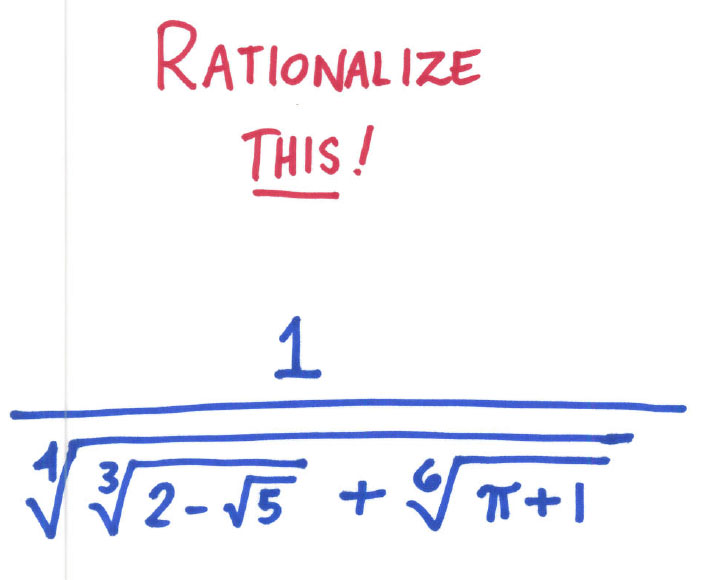
And I rest my case.

 “. Legendre takes 92 of the most familiar types of pasta, categorizes them, determines the complex mathematical equation describing the shape and shows us incredibly intricate computer models for each type of pasta.
 into your webpages, but they all feel like hacks. In particular, I like the
  . Oh wait, that’s not completely true. Leap years don’t really occur every four years. Years divisible by 100 are not leap years, unless also divisible by 400. So, the actual probability is
 .
. .
. should be evaluated. We’re just unclear on how 2^3^4 should be evaluated.


 Random Walks