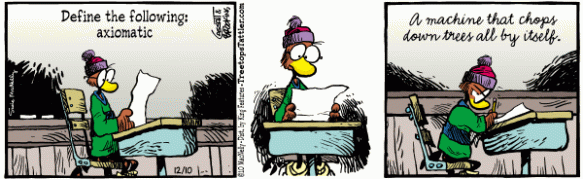
Another mathematically themed Shoe
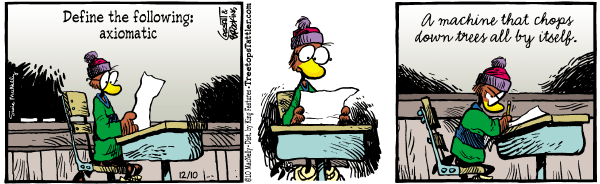
Another mathematically themed Shoe
[Hat tip: Gene Chase]

Another mathematically themed Shoe
[Hat tip: Gene Chase]
A Calculus textbook should seem like fun, right? I think so!
 [Hat tip: my dad]
Dr. Gene Chase guest author again.
The video at Joy of Stats shows 200 countries’ health and wealth over 200 years. The augmented reality (AR) presentation makes it interesting even if you’re not a geek like me.
My favorite part of Statistics isn’t numerical. It’s graphical. Visual data analysis is powerful because our eyes coupled with our minds are able to see patterns that no amount of means, modes, medians, and standard deviations can show.
Another youtube video that doesn’t quite count as math :-). Some of my readers know I like to juggle and I can balance a pencil on my nose, among other things. Though I’m not quite as good as this machine:
A few weeks ago, I blogged about a calculator giveaway at Wild About Math. Since then, Sol has posted a submitted solution here (and here’s the direct link to the pdf solution by Nate Burchell).
Here’s the problem for those who didn’t see it:
One can create a triangle of consecutive positive integers as follows:
 1
 2  3
 4  5  6
 7  8  9 10
11 12 13 14 15
16 17 18 19 20 21
   . . .
Each row, R, has R numbers. Each column, C, has infinitely many numbers. Rows and columns begin at 1. We define a function F(R,C) for row R and column C such that F(R,C) gives us a value in the triangle. Thus, F(1,1) = 1, F(2,1) = 2, and F(2,2) = 3. Note that F(R,C) is only defined when 1 < = C <= R.
Part 1: Come up with a formula that computes F(R,C) in terms of R and C for any positive values of R and C when 1 < = C <= R. Show your work.
Part 2: Come up with a formula or algorithm that, given a positive integer n, determines R and C.
I also solved the problem and submitted a solution but I didn’t win. Here’s my own solution.
Here’s a great marble ramp, built into a kid’s room. I like it. (This does count as math, right?)
This is the first guest post from John Chase’s dad, also a math teacher. Thanks, son, for letting me post to your blog.
Gene Chase: I was taking a shower today when I figured out why I always confused the words “sequence” and “series.” 2, 3, 4, 5, … is a sequence; 2+3+4+5 is a series. Until today, I thought that my confusion was because “series” and “sequence” both begin with “s.” Now I see the real problem! Teachers would say “sum the following series.” They should have said “evaluate the following series,” since the series is already a sum.
Comment from John Chase: In non-mathematical contexts we don’t differentiate between the two. We think of “television series” and a “series” of cars in a line at an intersection. How mathematically sloppy!
Gene Chase: Yes, usually mathematical language is general language made more precise, not less precise. For example, if you tell a story elliptically, you leave things out of it; if you tell the story parabolically, you give an analog of the story; if you tell the story hyperbolically, you embellish it. The corresponding geometric figures have eccentricities which are either between 0 and 1 (ellipse), precisely equal to 1 (parabola), or greater than 1 (hyperbola).
This makes sense when you remember that “elliptic” is Greek for “defective,” “para” is Greek for “along side,” and “hyper” is Greek for “beyond.”
Another fabulous TED talk on education. I’m inspired.

[Hat tip: my brother Tim]
Here’s a recently posted TED talk by Conrad Wolfram, of Wolfram Research and wolframalpha.com. I was hopeful about this talk, because I find great entertainment value in wolframalpha.com. I was a bit disappointed. I disagree pretty strongly with what he says, even though he makes a few good points. Math, in my opinion, is not at all about solving real world problems. It’s about formal systems that express relationships between “meaningless marks on paper” (Hilbert). And to quote Poincare, “The mathematician does not study pure mathematics because it is useful; he studies it because he delights in it and he delights in it because it is beautiful.” Indeed. Math is beautiful and fun. The way Mr. Wolfram presents math doesn’t sound like very much fun to me.
 Random Walks