
I went down to the USA Science & Engineering Festival yesterday. There were thousands of people there, including our science teacher Mr. Martz at the QuarkNet booth, and our distinguished guest Glen Whitney with the Math Museum exhibit. (I also saw a few of you, too!)

A kid tries to build an unsupported arch of overlapping rectangular bricks.
At the Rockville Science Center‘s booth (the Rockville Science center doesn’t exist yet), I stopped because I immediately recognized an application of the harmonic series! The goal is to stack thin 8″ rectangular bricks in such a way that they span a gap of 22″. This girl needed a bit of my help to get started, but as you can see in the photo, now she’s doing marvelously. As I remember, the literature at the table gave instructions to overlap the top brick by half, the next by a quarter, the next by an 8th and so on. But the mathematicians in the crowd know that this overlapping strategy would limit us to a spanning distance of 16″, even given an infinite number of bricks (do you remember why?). It actually turns out that you can build this kind of stack with an infinite overlap. The overlaps are proportional to the harmonic series, which is divergent. Here’s a nice paper about it.
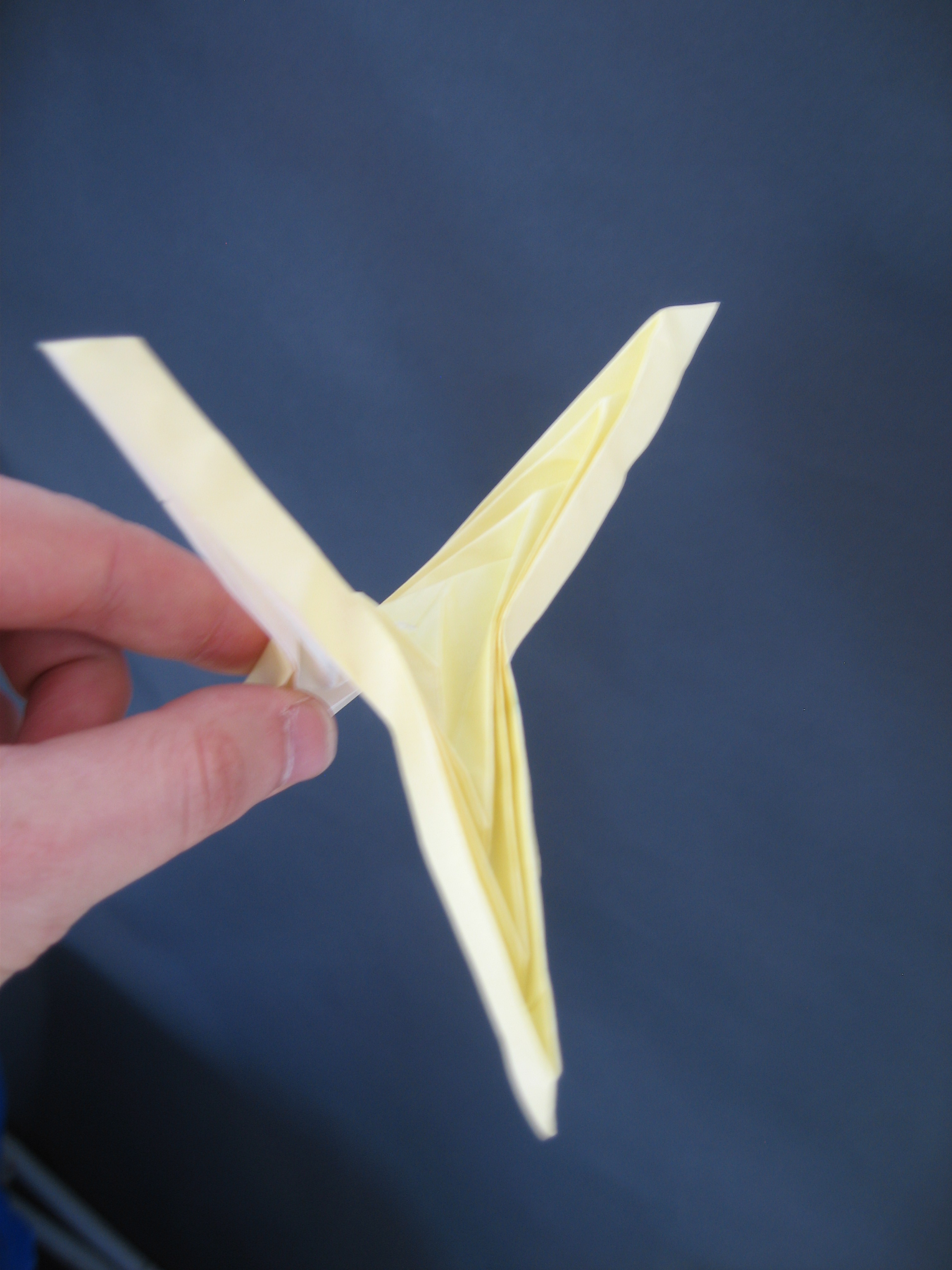
My origami-approximation to the hyperbolic paraboloid.
I stopped by the MAA’s booth long enough to make this origami hyperbolic paraboloid. You can learn to make your own here.

Me and Glen Whitney
Right next to the MAA’s booth was the Math Museum‘s booth. I stopped by to say hi to Glen, our speaker from the previous day. And while I was there I made a tetraflexagon (directions on their website). And I made my own Math Museum logo. Cool! Also, they have this circular laser array that allows you to see slices of solid figures. Check out my slices:

A triangular slice of the dodecahedron.

A pentagonal slice of the dodecahedron.

A slice of Mr. Chase :-).
I played around with the dodecahedron. With it you can get slices that are regular triangles & hexagons (by moving through a vertex), regular pentagons & decagons (by moving through a face), or squares & octagons (by moving through an edge). Remind anyone of Flatland? It made me curious to try some other platonic solids. My intuition is that the dual of each platonic solid would yield the same regular cross sections. But I have no idea. Anyone else know?
Here are some other things I saw:

Giant Newton's Cradle
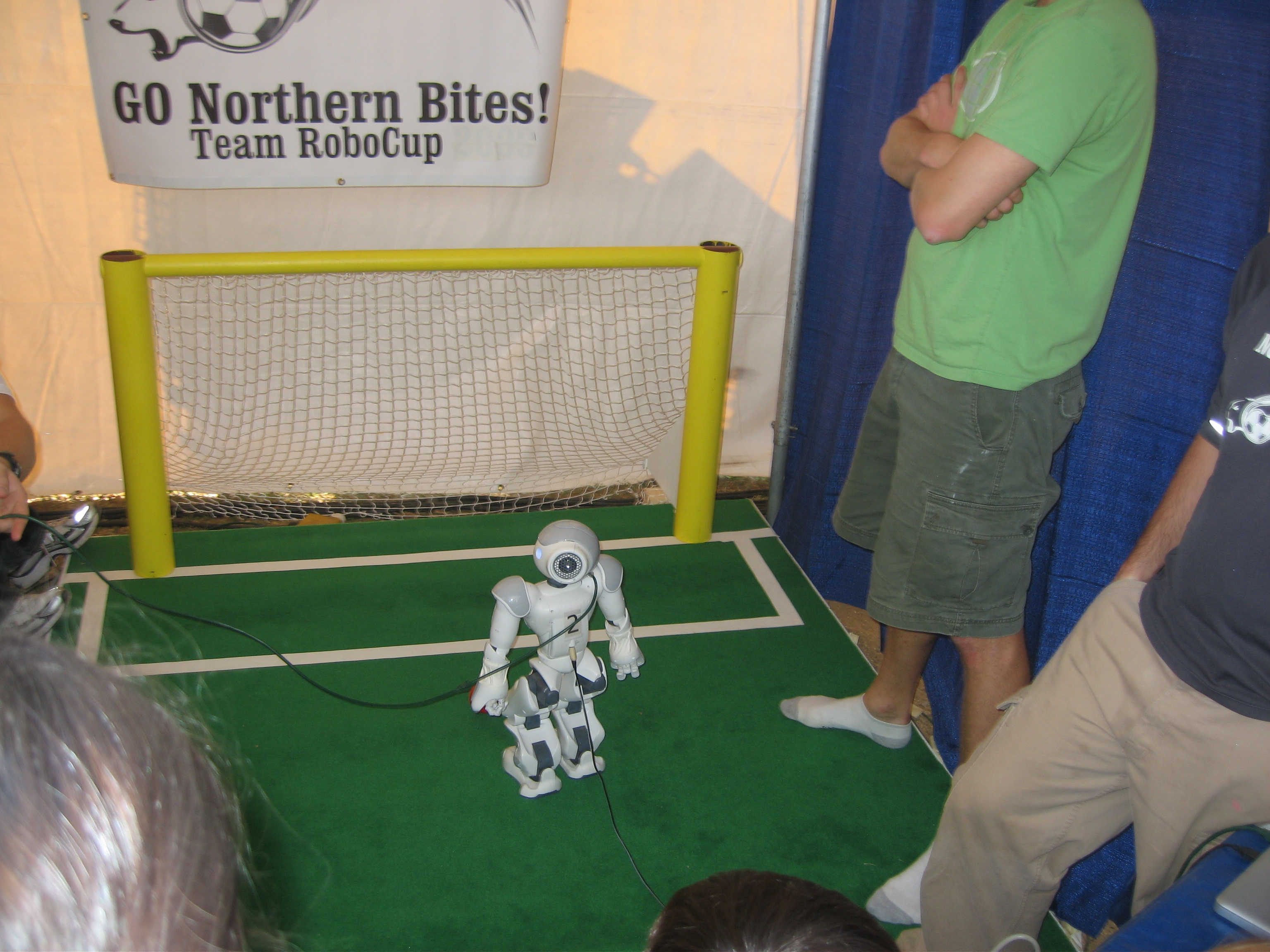
Autonomous robot soccer player.
I also saw this giant person-operated spider robot. Very cool :-).

Mr. Chase is approximately 2 billion nanometers tall.
The last thing I did yesterday was the Nano Brothers Juggling Show. Very cool. I’ve actually seen them perform before. Those of you who know me, know I’m an avid juggler. The juggling was fun, but even more fun was the way they incorporated science into the show.


 Random Walks