Could your math teacher be replaced by video?

Before I get to the titular topic, let me share some links. I’ve been meaning to post links to a couple of online resources that are astonishingly thorough. I strongly encourage you to check all these out.

  • Drexel Math Forum — This site has been around for years, I’m just getting around to posting about it now. But if you’ve never been there, I highly recommend it. Almost any math question high school students could asked has been answered and cataloged on this site (including misconceptions about asymptotes like I posted about the other day).
  • Interact  Math — When you first link to this page you’ll be unimpressed. But select a book from the drop down menu and then pick a chapter and set of exercises. Then, click on an exercise and prepare to take an interactive tour of that problem. The site let’s you graph lines, type math equations, do multiple choice problems, and more. If you have trouble with the problem, it will interactively walk you through each step, asking you simpler questions along the way. What a fantastic resource! Unfortunately, almost none of our books are on the drop down list. That doesn’t keep it from being useful. Just find problems similar to what you’re struggling with and try those.
  • Khan Academy — A nonprofit organization started by Sal Khan, this site has 1800+ youtube instructional videos, nicely organized by course and topic. You can go learn everything from basic arithmetic to college level Calculus (and Differential Equations, Linear Algebra, Statistics, Biology, Chemistry, Physics, Economics…). Sal’s mission is to provide a world class education to anyone in the world for free. It’s very exciting to see how this site will grow, and possibly change how we do education.

Math Teaching by Video

Some of these sites, especially the Khan Academy, make me wonder how long our modern American school system will remain in its present form.  Will we always have a teacher in the front of the math classroom delivering instruction?

I’m not afraid of the idea that we (teachers) could be partially replaced by video lessons. It’s actually a pretty good idea. The very best instructional practices could be incorporated into a flawlessly edited video. Teachers wouldn’t make frustrating, careless mistakes, students could replay the videos at any time, and substitute teachers could easily run the class. Every school, even the poorest and most marginalized would be able to deliver top-notch, world class instruction.

And what would teachers do, then? Qualified teachers could turn their efforts toward more of “coaching” and “discussion leading” role, concentrating on one-on-one sessions, remediation, reteaching, providing feedback, grading, seminars, open forums, field trips, and inquiry-based instruction that supplements the more formal video presentations. And don’t forget blogging! 🙂 So much of a teacher’s time is currently spent preparing lessons and teaching them that they have very little time for all those other (more?) important aspects of teaching. All this time devoted to preparation is being spent by teachers everywhere. Imagine the possibilities if we devoted the bulk of our time to these other aspects instead of preparing instruction. Sounds really great to me.

Interesting Cube Problem

If the cube has a volume of 64, what is the area of the green parallelogram? (Assume points I and J are midpoints.)

Go ahead, work it out. Then, go here for a more in depth discussion, including a video explanation. Also, see my very simple solution in the comments on that page. (My Precalculus students should especially take note!)

And, welcome, SAT Math Blog, to the internet! Thanks for pointing us to this great problem and creating the nice diagram above.

Very Nice Java Applets

I’m always on the look out for nice java applets (or flash, or javascript, or whatever) that help visualize tough math concepts. The best applets are not merely gimmick, but truly make the mathematics more accessible and invite you to explore, predict, and play with the concepts.

Most recently, my dad pointed me to this website.  At this site, you’ll find well over one hundred very nice applets that show things I haven’t seen around the web before. For instance, play around with your favorite polyhedra in 3d, then let the applet truncate or stellate the polyhedron, all with nice animation. And of course, you’ll want to mess with all the settings on the drop down menus, too! Additionally, you can see a mobius strip, klein bottle, cross cap, or a torus. Also, I was just recently blogging about complex functions. Some of these applets allow you to visualize with animation and color various complex functions. Having just completed a grad class in differential equations, I was also interested in these ODE applets. You may also have fun with fractals, like this one.

There are lots of other nice applet websites out there. As you know, I’m a huge fan of GeoGebra (free, open source, able to be run online without installation, easy to use, powerful). Someday maybe I’ll post more extensively about its merits. In the meantime, you can check it out here.  Many of these applets use GeoGebra. This site has a lot of nice applets too.  And here. This one’s rather elementary, but fun for educators. These are great, too. These are all sites I’ve used in class. Like I said, I think they’re more than just ‘cool’–they really do help elucidate hard-to-understand topics.

Feel free to share other applet sites you like.

Really Fun Limit Problem (revisited)

I posted this problem a few weeks ago:

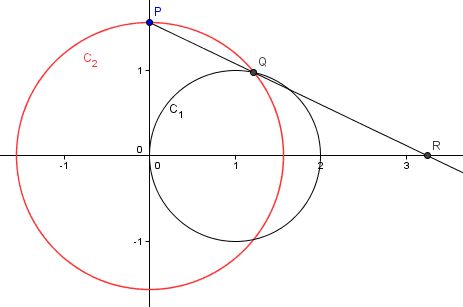
The figure shows a fixed circle C_1 with equation \left(x-1\right)^2+y^2=1 and a shrinking circle C_2 with radius r and center the origin (in red). P is the point (0,r), Q is the upper point of intersection of the two circles, and R is the point of intersection of the line PQ and the x-axis. What happens to R as C_2 shrinks, that is, as r\rightarrow 0^{+}?

And I also posted this applet, so you could investigate it yourself.

Now, I post the solution. Initially, I thought that the x-coordinate of R would go off to infinity or zero, I wasn’t sure which. The equation for C_2 is x^2+y^2=r^2. Solving for the intersection of the two circles, Q, we find it has coordinates

Q=\left(\frac{r^2}{2},\sqrt{r^2-\frac{r^4}{4}}\right)

Remembering that P=(0,r), we now find the equation of line PQ in point-slope form.

y-r=\left(\frac{r-\sqrt{r^2-\frac{r^4}{4}}}{0-\frac{r^2}{2}}\right)(x-0)

Now, we seek to find the coordinates of R, the x-intercept of the line. Letting y=0 in the above equation, we solve for x and find

x=\frac{\frac{r^2}{2}}{1-\sqrt{1-\frac{r^2}{4}}}

We now take the limit of x as r\rightarrow 0.

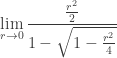
\displaystyle\lim_{r\rightarrow 0}\frac{\frac{r^2}{2}}{1-\sqrt{1-\frac{r^2}{4}}}

If we try to evaluate this limit by plugging in 0, we get an indeterminant form 0/0. We can either use L’hopital’s Rule or evaluate it numerically. Either way, we find.

\displaystyle\lim_{r\rightarrow 0}x=4

I have to say, this result surprised me. Like I said, I expected this limit to evaluate to 0 or infinity–but 4?? I had to get a bit more of an intuitive understanding, so I built that Geogebra applet.

Also, I was told afterward, by the student who brought this to me, that there’s a straight-forward geometric way of deriving the answer, based on the observation that point Q and point R and the point (2,0) (0,2) form an isosceles triangle for all values of r. The observation isn’t trivial. Can you prove it’s true? Once you do realize this fact, though, the above result is clear.


Really Fun Limit Problem

Here’s a great problem that a student brought to me today. For those who’ve been wanting a ‘problem of the month,’ here you go:

The figure shows a fixed circle C_1 with equation \left(x-1\right)^2+y^2=1 and a shrinking circle C_2 with radius r and center the origin (in red). P is the point (0,r), Q is the upper point of intersection of the two circles, and R is the point of intersection of the line PQ and the x-axis. What happens to R as C_2 shrinks, that is, as r\rightarrow 0^{+}

The Saint Louis Arch and y=coshx

NPR’s Science Friday had an episode highlighting the mathematics behind the Saint Louis Arch. You can watch a little video on the subject at their website, here.

The shape of the arch is the same shape of a hanging chain, called a catenary. “Catenary” is another name for the hyperbolic cosine function,

\cosh {x} = \frac {e^{x}+e^{-x}} {2}

It’s not the world’s most riveting video, but it does highlight this important function that doesn’t get much press in our high school math curriculum. If you watch the video, you’ll learn something about this function, and you’ll learn that the catenary is not only the shape of a hanging chain but also the shape of the most stable arch. For more on the mathematics of the Saint Louis Arch, visit the wikipedia article.

In particular, the Saint Louis Arch has the equation

y = 693.8597 - 68.7672\cosh {(0.0100333x)}

Now, of course you want to know about the hyperbolic sine function, too. I’ll let you look it up yourself (or maybe you can take a guess, first?). Then ask yourself some questions you might be dying to know: Which functions are odd/even? What trig identities are associated with these functions? For Calculus students: What is the derivative of each of these functions? What is the power series? And there are some exciting connections with these functions and complex numbers, too. Go play, and tell me what you learn!