In less than a month, we’ll be hosting the one and only James Tanton at our school. We’re so excited! I’m especially excited because he’s totally going to help me rally the troops in this fight:
He posted this a few years ago, but I only stumbled on it recently. I’ve been looking for Tanton videos to use in our classes so we can get all psyched up about his visit! Needless to say, I was loving this video :-).
For more on why I’m not such a big fan of ‘rationalizing the denominator’ see this post.
I presented the following example in my Precalculus classes this past week and it bothered students:
Let and . Compute and and state the domain of each.
As usual, I’ll give you a second to think about it yourself.
..
..
Done yet?
.
Here are the answers:
The reason that the first one was unsettling, I think, is because of the restricted domain (despite the fact that the simplified form of the answer seems not to imply any restrictions).
The reason the second one was unsettling is because they had forgotten that . It seems to be a point lost on many Algebra 2 students.
Happy first day of school! For us, today marks the first day of the school year and we’re welcoming students into our midst. What are the new kids (the freshmen) going to be like?
Each year Beloit College describes the incoming college freshmen class with its now famous “Mindset List.” I looked around and couldn’t find a high-school equivalent. So here’s one I came up with. This is a description of the incoming high school freshmen class (class of 2017). Note that all of descriptions on Beloit’s college freshmen mindset list apply also to high school freshmen. So here’s my own “high school class of 2017 mindset list.” Enjoy!
The Euro has always existed. So has Sponge Bob Square Pants. And Google, Inc. And the iMac. And Viagra.
Bill Gates has always been worth over $100 billion.
You can talk to them about the Sandy Hook shooting or the Virginia Tech massacre, but they won’t remember anything about Columbine, which happened the year they were born.
Star Wars Episode 1: The Phantom Menace is as much of an ‘old-school’ classic as any of the original Star Wars movies. The movies Fight Club, The Matrix, American Pie, Saving Private Ryan, Armageddon, and The Sixth Sense also came out in the years they were born.
East Timor has always been a sovereign nation.
George W. Bush and Barack Obama are the only presidents that they really know. Clinton left office when they were just 2.
Exxon and Mobil have always been the same company.
Movies have always been reviewed by Ebert & Roeper .(Gene Siskel died the year they were born; Roger Ebert just died this past April.)
They won’t have any memories of John F. Kennedy Jr, Dr. Spock, Frank Sinatra, Roy Rogers, or Alan Shepherd, all of whom died just as they were being born.
They have always had their music in mp3 format and used mp3 players (invented in 1998). CD players? SO passé.
Seinfeld closed up shop before they were born.
——–
For more events that happened in 1998 and 1999, visit the wikipedia articles. Please feel free to correct any of my above information or suggest additions!
Yes it’s true. I’m writing about trapezoids again (having written passionately about them here and here previously). I’ve been taking a break from blogging, as I usually do in the summer. For us, school starts in just two weeks. So I thought I’d come out of my shell and post something…and of course I always have something to say about trapezoids :-).
Let’s start with the following easy test question. Don’t peek. See if you can answer the question without any help.
Which of the following quadrilaterals are trapezoids?
Before giving the answer, let me first just remind you about my very strongly held position. I believe that instead of this typical textbook definition (the “exclusive definition” we’ll call it) that reads:
“A quadrilateral with one and only one pair of parallel sides.”
the definition should be made inclusive, and read:
“A quadrilateral with at least one pair of parallel sides.”
So the test question above was easy, right? Quadrilaterals (A) and (C) are trapezoids, I hear you say.
Not so fast!! If you’re using the inclusive definition, then the correct answers are actually (A), (B), (C), (D), and (E). But it gets better: If you were using the the exclusive definition, then NONE of these are trapezoids. In order for (A) and (C) to be trapezoids, under the exclusive definition, you must prove that two sides are parallel AND the two remaining sides are not parallel (and you can’t assume that from the picture…especially for (C)!).
Can you see the absurdity of the exclusive definition now?
I finish by offering the following list of reasons why the inclusive definition is better (can you suggest more reasons?):
All other quadrilaterals are defined in the inclusive way, so that quadrilaterals “beneath” them inherit all the properties of their “parents.” A square is a rectangle because a square meets the definition of a rectangle. Likewise, parallelograms, rectangles, rhombuses, and squares should all be special cases of a trapezoid.
The area formula for a trapezoid still works, even if the legs are parallel. It’s true! The area formula works fine for a parallelogram, rectangle, rhombus, or square.
No other definitions break when you use the inclusive definition. With the exception of the definition that some texts use for an isosceles trapezoid. Those texts define an isosceles trapezoid has having both legs congruent, which would make a parallelogram an isosceles trapezoid. Instead, define an isosceles trapezoid as having base angles congruent, or equivalently, having a line of symmetry.
The trapezoidal approximation method in Calculus doesn’t fail when one of the trapezoids is actually a rectangle. But under the exclusive definition, you would have to change its name to the “trapezoidal and/or rectangular approximation method,” or perhaps ban people from doing the trapezoidal method on problems like this one: Approximate using the trapezoidal method with 5 equal intervals. (Note here that the center trapezoid is actually a rectangle…God forbid!!)
When proving that a quadrilateral is a trapezoid, one can stop after proving just two sides are parallel. But with the exclusive definition, in order to prove that a quadrilateral is a trapezoid, you would have to prove two sides are parallel AND the other two sides are not parallel (see the beginning of this post!).
Here’s a question that the folks who run the NCTM facebook page posed this week:
Find the next three terms of the sequence 2, 8, 4, 10, 5, 11, 5.5, …
Feel free to work it out. I’ll give you a minute.
…
Done?
…
still need more time?
..
give up?
…
Okay. The answer is 11.5, 5.75, 11.75.
The pattern is interesting. Informally, we might say “add 6, divide by 2.” This is an atypical kind of sequence, in which it seems as though we have two different rules at work in the same sequence. Let’s call this an Arithmetic/Geometric Hybrid Sequence. (Does anyone have a better name for these kinds of sequences?)
But a deeper question came out in the comments: Someone asked for the explicit rule. After a little work, I came up with one. I’ll give you my explicit rule, but you’ll have to figure out where it came from yourself:
More generally, if we have a sequence in which we add , then multiply by repeatedly, beginning with , the explicit rule is
And if instead we multiply first and then add, we have the following similar rule.
And there you have it! The explicit formulas for an Arithmetic/Geometric Hybrid Sequence:-).
(Perhaps another day I’ll show my work. For now, I leave it the reader to verify these formulas.)
On April 17, a paper arrived in the inbox of Annals of Mathematics, one of the discipline’s preeminent journals. Written by a mathematician virtually unknown to the experts in his field — a 50-something lecturer at the University of New Hampshire named Yitang Zhang — the paper claimed to have taken a huge step forward in understanding one of mathematics’ oldest problems, the twin primes conjecture.
Editors of prominent mathematics journals are used to fielding grandiose claims from obscure authors, but this paper was different. Written with crystalline clarity and a total command of the topic’s current state of the art, it was evidently a serious piece of work, and the Annals editors decided to put it on the fast track.
Just three weeks later — a blink of an eye compared to the usual pace of mathematics journals — Zhang received the referee report on his paper.
“The main results are of the first rank,” one of the referees wrote. The author had proved “a landmark theorem in the distribution of prime numbers.”
This is very exciting news, and the whole story has a fantastic David & Goliath feel–“little known mathematician delivers a crushing blow to a centuries old problem” (not a fatal blow, but a crushing one). It’s such a feel-good story, almost like Andrew Wiles and Fermat’s Last Theorem. Here’s my favorite part of the article:
…during a half-hour lull in his friend’s backyard before leaving for a concert, the solution suddenly came to him. “I immediately realized that it would work,” he said.
Just chillin’ in his friend’s backyard…and it came to him! Anyone who has worked on math problems or puzzles has had this experience, right? It seems like an experience common to all people. This has definitely happened to me lots of times–an insight hits me out of nowhere and unlocks a problem I’ve been working on for weeks. It’s one of the reasons we do mathematics!
The Calc book we’re teaching from defines it this way:
A point where the graph of a function has a tangent line and where the concavity changes is a point of inflection.
No debate about there being an inflection point at x=0 on this graph.
There’s no debate about functions like , which has an unambiguous inflection point at .
In fact, I think we’re all in agreement that:
There has to be a change in concavity. That is, we require that for we have and for we have , or vice versa.*
The original function has to be continuous at . That is, does not have a point of inflection at even though there’s a concavity change because isn’t even defined here. If we assign a value at zero for this function, say , the definition of the function is no longer at issue. Yet we would all agree that does not constitute a point of inflection, right? The continuity requirement seems to formalize our intuition here.
The point of inflection x=0 is at a location without a first derivative. A “tangent line” still exists, however.
But the part of the definition that requires to have a tangent line is problematic, in my opinion. I know why they say it this way, of course. They want to capture functions that have a concavity change across a vertical tangent line, such as . Here we have a concavity change (concave up to concave down) across and there is a tangent line () but is undefined.
Is x=0 a point of inflection? Some definitions say no, because no tangent line exists.
So It’s clear that this definition is built to include vertical tangents. It’s also obvious that the definition is built in such a way as to excludecusps and corners. Why? What’s wrong with a cusp or corner being a point of inflection? I would claim that the piecewise-defined function shown above has a point of inflection at even though no tangent line exists here.
I prefer the definition:
A point where the graph of a function is continuous and where the concavity changes is a point of inflection.
That is, I would only require the two conditions listed at the beginning of this post. What do you think?
Once you’re done thinking about that, consider this strange example that has no point of inflection even though there’s a concavity change. As my colleague Matt suggests, could we consider this a region of inflection? Now we’re just being silly, right?
A region/interval of inflection?
———————————————
Footnotes:
* When we say that a function is concave up or down on a certain interval, we actually mean or for the whole interval except at finitely many locations. If there are point discontinuities, we still consider the interval to have the same concavity.
** This source, interestingly, seems to require differentiability at the point. I think most of us would agree this is too strong a requirement, right?
I’ve been loving the videos that SpikedMathGames has been posting on youtube. Check out their channel here. In particular, I’ve enjoyed Paradox Tuesday. Here’s one from a few weeks ago which really interested me (if you go to the youtube page, you’ll see I’ve been active in the comments!):
I’m especially interested in paradoxes that deal with infinity, countability, and probability. Here’s another great paradox that deals with just those issues that my friend Matthew Wright shared with me a few months ago (thanks Matthew!). It’s called the Grim Reaper paradox (can’t link to the Wikipedia article–it doesn’t yet exist), proposed in 1964 by José Amado Benardete in his book Infinity: an essay in metaphysics, and I first read about it on Alexander Pruss’s blog here, and I quote:
Say that a Grim Reaper is a being that has the following properties: It wakes up at a time between 8 and 9 am, both exclusive, and if you’re alive, it instantaneously kills you, and if you’re not alive, it doesn’t do anything. Suppose there are countably infinitely many Grim Reapers, and before they go to bed for the night, each sets his alarm for a time (not necessarily the same time as the other Reapers) strictly between 8 and 9 am. Suppose, also, that no other kind of death is available for you, and that you’re not going to be resurrected that day.
Then, you’re going to be dead at 9 am, since as long as at least one Grim Reaper wakes up during that time period, you’re guaranteed to be dead. Now whether there is a paradox here depends on how the Grim Reapers individually set their alarm clocks. Suppose now that they set them in such a way that the following proposition p is true:
(p) for every time t later than 8 am, at least one of the Grim Reapers woke up strictly between 8 am and t.
Here’s a useful Theorem: If the Grim Reapers choose their alarm clock times independently and uniformly over the 8-9 am interval, then P(p)=1.
Now, if p is true, then no Grim Reaper kills you. For suppose that a Grim Reaper who wakes up at some time t1, later than 8 am, kills you. If p is true, there is a Grim Reaper who woke up strictly between 8 am and t1, say at t0. But if so, then you’re going to be dead right after t0, and hence the Grim Reaper who woke up at t1 is not going to do anything, since you’re dead then. Hence, if p is true, no Grim Reaper kills you. On the other hand, I’ve shown that it is certain that a Grim Reaper kills you. Hence, if p is true, then no Grim Reaper kills you and a Grim Reaper kills you, which is absurd.
Go visit his blog post for a discussion of why this seems unresolvable, and how it may actually put forward a case for time being discrete rather than continuous. Crazy thought.
There’s something deeply unsettling about this paradox and also the Unexpected Hanging paradox. Anytime we deal with probabilities and certainty, paradox seems to be lurking nearby.
I sometimes ask my students this somewhat related question–perhaps you’ve heard it too:
How many positive integers have a 3 in them? (That is, in their decimal representation. 6850104302 has a 3 but 942009947 does not.)
If you haven’t ever considered this question, take the time to do it now.
Though I actually once worked out the result using limits (like Alexander Bogomolny does marvelously here), it’s easy enough to work out the result in our heads:
First ask yourself how many digits a randomly selected integer has. The number of digits is almost certainly greater than 2, right? There are only 90 two-digit positive integers, a finite number, and there are an infinite number of integers with more than two digits. It follows that if you were to pick one at random from among all positive integers*, it would be almost certain to contain more than two digits.
The same argument could be applied to a larger number of digits. By the same logic as above, we can convince ourselves that ‘most randomly selected integers have more than a trillion digits’. It’s a bit of an incredible statement, really. We rarely ever work with the ‘most-common’ kind of numbers (the big ones!).**
What is the probability that a number with a trillion digits has a 3 in it? Well, it’s almost certain. The probability approaches 100%. If we consider ALL numbers, the probability IS 100% (or is it?). This is a real dilemma. How can we say that 100% of numbers have a 3 in them when this is clearly not true?
We’ve been pretty sloppy here, but regardless, this kind of fast-and-loose infinite probability question is unsettling.
Do you want to try taking a crack at these? Feel free to comment below.
Oh, and Happy Birthday Euler!
_________________________________
Footnotes:
* Picking a number from the set of all positive integers requires the axiom of choice.
** My comment that the ‘most-common’ kind of numbers are the big ones reminds me of Ronald Graham’s quote: “The trouble with integers is that we have examined only the very small ones. Maybe all the exciting stuff happens at really big numbers, ones we can’t even begin to think about in any very definite way. Our brains have evolved to get us out of the rain, find where the berries are, and keep us from getting killed. Our brains did not evolve to help us grasp really large numbers or to look at things in a hundred thousand dimensions.” Love that quote, especially considering it comes from Ronald Graham, an expert in Ramsey Theory, and the creator of one of the largest named numbers :-). The fact that we have only ever studied the most common kinds of numbers is also confirmed by the fact that most numbers are irrational. Worse, most numbers are indescribable!

 and
and  . Compute
  and
and  and state the domain of each.

 . It seems to be a point lost on many Algebra 2 students.

 works fine for a parallelogram, rectangle, rhombus, or square.
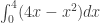 using the trapezoidal method with 5 equal intervals. (Note here that the center trapezoid is actually a rectangle…God forbid!!)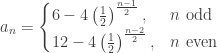
 , then multiply by
  repeatedly, beginning with
  , the explicit rule is



 , which has an unambiguous inflection point at
  .
. we have
  and for
  we have
  , or vice versa.*
 has to be continuous at
  . That is,
  does not have a point of inflection at
  , the definition of the function is no longer at issue. Yet we would all agree that
  does not constitute a point of inflection, right? The continuity requirement seems to formalize our intuition here.
![f(x)=\sqrt[3]{x}](https://s0.wp.com/latex.php?latex=f%28x%29%3D%5Csqrt%5B3%5D%7Bx%7D&bg=ffffff&fg=333333&s=0&c=20201002) . Here we have a concavity change (concave up to concave down) across
. Here we have a concavity change (concave up to concave down) across  is undefined.
 shown above has a point of inflection at

 Random Walks