
A new, dangerous conic section discovered
1

 I mentioned Sporcle the other day in a post, and I just assume everyone’s already addicted to Sporcle quizzes. But if not, I guess here’s your news-flash. These timed quizzes, most of which are user-generated, are quite fun and very unique. I urge you to try the thousands of quizzes available on their website and see how you stack up against the competition (currently there are over 200,000 quizzes). There is also a Sporcle app for the iPhone and Android. I actually invested in the pay-for version of it, since it continually updates with new quizzes.
Some of the quizzes on their website include straight-forward tasks like naming all 50 states in 10 minutes or naming all of Queen’s albums. But they have more unique ones like naming all the words of the 23rd Psalm in the King James version (in any order) or words that end in “gue”, as well.
In particular, here are a few math quizzes:
And here are 352 more math quizzes on Sporcle. Enjoy!

What do you think of when a newscaster shares a ‘significant’ number?


My wife and I are expecting our first child in February, so these are definitely items that should be on our registry, wouldn’t you agree?
I saw these first on thinkgeek.com. Introductory Calculus for Infants is currently out of stock, but Amazon.com has it! I haven’t seen any legitimate reviews of these books yet (no reviews on amazon.com), so I’ll have to provide a review once I get them. Introductory Calculus is a Calculus book, Andre Curse is about infinite recursion, as the cover subtly suggests.
This is the most important thing to be thinking of as I prepare for fatherhood, right?
Actually, I have this feeling all the time when I’m doing my grad work. If you’ve dabbled in higher-level math at all, you probably have had this feeling too. That’s why we like Greek letters, capital letters, italic letters, script letters, and even a few Hebrew and Danish letters (can you think of which Danish character I’m thinking of?). I know all my Greek letters, not because I know any Greek, but because I’ve been exposed to every single one of them through mathematics. Do you think you could name them all too? If you think you’ve got what it takes, go ahead and try this sporcle quiz :-).
On a more serious note, I do always take the time to introduce new Greek letters, just like any other new notation students haven’t seen before. We practice drawing the symbol, I discuss the difference between the lowercase and capital version of that letter, and we appropriately name the symbol. I go to great lengths to do this because I’ve been in a lot of grad classes where the teacher assumed you knew what his/her squiggles meant on the board. I think it’s the nice thing to do to stop and explain your notation.

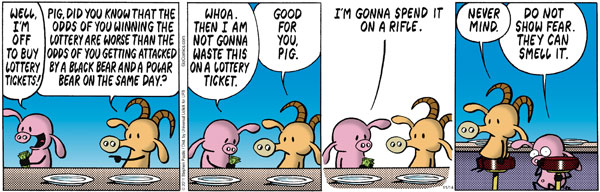
Pearls Before Swine
I’ve mentioned Khan Academy lots of times before, and other resources that allow teachers (math teachers in particular) to “flip the classroom.” Here’s a nice graphic that summarizes the model and provides a bit of research in favor of it. I haven’t been bold enough to try it, but I’d like to experiment in the next few years. It seems like you wouldn’t have to buy into the model 100%; you could use the flipped classroom model sometimes, and the traditional model other times.
Also, it occurs to me that this discussion is most relevant and most revolutionary in the math classroom. English and History classes have always used this flipped classroom model, to some extent–you read outside of class, then come to class to discuss the material. Historically, it’s math teaching that has been lecture-based. So maybe we’re just catching on to something that English and History teachers have known all along: the real thinking and learning happens when the student is involved–talking, speaking, doing, practicing, experimenting.

I have a small problem with the following language in our Algebra 2 textbook. Do you see my problem?
Horizontal Line Test
If no horizontal line intersects the graph of a function f more than once, then the inverse of f is itself a function.
Here’s the issue: The horizontal line test guarantees that a function is one-to-one. But it does not guarantee that the function is onto. Both are required for a function to be invertible (that is, the function must be bijective).
Example. Consider 

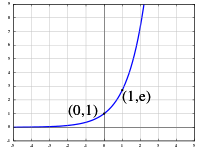
Wrong. The mapping given is not invertible, since there are elements of the codomain that are not in the range of 


This might seem like splitting hairs, but I think it’s appropriate to have these conversations with high school students. It’s a matter of precise language, and correct mathematical thinking. I’ve harped on this before, and I’ll harp on it again.
Am I blundering fool? You decide!
It turns out the trapezoid construction I posted earlier today is trivial. Thanks to Alexander Bogomolny for pointing out my error. The construction is quite easy (and it does not require the height), and I quote Alexander:
No, you do not need the height.
Imagine a trapezoid. Draw a line parallel to a side (not a base) from a vertex not on that side. In principle, there are two such lines. One of these is inside the trapezoid. This line, the other side (the one adjacent to the line) and the difference of the bases form a triangle that could be constructed with straightedge and compass by SSS. Next, extend its base and draw through its apex another base. That’s it.
So I redid my Geogebra Applet and posted it here. It’s not really worth checking out, though, since it’s indistinguishable from my previous applet. (In truth, you can reveal the construction lines and see the slight differences.) But I did it for my own satisfaction, just to get the job done correctly :-). Anyway, three cheers for mathematical elegance, and for Alexander Bogomolny*.
*check out Alexander’s awesome blog & site, a true institution in the online math community!
 Random Walks