I’ve been enjoying following this youtube channel about math, LaTeX, and juggling. It’s authored by an acquaintance of mine (Joe) that I know from the juggling community, actually. Here’s one Joe posted this week that I particularly liked:

I’ve been enjoying following this youtube channel about math, LaTeX, and juggling. It’s authored by an acquaintance of mine (Joe) that I know from the juggling community, actually. Here’s one Joe posted this week that I particularly liked:

….Groan…!
The math carnivals are in full swing. I’ll be hosting one here at Random Walks in June, so get excited for that! 🙂 If you haven’t had a chance to check out Math Carnival #85 hosted by Aperiodical, go do it now. I especially like the idea of Math Busking, since I’ve done plenty of street performing as a juggler. Maybe I need to try adding math to my show!

Here’s another article from NCTM president, J. Michael Shaughnessy. He makes a point that Art Benjamin has made before, that Calculus should not be the goal of high school mathematics. I think I agree too. In general I agree with his article, but there are a few points on which I disagree.
In particular, he says, “If calculus is to be taught in high school, it should be taught at a college level.” I don’t think it hurts to teach non-AP Calculus. I say this because “Calc with Apps” is a course I teach, and I find the students really benefit from the more relaxed pace. There’s no pressure from an AP test at the end. Many come to my class lacking confidence, and leave having their confidence restored.
Shaughnessy goes on to say, “Whenever students enroll in calculus, they should have a solid mastery of algebra, geometry, and trigonometry.” I only agree with this in part. My kids have already taken Algebra 1 and 2, and Precalculus. There are definitely some algebraic rough spots that need to be smoothed out as we go through the course. But again, I find my course the perfect place to do it–since those algebraic skills are routinely needed for the Calculus. And in the end, they say they like math again.
I’ve heard from lots of kids who have gone on to take more Calculus in either high school (AP) or college and have really appreciated the informal foundation that we provided in our lower-key course.
This is Shaughnessy’s final president’s message. President-Elect Linda Gojak will be taking over. I’ll be sure to highlight some of her articles, too!
Just had to share my Easter Egg honoring the school at which I teach:
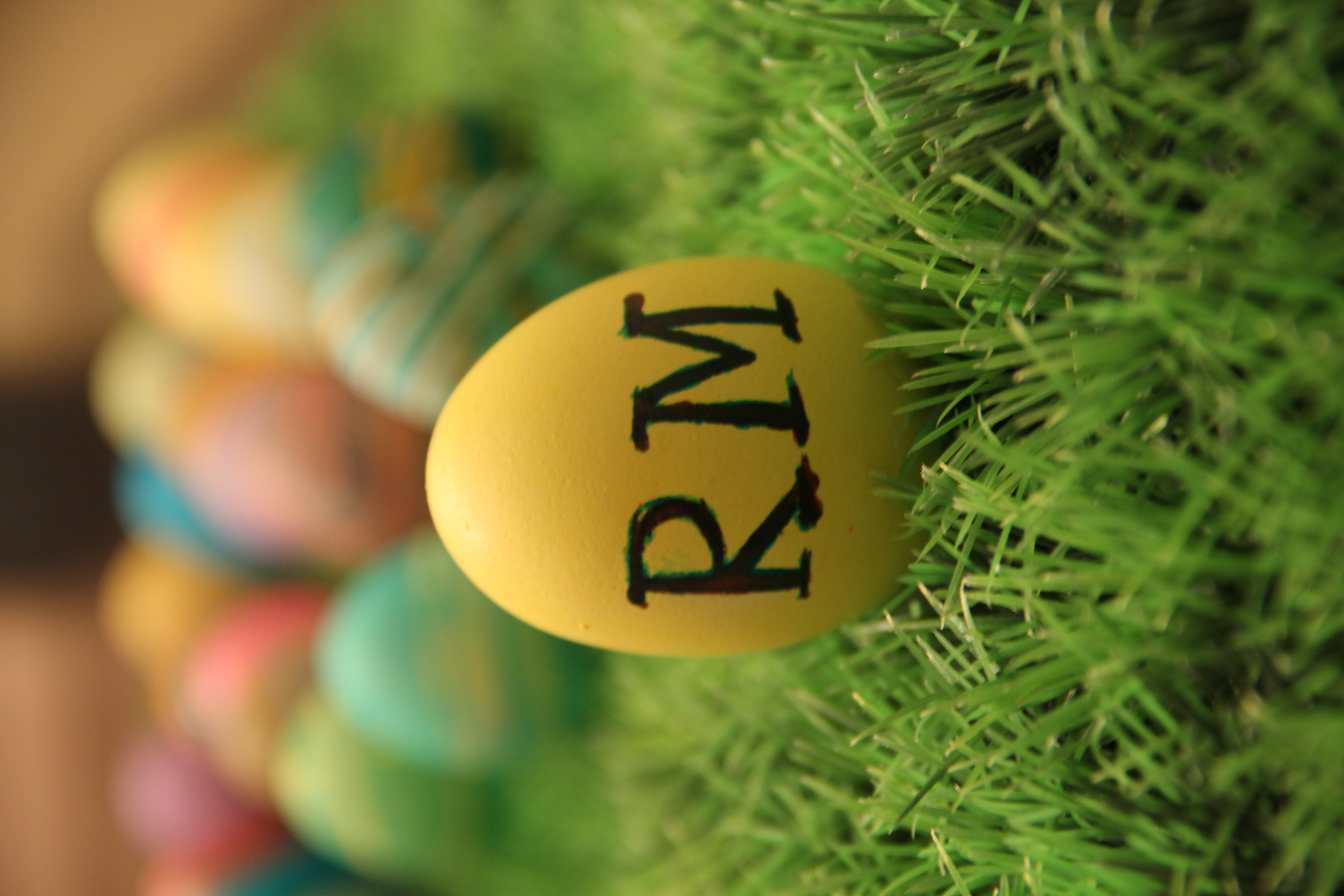
(front) Richard Montgomery

(back) Ritchie the Rocket
Compare with the eggs from last year. I think I’m improving my egg-decorating skills!
Your comic relief for the day :-).

If you haven’t yet checked out Stephen Wolfram’s blog post from March 8th, you absolutely need to. I was impressed with how many categories of data he kept, not just his presentation and analysis of it. He analyzed his email, walking, phone time, keystrokes, and calendar events. And he did this for all of the last decade! Wow. Here are his averages from over that time, shown against the hours in the day.

This was also a nice chance for him to advertise the incredible power of all of his software!
As for email, you can do an analysis on your gmail account from the past year by using this free utility from toutapp.com. I did it and really enjoyed seeing who my top contacts were, learning that I reply to 18% of the emails I receive, and that 47% of the emails I send get responses. Each month on average I received 240 emails and sent 69 emails. And in 2011, I had to deal with a total of 3299 emails. All of this is just in my personal email account, too! I have two other email accounts as well. Go get your analysis!
Even though I’d love to say I use 
That being said, Microsoft has made a significant upgrade to its equation editor with the release of Office 2007 (I know, pretty stale news–but my school just upgraded this past year) and
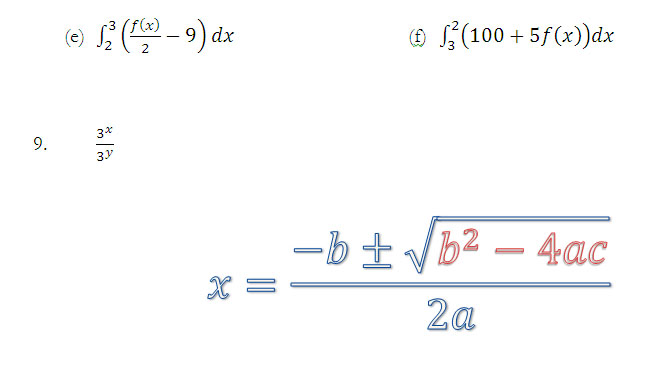
The new equation editor is much better for the following reasons:
1. The shortcuts are amazing, and most simple
2. Most calculator-style syntax is accepted as well. So typing 3^x [space] / 4^y [space][space] results in 
produced by typing “lim_(n\to\infty)[space]((2n+1)(3n-2))/(4n^2)[space]=3/2[space].”
3. As hinted above, the new equation editor responds to all the normal font formatting options in Microsoft Office. You can color your formulas, you can change the font size, and you can apply any other text effect like shadow/glow/outline/etc. [edit: Though you can change all those things, no, you cannot change the font face. There are a limited number of fonts available for use, and the only one I know of is the default, Cambria Math–if you know of another one, please share!]
4. In powerpoint, animations are quite a bit easier, since you can do all the equations in-line as part of the text, rather than juggling scads of different text and equation objects.
For more on Microsoft’s new Equation Editor, please check out my more recent post here!
Today at our school we had to have the obligatory π day celebrations. Here are the ways we observed π at RM:
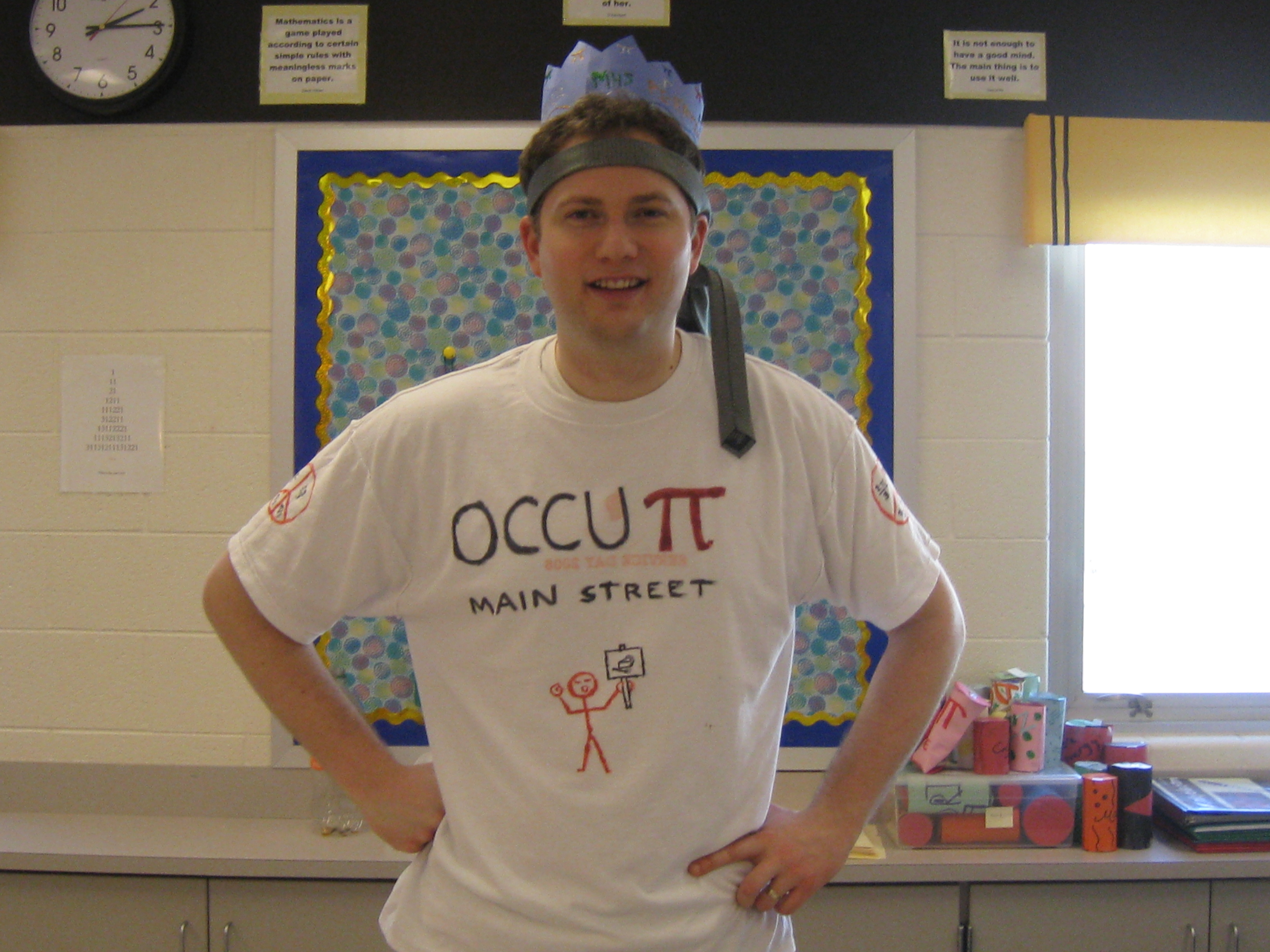
Get the joke?? On the back it says "We are the 3.14%."

Action shot

Mr. Chase wins!


One more thing you can still do, if you haven’t yet observed π day:
Also, on an unrelated note, today’s Google logo is great. If you’re interested in the mathematics of origami, you probably know who Robert Lang is. Today’s Google logo is an origami piece created by Lang in honor of the late Akira Yoshizawa, world famous origami artist.

This math website has a great idea: If we can read bedtime stories to our children each night to increase literacy, shouldn’t also be reasonable to do a math problem before bed each night too? My sister and brother-in-law already do this, and it’s great fun. But this website does all the work for you and you can even sign up for a daily problem in your email. All of this is thanks to website creator, Laura Bilodeau Overdeck. Check it out here.
When my little daughter is a bit older, I’ll definitely be giving her some daily math problems.
 It stands for “Science, Engineering, Technology, and Mathematics” and it’s a buzz word in education circles these days. This is especially true because programs advancing the cause of STEM may be eligible for federal funds (through the National Science Foundation). I benefit directly from such programs, since the masters degree I am currently getting is fully funded because I am a ‘secondary STEM teacher.’
The term is abused, since everyone wants to call what they’re doing “STEM.”
NCTM President J. Michael Shaughnessy hits the nail on the head in this great article (I just posted one of his articles the other day). I’ve included a few snippets here, but I encourage you to read the whole article.
.
STEM: An Advocacy Position, Not a Content Area
by NCTM President J. Michael Shaughnessy
More and more these days, in educational meetings, conferences, and policy arenas, the talk is that “it’s all about STEM.” STEM is an acronym for science, technology, engineering, and mathematics, and it has rapidly become a driving force in educational policy and funding decisions in the United States. I find both strengths and problems with the current STEM discussions across our professional communities.
He provides a balanced critique of the STEM label as it’s used nationally and locally.
As a political advocacy position, STEM—that is, STEM funding and STEM initiatives—is of critical importance to the health of the mathematics and science education communities. In this arena, STEM makes perfect sense. It is when the term “STEM” filters down to states, districts, schools, and pre-K–12 teaching that the waters can become muddled.
The Problem with STEM
The translation from national policy to the rhetoric of state and local politics can give rise to generalist discussions about STEM programs and STEM schools, which in turn can lead to the dilution of important mathematics content. Terms such as “STEM program,” “STEM school,” and “STEM curriculum” are proliferating in our educational jargon. The acronym is shifting from a noun that represents four crucial content areas to an adjective that is used to describe just about anything and everything that anyone is doing related to science or mathematics. STEM is becoming the word du jour, because that’s where the funding lies. One can almost hear the cry in the halls of state departments of education, school district offices, principals’ offices, and school corridors: “We do STEM!” But what exactly does that mean? What are the specific innovations in the teaching and learning of mathematics and science that states, districts, and schools are implementing when they refer to themselves as “STEM intensive” or as having “a STEM program?” We should ask our leaders exactly what they mean when they use the word “STEM.” We deserve more than a generalist blanket response that represents a grouping for funding without specific content or pedagogical substance.
And of course, with an obvious bias (with which I agree!), Shaughnessy goes on to say,
With all due respect to our colleagues in the other disciplines, we assert that the letters in STEM are not all of equal importance in the pre-K–12 education of our students. Mathematics is paramount, mathematics is primal, mathematics is the most important STEM discipline.
Read the whole article here.
.

 Random Walks