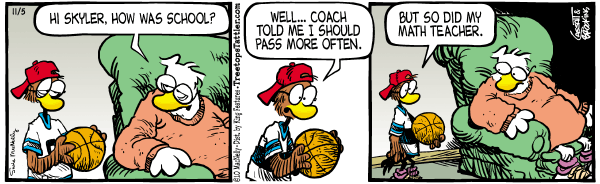
Here’s a great marble ramp, built into a kid’s room. I like it. (This does count as math, right?)

Here’s a great marble ramp, built into a kid’s room. I like it. (This does count as math, right?)
This is the first guest post from John Chase’s dad, also a math teacher. Thanks, son, for letting me post to your blog.
Gene Chase: I was taking a shower today when I figured out why I always confused the words “sequence” and “series.” 2, 3, 4, 5, … is a sequence; 2+3+4+5 is a series. Until today, I thought that my confusion was because “series” and “sequence” both begin with “s.” Now I see the real problem! Teachers would say “sum the following series.” They should have said “evaluate the following series,” since the series is already a sum.
Comment from John Chase: In non-mathematical contexts we don’t differentiate between the two. We think of “television series” and a “series” of cars in a line at an intersection. How mathematically sloppy!
Gene Chase: Yes, usually mathematical language is general language made more precise, not less precise. For example, if you tell a story elliptically, you leave things out of it; if you tell the story parabolically, you give an analog of the story; if you tell the story hyperbolically, you embellish it. The corresponding geometric figures have eccentricities which are either between 0 and 1 (ellipse), precisely equal to 1 (parabola), or greater than 1 (hyperbola).
This makes sense when you remember that “elliptic” is Greek for “defective,” “para” is Greek for “along side,” and “hyper” is Greek for “beyond.”
Another fabulous TED talk on education. I’m inspired.

[Hat tip: my brother Tim]
Here’s a recently posted TED talk by Conrad Wolfram, of Wolfram Research and wolframalpha.com. I was hopeful about this talk, because I find great entertainment value in wolframalpha.com. I was a bit disappointed. I disagree pretty strongly with what he says, even though he makes a few good points. Math, in my opinion, is not at all about solving real world problems. It’s about formal systems that express relationships between “meaningless marks on paper” (Hilbert). And to quote Poincare, “The mathematician does not study pure mathematics because it is useful; he studies it because he delights in it and he delights in it because it is beautiful.” Indeed. Math is beautiful and fun. The way Mr. Wolfram presents math doesn’t sound like very much fun to me.
Dave @ MathNotations posted this nice problem today, good for an Algebra 2 or Precalculus class. I like it:
Consider the following problem:
If -5 ≤ x ≤ 4, and f(x) = 2x2 – 3, how many integer values are possible for f(x)?
For the solution, and some added pedagogical discussion, visit the original post here. Thanks, Dave!
I think this is good news for our county schools in Montgomery County, Maryland:
Montgomery County schools to push basic math to prepare students for algebra
By Michael BirnbaumWashington Post Staff Writer
Friday, November 5, 2010; 12:00 AMMontgomery County long has pushed its students to take ever-more-challenging math at ever-younger ages. Now educators will back off in the hope that more time and depth with the basics will yield payoffs in high school and beyond, school officials said Thursday.
Elementary and middle school students will no longer skip grade levels in math in large numbers. Instead, they will spend extra time on fundamental mathematical concepts that will better prepare them for Algebra I in the eighth grade and advanced math topics in high school. The school system aims to increase the number of high school students taking courses such as calculus and statistics.
The new direction comes as part of a sweeping set of recommended changes in the math curriculum released Thursday. Some of the recommendations cost money and require school board approval. Others, including the change in math acceleration, do not, and will be implemented quickly, officials said.
“Some students were placed in classes, and perhaps they weren’t as prepared as they should have been,” said Frieda Lacey, deputy superintendent of Montgomery schools, who sat on the work group that wrote the report. She said it was better to tackle topics in greater depth.
And I wonder if this will be a growing trend. Are other math teachers out there sensing a turning of the tide in curriculum? I know the new Common Core standards make this move, toward a more in-depth approach. So perhaps this is a national turning of the tide. On the face, I think this seems like a good direction in which to go.
I just ordered this book. I’m excited to see what it’s like. And of course, I’ll be sure to let you know how it is!

Here are a few noteworthy posts I’ve seen in the math blogosphere recently:

 Random Walks