
I’m currently taking a grad class in differential equations. I just had a homework problem that asked about the heat conduction in a long, thin rod. It inspired me to create another GeoGebra applet, and I thought I’d share. The math might be a bit inaccessible, but the results are fairly straightforward.

Consider a solid rod of some kind of uniform material (maybe aluminum or cast iron). Say it’s 20 cm long. And say, for whatever reason, the temperature at a given place in the bar is initially given by this distribution:
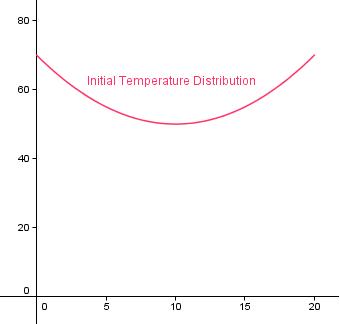
Notice the bar is 70 degrees at each end and 50 degrees in the middle. (This is arbitrary…I just picked this distribution, just for fun.)
Now, let’s say the sides of the bar are insulated, and we just apply heat to the ends. If we maintain a temperature of 10 degrees at one end and 50 degrees at the other end, after a long time, we would expect the temperature throughout the bar to be evenly distributed, ranging from 10 degrees to 50 degrees. It would look something like this:
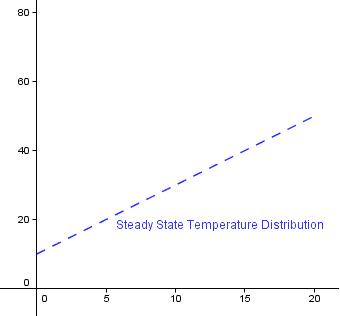
Now, the question is, what is the temperature throughout the bar after 1 second? It should be pretty close to the original distribution still, right? Right. What about after 10 seconds? 30 seconds? 30 days? Eventually it will look like the above distribution. That’s why we call this the “steady-state” distribution.
Here’s what the temperature throughout the bar looks like after 30 seconds, for instance.

Notice that the temperature distribution is still very similar to the initial distribution, but that the ends are changing temperature. This will happen more and more over time.
The applet I constructed lets you change everything about this situation: the length of the bar, the type of material, the temperature we apply to each end, and the initial temperature distribution. Like I said, the math is a bit nasty, but the results are intuitive, I hope. If you want to see some more of the math, feel free to do some reading!

 converge?

 with equation
  and a shrinking circle
  with radius
  and center the origin (in red).
  is the point
  ,
,  is the upper point of intersection of the two circles, and
  is the point of intersection of the line
  and the
  -axis. What happens to
  ?
?
 . Solving for the intersection of the two circles,
 , we now find the equation of line
 in the above equation, we solve for
 .
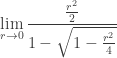
.

 Random Walks