First Day of School!

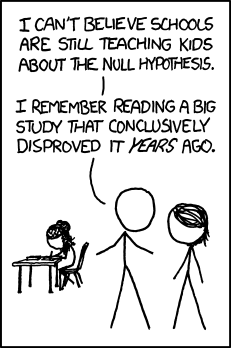
interestingly, I wore almost the identical outfit as this guy for our first day of school :-)

I just wanted to let everyone know that I’m back, and excited for the new school year.  I took a little summer break from blogging, just like I did from teaching :-).

Today was our first day of school at Richard Montgomery High School, where I teach. (And we actually did have school today, even though we had both a 5.8 earthquake and an ‘historic’ hurricane in the last week.) So welcome back to all my current and former students!

Proving the “obvious”

from graphjam.com

As Eric Temple Bell said, “‘Obvious’ is the most dangerous word in mathematics.” That being the case, it is often true that we have trouble proving statements that seem self-evident. Many times we are indeed tempted to say “clearly” or “obviously” or “it is trivial” or “the details have been left to the reader” or “this easily follows from Theorems 4.8, 5.1, and Definition 5.8”. For a full list of invalid proof techniques, visit this hilarious site. Here are a few samples (it’s a LONG list!), quoted from  full list on their site:

  • Proof by intimidation (“Trivial.”)
  • Proof by example (The author gives only the case n = 2 and suggests that it contains most of the ideas of the general proof.)
  • Proof by vigorous hand waving (Works well in a classroom or seminar setting. )
  • Proof by exhaustion (An issue or two of a journal devoted to your proof is useful. )
  • Proof by importance (A large body of useful consequences all follow from the proposition in question.)
  • Proof by accelerated course (We don’t have time to prove this… )

Choosing the level of rigor for a proof is often difficult–depending on the mathematical context, and the audience. I’m taking a graduate class in Analysis right now, so I definitely think about this a lot! In fact, I might add one more to the list:

  • Proof by beautiful typesetting (Because the proof looks good and is typed in \LaTeX, it must be right.)

At least,  I hope my professor feels that’s a valid technique :-).

The Arc Cotangent Controversy

I love this discussion at squareCircleZ. All my readers should check it out. Which is the graph of arccot(x)?

from squarecircleZ

from squarecircleZ

I especially like this controversy because some big players have weighed in on each side. Mathcad and Maple prefer the first interpretation, Mathematica and Matlab prefer the second.

For a more thorough treatment, check out the original post here. Three cheers for great math blogging! 🙂

Origami Hyperbolic Paraboloid

As  I told my classes today, I went to part of a math conference this weekend (this EPADEL MAA meeting, to be specific).

The closing talk was on the Mathematics of Origami by Amanda Serenevy of the Riverbend Community Math Center. Afterward, Amanda taught some of us to fold Hyperbolic Paraboloids with a square of paper. (They are of course approximations to a hyperbolic paraboloid and the paper actually bends in non-rigid ways, which is a bit devious.) Here’s a link to the MAA website where they have instructions on how to make them. And here’s an instructional youtube video, too:

I’ve actually made one before, but I thought I’d highlight it again, since I advertised it in class today and thought my students would appreciate the instructions.

I might report more from the math conference another time soon. I had a good time!


Population Mean & Median

Have you seen this map, which shows the geographic center of the USA and also plots the current median and mean of the population? Very interesting! I got it from another math teacher, but I think the original source is the US Census Bureau (that’s what the bottom of the file says at least!). It inspired me to do some more poking around, and in the wikipedia article I found this map of how the population mean has moved over the last two centuries. Cool.


The movement of the population mean 1790-2010


And of course, here’s the median’s movement over time, too:

Movement of the Population Median