
Sparked by a conversation this past weekend about the usefulness of the half-angle identities, I constructed geometric proofs for 

And while I was at it, I thought I’d share all my other geometric proofs, so here they are, posted mostly without comment.
Some of these are so well-known as to be not worth mentioning. Many of them have been stolen from Proofs Without Words I or Proofs Without Words II. I came up with a few of them myself. Frustratingly, almost none of them are to be found in Precalculus textbooks, where they might be learned and appreciated.

________________________________________________________

__________________________________________________________

_____________________________________________________________

________________________________________________________________

_______________________________________________________________
______________________________________________________________

_________________________________________________________________

______________________________________________________________
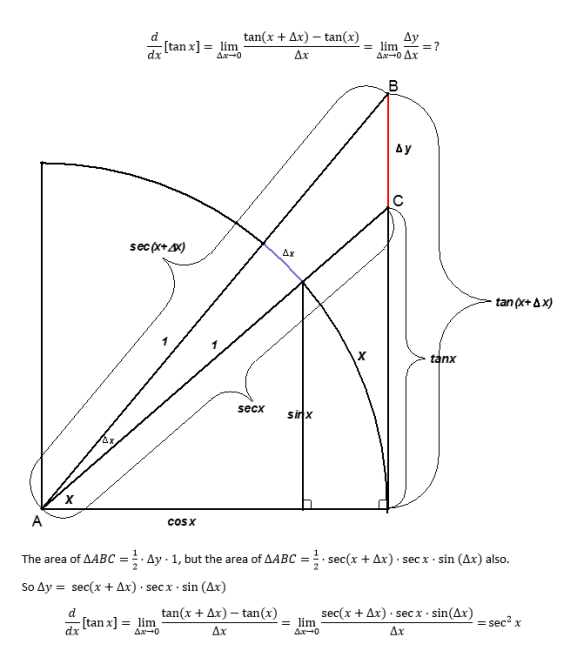
Though this one is my favorite:

____________________________________________________________________________

_______________________________________________________________________________________
Partially because of the way it naturally generalizes into the proof of the derivative of sine. If you just let 


_____________________________________________________________________________________

______________________________________________________________________________________

_______________________________________________________________________________________

___________________________________________________________________________________

__________________________________________________________________________________

___________________________________________________________________________________________

____________________________________________________________________________________
 ____________________________________________________________________________________
And finally, one that shows that the sum of a sine and cosine function of the same argument is also a sinusoid. Since I lost the original picture and don’t feel like remaking it, you’ll have to complete the proof on your own!

____________________________________________________________________________________
Update: After some feedback on twitter, I’ve decided to add a few more diagrams. Tim Brzezinski sent me a link to his website of geometric proofs of trig identities and he had some that I’ve never seen before.
Check it out!
https://www.geogebra.org/m/DxAcj8E2#material/QedMT7Pw
I’ve taken two of his diagrams and added them below.

_________________________________________________________

____________________________________________________________________________________

_________________________________________________________________________________________


 . Some textbooks introduce it more or less out of the blue as “an important limit to know” and prove it via the Squeeze Theorem. Others prefer to wait until halfway through the above proof, realizing only then that this limit is important and solving it with a purpose in mind. There is also a difference of opinion as to how much rigor is required to establish the key inequality, that
  . My textbook uses an area argument, but others prove the inequality with a nested sequence of segment inequalities.
 in precalculus, along with other interesting functions like
  , and
, and  . These are more or less exercises in recognizing the so-called “envelope” of the product or sum of a periodic function and another function and have various scientific applications. The very informal geometric argument for why
 ![\frac{d}{dx} [\sin x] = \cos x](https://s0.wp.com/latex.php?latex=%5Cfrac%7Bd%7D%7Bdx%7D+%5B%5Csin+x%5D+%3D+%5Ccos+x&bg=ffffff&fg=333333&s=0&c=20201002) as a corollary.
as a corollary.



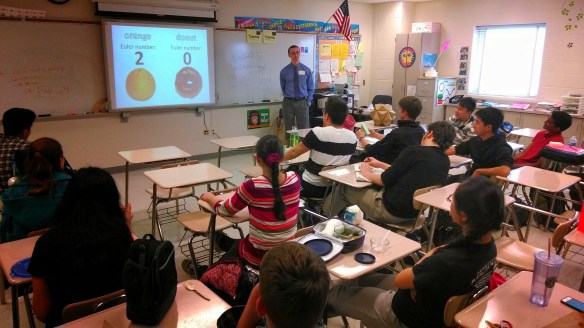 He had our students counting vertices, edges, and faces of various surfaces in order to compute the Euler Characteristic. Students discovered that the Euler Characteristic is a topological invariant.
 In his talk he also walked the students through a proof that there are only five regular surfaces, using the Euler Characteristic. This is more difficult than the typical proof, but elegant because the proof doesn’t appeal to geometry. That is, the proof doesn’t ever require the assumption that the faces, angles, or edges are congruent. In this sense, it is a topological proof.* Very cool indeed!
 Bio: Matthew Wright went to Messiah College and then went on to received his MS and PhD from University of Pennsylvania, where his thesis was in applied and computational topology. He was a professor at Huntington College for two years but is now at the
 Random Walks