Powerful Problem (hint)

A few weeks ago I posted this “powerful” problem:

Solve \left(x^2-5x+5\right)^{\left(x^2-9x+20\right)}=1

Now, allow me to give you a major hint. Consider the simpler equation

a^b=1

What are the possible values of a and b? Here are the possible combinations:

    • a=1 and b is anything
    • b=0 and a is any nonzero number

And here’s the tricky one that most people forget:

    • a=-1 and b is even

You now have enough information to solve the original equation. I think you’ll be delighted with the solution!

Do Irrational Roots Come in Pairs? (Part 3)

continued from this post…

What polynomials can be solved?

Students are used to solving quadratic polynomials with the quadratic formula (if factoring techniques don’t work). And I mentioned in the previous post that Cardano gave us the very messy cubic formula. So it’s natural to ask, what polynomials can be solved?

The answer is that we can solve and get exact solutions for any polynomial up to degree four. This result is due to Ferrari and explained here (not for the faint of heart!!). It’s fun to give wolframalpha.com a fourth degree polynomial and see it go to work finding the exact zeros. Be sure to click on “Exact Form” to see the crazy nested radicals. Amazing what computers can do.

Fifth degree or higher degree polynomials can’t be solved by any particular formula or method. Interestingly, it’s not just that we haven’t discovered a method yet–it’s actually been proven impossible to solve a fifth degree polynomial. Évariste Galois is credited for this proof; he laid the foundation for Modern Algebra with some mathematics we now call Galois Theory. He proved that for any formula you write down that you claim solves the general 5th degree polynomial, we can construct a 5th degree polynomial that can’t be solved by your formula.

I think I have all my facts right. Pretty interesting stuff…and I don’t claim to fully understand it! Perhaps I’ll post more someday after some research.


[And thanks to Mr. Davis and Matthew Wright for inspiring me to post on these topics!!]

Do Irrational Roots Come in Pairs? (Part 2)

continued from this post…

Are all irrationals of the form a+b\sqrt{c}?

Consider, for instance, the simple third degree polynomial

g(x)=x^3-2

This function has one real root, x=\sqrt[3]{2}, and two nonreal roots. But notice that this root isn’t of the form a+b\sqrt{c}. There are lots of other irrationals that are not of this form. In fact, there are “more” irrationals not of this form than there are of this form (the set of irrationals of the form a+b\sqrt{c} are countable and the entire set of irrationals is uncountable). Here are just a few more that aren’t of the special form:

\pi, e, \sqrt[5]{7} and -\sqrt[3]{\frac{2}{3\left(9-\sqrt{69}\right)}}-\frac{\sqrt[3]{\frac{1}{2}\left(9-\sqrt{69}\right)}}{3^{2/3}}

These irrationals seem a bit more contrived. This is an example of where our intuition doesn’t match reality. In fact, most real numbers are impossible to describe at all. This is very hard to believe, even though it’s true.  So we, necessarily, don’t talk about most numbers! On another note, \pi and e will never ever be roots of polynomials (which is why we call them transcendental).

Another example

Here’s another example of a polynomial with one irrational root that came up in our Precalculus homework this past week:

h(x)=x^3-x+1

This has only one real root. It’s an irrational root, and so it must not be of the form a+b\sqrt{c}. In fact, the  one real zero of h(x) is the last irrational number in the list above. How do we find such a convoluted answer?

The answer is we use Cardano’s Method, which works for cubic equations (it would work particularly nicely on the above  polynomial). But for higher degree polynomials, we can only hope to attack it using various algebraic tools like Rational Root Theorem, Descartes Rule of Signs, good guessing, long division, substitutions,  factoring techniques, or other sneaky algebraic tricks. If algebraic techniques fail, all we can do is resort to approximation (usually using Newton’s Method). So, for the first polynomial we started with,

f(x)=-x^5+2x^4+7x^3+x^2-4x+1

has one irrational root, but I don’t know how to find it except by approximation: It’s approximately 3.83. And WolframAlpha doesn’t know either.

So there we have it, real polynomials with rational coefficients can have ONE irrational root. Let no one convince you otherwise! 🙂

(And here’s another great discussion of this topic.)

Do Irrational Roots Come in Pairs? (Part 1)

The short answer is NO.

This past week I had a conversation with some of my colleagues about this question. A long time ago I put this on my list of math topics I needed to think about more. So I was grateful for an opportunity to think through this problem. The polynomial we were working with was

f(x)=-x^5+2x^4+7x^3+x^2-4x+1

We were talking about Rational Root Theorem and Descartes’ Rule of Signs. Descartes’ tells us that there are 3 or 1 positive real zeros and 2 or 0 negative real zeros. Rational Root Theorem tells us that if there any rational roots they will be \pm1. It’s easy to see that f(1)=6 and f(-1)=2, so neither of these are zeros. It has an odd degree, so it crosses the x-axis only once. That means that this fifth degree polynomial has 4 nonreal roots and 1 irrational root. How is this possible? Don’t irrational roots come in pairs?

The Irrational Root Theorem

Here’s the irrational root theorem (in my own words):

If a polynomial with rational coefficients has a zero of the form x=a+b\sqrt{c}, then it will also have the zero x=a-b\sqrt{c}.

At first, it may seem that the polynomial above, f(x), is a counterexample. But this assumes that all irrational numbers can be written in the form a+b\sqrt{c}.

I’ll close with an even easier counterexample: f(x)=x^5-2. This has only one irrational root, namely x=\sqrt[5]{2}.

Powerful Problem

I love this problem. I love it because it seems so complicated at first, just because we don’t teach students how to attack problems like this in Algebra class. There aren’t any “traditional” methods of attacking it, just a little mathematical reasoning/logic. Here it is:

Solve \left(x^2-5x+5\right)^{\left(x^2-9x+20\right)}=1

And this is my new “super duper” problem which I post throughout the year on my board (I use a lot of the same problems each year). I first saw this problem at Messiah College where one of my professors shared it–either Dr. Phillippy or Dr. Brubaker, I can’t remember which.

So give it a try. It’s sure to delight you. My Precalculus class was sharp enough to solve it today in one period (albeit, while I was teaching about a completely different topic :-)).

Could your math teacher be replaced by video?

Before I get to the titular topic, let me share some links. I’ve been meaning to post links to a couple of online resources that are astonishingly thorough. I strongly encourage you to check all these out.

  • Drexel Math Forum — This site has been around for years, I’m just getting around to posting about it now. But if you’ve never been there, I highly recommend it. Almost any math question high school students could asked has been answered and cataloged on this site (including misconceptions about asymptotes like I posted about the other day).
  • Interact  Math — When you first link to this page you’ll be unimpressed. But select a book from the drop down menu and then pick a chapter and set of exercises. Then, click on an exercise and prepare to take an interactive tour of that problem. The site let’s you graph lines, type math equations, do multiple choice problems, and more. If you have trouble with the problem, it will interactively walk you through each step, asking you simpler questions along the way. What a fantastic resource! Unfortunately, almost none of our books are on the drop down list. That doesn’t keep it from being useful. Just find problems similar to what you’re struggling with and try those.
  • Khan Academy — A nonprofit organization started by Sal Khan, this site has 1800+ youtube instructional videos, nicely organized by course and topic. You can go learn everything from basic arithmetic to college level Calculus (and Differential Equations, Linear Algebra, Statistics, Biology, Chemistry, Physics, Economics…). Sal’s mission is to provide a world class education to anyone in the world for free. It’s very exciting to see how this site will grow, and possibly change how we do education.

Math Teaching by Video

Some of these sites, especially the Khan Academy, make me wonder how long our modern American school system will remain in its present form.  Will we always have a teacher in the front of the math classroom delivering instruction?

I’m not afraid of the idea that we (teachers) could be partially replaced by video lessons. It’s actually a pretty good idea. The very best instructional practices could be incorporated into a flawlessly edited video. Teachers wouldn’t make frustrating, careless mistakes, students could replay the videos at any time, and substitute teachers could easily run the class. Every school, even the poorest and most marginalized would be able to deliver top-notch, world class instruction.

And what would teachers do, then? Qualified teachers could turn their efforts toward more of “coaching” and “discussion leading” role, concentrating on one-on-one sessions, remediation, reteaching, providing feedback, grading, seminars, open forums, field trips, and inquiry-based instruction that supplements the more formal video presentations. And don’t forget blogging! 🙂 So much of a teacher’s time is currently spent preparing lessons and teaching them that they have very little time for all those other (more?) important aspects of teaching. All this time devoted to preparation is being spent by teachers everywhere. Imagine the possibilities if we devoted the bulk of our time to these other aspects instead of preparing instruction. Sounds really great to me.

Asymptote Misconceptions

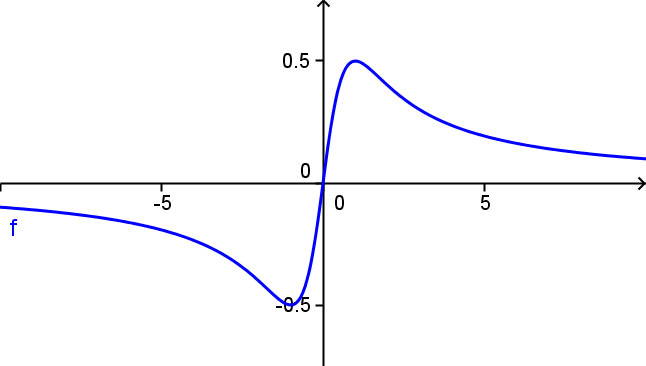
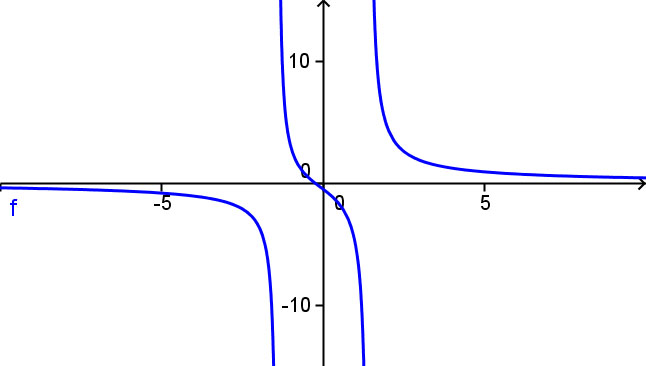
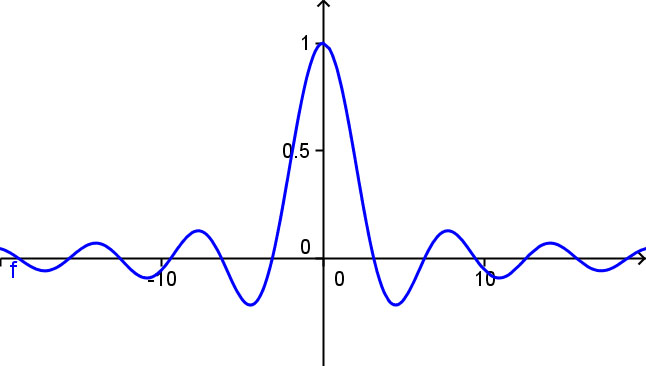
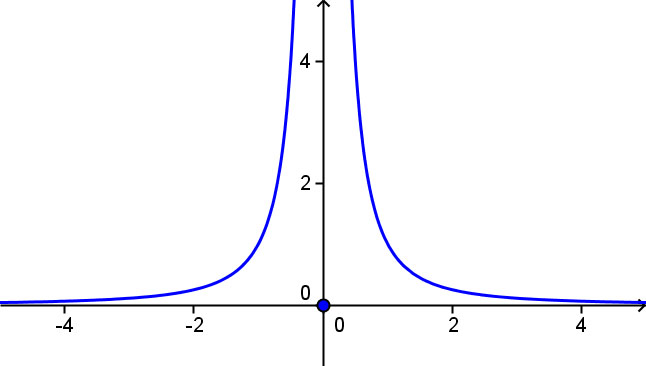
Can a function cross its horizontal asymptote? Can it be defined on its vertical asymptotes? Most students say no to both questions. But the answer to both questions is actually yes. At the beginning of every year I have to clear up this common misconception. So, let me write it all out so it’s cut and dry. We’ll start by examining a bunch of examples.

Functions that cross their horizontal asymptotes

f(x)=\frac{x}{x^2+1} (also try f(x)=xe^{-x^2})

f(x)=\frac{4x+1}{x^2-2}

f(x)=\frac{\sin{x}}{x}

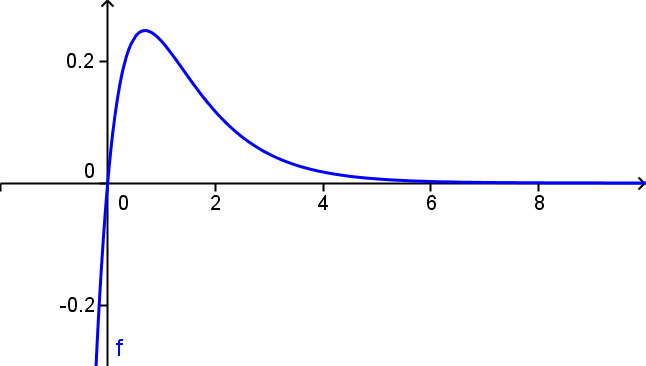
f(x)=-e^{-2x}+e^{-x}

Functions that are defined on their vertical asymptote

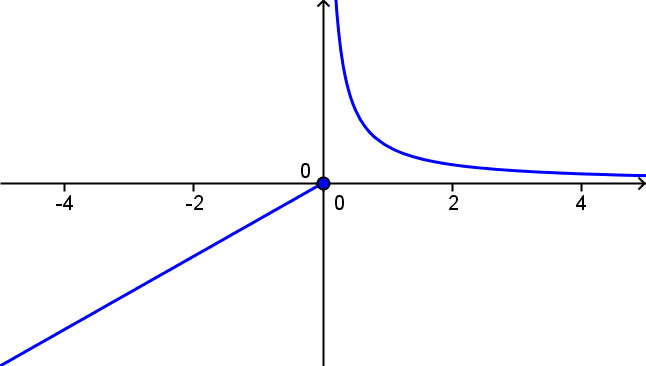
Functions defined on their vertical asymptotes are a bit more contrived, but they are completely legitimate and still pass the “vertical line test.” These functions must be defined piece-wise, like so:

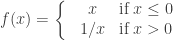
f(x)=\left\{\begin{matrix}&x   &\text{if}\;  x\leq0\\ &1/x &\text{if}\; x> 0\end{matrix}\right.

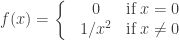
f(x)=\left\{\begin{matrix}&0   &\text{if}\;  x=0\\ &1/x^2 &\text{if}\; x\neq 0\end{matrix}\right.

What IS an asymptote?

Said loosely, an asymptote is a line that a curve gets closer to as it tends toward infinity (whereby we mean, anywhere on the outskirts of the coordinate plane). Feel free to read the wikipedia entry for all the gory details. It even mentions ‘curvilinear’ asymptotes–asymptotes that aren’t lines. Our Precalculus text mentions them too, but we don’t make a big deal about it.

The most rigorous definition of an asymptote our students see involves limits. And even then, we show you how to evaluate limits but don’t prove limits (with \epsilon\delta proofs!). That’s a bit different than when I took Calculus in high school. I remember learning the proofs. For those who miss them in high school, though, have no fear–a college course in elementary real analysis will feed your hunger! 🙂


So, to my students: I hope this helps clear up some issues you might have with asymptotes and frees your mind from the prototypical examples of asymptotes you might be used to!

First Week Fun

It’s so good to be back. I love summer, but unlike Calvin, I always enjoy returning to the school year. And I really like getting to know all of my students.

Just for fun, here’s a problem I came up with today. It combines some nice Algebra 2/Precal skills, and provides a nice exercise in analysis of functions. No calculator needed. Feel free to give answers in the comments below. In fact, feel free to suggest other similar problems.

Find the range of f(x)=2^{x^2-4x+1}.