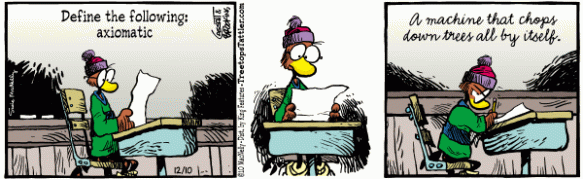
Another mathematically themed Shoe
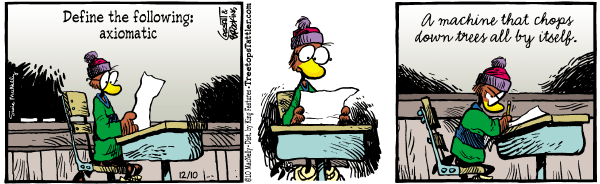
Another mathematically themed Shoe
[Hat tip: Gene Chase]

Another mathematically themed Shoe
[Hat tip: Gene Chase]
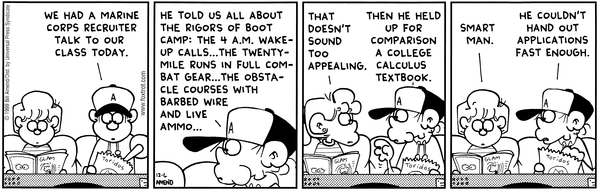
A Calculus textbook should seem like fun, right? I think so!
 [Hat tip: my dad]
Dr. Gene Chase guest author again.
The video at Joy of Stats shows 200 countries’ health and wealth over 200 years. The augmented reality (AR) presentation makes it interesting even if you’re not a geek like me.
My favorite part of Statistics isn’t numerical. It’s graphical. Visual data analysis is powerful because our eyes coupled with our minds are able to see patterns that no amount of means, modes, medians, and standard deviations can show.
A few weeks ago, I blogged about a calculator giveaway at Wild About Math. Since then, Sol has posted a submitted solution here (and here’s the direct link to the pdf solution by Nate Burchell).
Here’s the problem for those who didn’t see it:
One can create a triangle of consecutive positive integers as follows:
 1
 2  3
 4  5  6
 7  8  9 10
11 12 13 14 15
16 17 18 19 20 21
   . . .
Each row, R, has R numbers. Each column, C, has infinitely many numbers. Rows and columns begin at 1. We define a function F(R,C) for row R and column C such that F(R,C) gives us a value in the triangle. Thus, F(1,1) = 1, F(2,1) = 2, and F(2,2) = 3. Note that F(R,C) is only defined when 1 < = C <= R.
Part 1: Come up with a formula that computes F(R,C) in terms of R and C for any positive values of R and C when 1 < = C <= R. Show your work.
Part 2: Come up with a formula or algorithm that, given a positive integer n, determines R and C.
I also solved the problem and submitted a solution but I didn’t win. Here’s my own solution.
Here’s a great marble ramp, built into a kid’s room. I like it. (This does count as math, right?)
Another fabulous TED talk on education. I’m inspired.

[Hat tip: my brother Tim]
Here’s a recently posted TED talk by Conrad Wolfram, of Wolfram Research and wolframalpha.com. I was hopeful about this talk, because I find great entertainment value in wolframalpha.com. I was a bit disappointed. I disagree pretty strongly with what he says, even though he makes a few good points. Math, in my opinion, is not at all about solving real world problems. It’s about formal systems that express relationships between “meaningless marks on paper” (Hilbert). And to quote Poincare, “The mathematician does not study pure mathematics because it is useful; he studies it because he delights in it and he delights in it because it is beautiful.” Indeed. Math is beautiful and fun. The way Mr. Wolfram presents math doesn’t sound like very much fun to me.
Dave @ MathNotations posted this nice problem today, good for an Algebra 2 or Precalculus class. I like it:
Consider the following problem:
If -5 ≤ x ≤ 4, and f(x) = 2x2 – 3, how many integer values are possible for f(x)?
For the solution, and some added pedagogical discussion, visit the original post here. Thanks, Dave!
I think this is good news for our county schools in Montgomery County, Maryland:
Montgomery County schools to push basic math to prepare students for algebra
By Michael BirnbaumWashington Post Staff Writer
Friday, November 5, 2010; 12:00 AMMontgomery County long has pushed its students to take ever-more-challenging math at ever-younger ages. Now educators will back off in the hope that more time and depth with the basics will yield payoffs in high school and beyond, school officials said Thursday.
Elementary and middle school students will no longer skip grade levels in math in large numbers. Instead, they will spend extra time on fundamental mathematical concepts that will better prepare them for Algebra I in the eighth grade and advanced math topics in high school. The school system aims to increase the number of high school students taking courses such as calculus and statistics.
The new direction comes as part of a sweeping set of recommended changes in the math curriculum released Thursday. Some of the recommendations cost money and require school board approval. Others, including the change in math acceleration, do not, and will be implemented quickly, officials said.
“Some students were placed in classes, and perhaps they weren’t as prepared as they should have been,” said Frieda Lacey, deputy superintendent of Montgomery schools, who sat on the work group that wrote the report. She said it was better to tackle topics in greater depth.
And I wonder if this will be a growing trend. Are other math teachers out there sensing a turning of the tide in curriculum? I know the new Common Core standards make this move, toward a more in-depth approach. So perhaps this is a national turning of the tide. On the face, I think this seems like a good direction in which to go.
 Random Walks