LEGO math

This article was just posted to wired.com today and is an interesting summary of some research from 2002–but it is new to me. Here’s an excerpt from Samuel Arbesman’s article:

Most objects are made up of smaller parts, combined in complicated and diverse ways… In the wonderfully titled paper Scaling of Differentiation in Networks: Nervous Systems, Organisms, Ant Colonies, Ecosystems, Businesses, Universities, Cities, Electronic Circuits, and Legos,Mark Changizi and his colleagues set out to understand this concept. They found that in every single one of the systems in the wildly interdisciplinary list of the subtitle there was an increase in the number of types of components as the total number of pieces grew. The larger something is, the more types of building blocks it uses.

And this includes, of course, Lego bricks. Using a dataset of 389 Lego sets (this was done back in 2002, so if anyone can download the data easily, I would love to see if the results hold up with a richer dataset), they examined the number of distinct types of pieces in a set versus the total number of pieces in that set (examples of sets include “Air Patrol”, “Spy Boat”, and “Cargo Crane”, and a master list of Lego piece types is here).

They found that the number of piece types to total number of pieces could be fit nicely to a power law. Here it is on a log-log scale:

This curve demonstrates that as the number of pieces in a set grows, so do the number of piece types. However, the number of piece types grows sublinearly: while a larger set uses more piece types, as sets becomes larger, they use progressively fewer additional piece types (so larger sets actually use fewer types per piece). This is similar to other sublinear curves, where larger animals use less energy per cell for metabolism or larger cities actually need fewer gas stations per capita. Essentially, larger sets become more efficient, using the same pieces that smaller sets do, but in a more complex and diverse way.

(more)


Now, just for fun, here’s a video of a  great LEGO contraption (HT: Tim Chase).

Also, just for fun, here’s a photo of a 4-foot Lego 737 that my friend Matthew and I built. We’ve actually finished most of it, I just don’t have a recent picture. (Notice in this photo the roof, tail, and wings are missing.) But this gives you a taste:


Teaching math with applications

Wow, if the title of this post didn’t grab you, I don’t know what will. Pretty riveting, right? Has anyone ever thought of teaching math with applications? </end sarcasm>

This is the basic thesis of a recent article from the NY Times, “How to Fix Our Math Education” by Sol Garfunkel and David Mumford:

THERE is widespread alarm in the United States about the state of our math education. The anxiety can be traced to the poor performance of American students on various international tests, and it is now embodied in George W. Bush’s No Child Left Behind law, which requires public school students to pass standardized math tests by the year 2014 and punishes their schools or their teachers if they do not.

All this worry, however, is based on the assumption that there is a single established body of mathematical skills that everyone needs to know to be prepared for 21st-century careers. This assumption is wrong. The truth is that different sets of math skills are useful for different careers, and our math education should be changed to reflect this fact.

Today, American high schools offer a sequence of algebra, geometry, more algebra, pre-calculus and calculus (or a “reform” version in which these topics are interwoven). This has been codified by the Common Core State Standards, recently adopted by more than 40 states. This highly abstract curriculum is simply not the best way to prepare a vast majority of high school students for life.

For instance, how often do most adults encounter a situation in which they need to solve a quadratic equation? Do they need to know what constitutes a “group of transformations” or a “complex number”? Of course professional mathematicians, physicists and engineers need to know all this, but most citizens would be better served by studying how mortgages are priced, how computers are programmed and how the statistical results of a medical trial are to be understood.

(more)

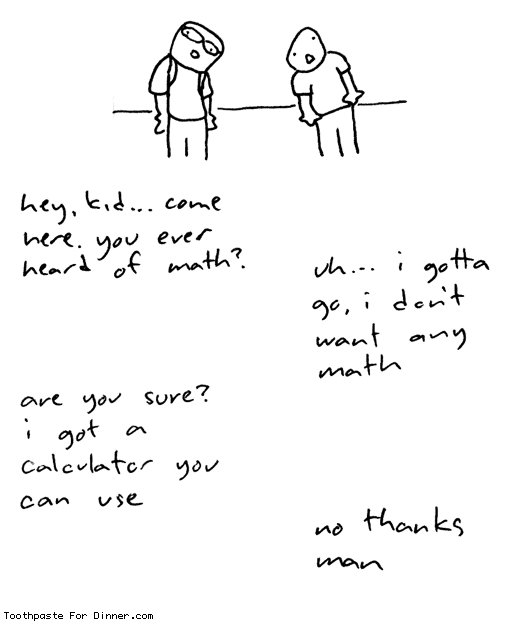
from toothpastefordinner.com

To be fair, the real thesis–if you read further in the article–is that we should primarily teach applications and math can swoop in and rescue us if and when it’s needed:

Imagine replacing the sequence of algebra, geometry and calculus with a sequence of finance, data and basic engineering. In the finance course, students would learn the exponential function, use formulas in spreadsheets and study the budgets of people, companies and governments. In the data course, students would gather their own data sets and learn how, in fields as diverse as sports and medicine, larger samples give better estimates of averages. In the basic engineering course, students would learn the workings of engines, sound waves, TV signals and computers. Science and math were originally discovered together, and they are best learned together now.

If you haven’t gathered already, I don’t agree at all with this thesis. It’s my opinion that math should be taught as math, respected as its own field of study, and a valuable part of a high school liberal arts curriculum. Students should value math for its inherent, abstract beauty. Applications are of course a must in any course. But I find that in the text resources I’ve used, the applications are often contrived. Extremely contrived. Doing math should feel like playing a game, like working on a puzzle, or like arguing.

In fact, when high school students ask why are we learning this?, I FIRST respond with the things I just said: It’s part of a liberal education; it will make you a well-rounded, intelligent person who can hold conversations with other smart people in other fields; and it’s fun. I mention SECOND what applications exist for the math we’re learning. For high school students, if we’re honest, most of them will never need any of the math we’re teaching. Seriously. If you’re not working in a math or science field, when was the last time you had to factor a polynomial?

The authors go on to say “Science and math were originally discovered together, and they are best learned together now.” But this is not universally true. In many cases, the ‘useless’ math was developed first (think of number theory for instance) and then only later were applications discovered (think of the RSA or El Gamal public key encryption schemes).

So why learn math? There was a nice post about this yesterday on one of my new favorite blogs, dy/dan, titled “Cornered By The Real World.” He highlights this great article by Samuel Otten in this August’s Math Teacher magazine. I highly recommend reading the whole article. As a taste, I’ll include the same snippet that Dan shared:

I believe that thinking and acting as if the justification for teaching and learning mathematics is found solely in everyday applications can be dangerous. Mathematics does not exist only to serve other professions, nor is it merely a collection of algorithms and procedures for dealing with real-world situations. Such a mind-set essentially paints our discipline into a weak and lonely corner and leaves undefended many of its greatest aspects.

I could say more about this, but I’ll spare you. I’m passionate about making math a subject worth learning all on its own. If I say more, I’ll start to sound like Paul Lockhart.

Longest mathematical proof

Here’s a recent article from NewScientist.com, Prize awarded for largest mathematical proof by Stephen Ornes:

The largest proof in mathematics is colossal in every dimension – from the 100-plus people needed to crack it to its 15,000 pages of calculations. Now the man who helped complete a key missing piece of the proof has won a prize.

In early November, Michael Aschbacher, an innovator in the abstract field of group theory at the California Institute of Technology in Pasadena will receive the $75,000 Rolf Schock prize in mathematics from the Royal Swedish Academy of Sciences for his pivotal role in proving the Classification Theorem of Finite Groups, aka the Enormous Theorem.

(more)


John Milnor wins Abel Prize

Just two days ago, the Norwegian Academy of Science and Letters awarded mathematician John Milnor the 2011 Abel Prize. Though it was just awarded, the prize is in recognition of decades of work. Here’s a link to the short piece on NPR show All Things Considered. And here’s a direct link to the Abel prize website.  And here’s a snippet from the Scientific American article:

Dimension-Cruncher: Exotic Spheres Earn Mathematician John Milnor an Abel Prize

His discovery that some seven-dimensional spheres look different under the lens of calculus spurred decades of research in topology.

John Milnor, an American mathematician best known for the discovery of exotic hyperspheres, was awarded the 2011 Abel Prize, the Norwegian Academy of Science and Letters announced March 23.

Milnor, a professor at Stony Brook University in New York State, got a call at his Long Island home at 6 A.M. informing him he was receiving the $1-million prize—an honor first awarded in 2003 as mathematics’ answer to the Nobel Prizes. “I knew I was a possible candidate, but I certainly didn’t expect it,” says Milnor, 80, who had already earned numerous awards during his career, including a Fields Medal in 1962 and a Wolf Prize in 1989. Milnor is the second consecutive American-born Abel laureate; the 2010 prize went to John Tate of the University of Texas at Austin for his contributions to number theory.

(more)

The reason I’m linking to lots of other sources is because I don’t understand Milnor’s results very well :-). But it sounds impressive.

[Hat tip: Raynell Cooper]


Obligatory π Day Post

Happy π-day.


We had lots and lots of pie, cookies, chips, cheese balls, and other ’round’ snacks today. A fun excuse for a party :-). I showed them a powerpoint with some interesting facts about π. One of my classes even got to whoop and holler at 1:59:26.

I showed some of my classes this:

[youtube:http://www.youtube.com/watch?v=nmXkDbGdD4Q&feature=player_embedded&rel=0%5D


And I showed one of my classes this, which was put up just today by Vi Hart (bonus: see if you can find the small error in this video):

[youtube:http://www.youtube.com/watch?v=jG7vhMMXagQ&feature=player_embedded&rel=0%5D


I’m not sure where I stand on the whole Tau thing. I do think it helps with learning the unit circle and trig values. But I’m not convinced it makes most formulas simpler. And history is a force to be reckoned with. There is lots of mathematical notation that could use some revision, I suppose.


Predicting Partitions

This recent news from the American Institute of Mathematics:

January 20, 2011.   Researchers from Emory, the University of Wisconsin at Madison, Yale, and Germany’s Technical University of Darmstadt discovered that partition numbers behave like fractals, possessing an infinitely-repeating structure.

In a collaborative effort sponsored by the American Institute of Mathematics and the National Science Foundation, a team of mathematicians led by Ken Ono developed new techniques to explore the nature of the partition numbers. “We prove that partition numbers are ‘fractal’ for every prime. Our ‘zooming’ procedure resolves several open conjectures,” says Ono.

Accompanying this result was another achievement developing an explicit finite formula for the partition function. Previous expressions involved an infinite sum, where each term could only be expressed as an infinite non-repeating decimal number.

Counting the number of ways that a number can be ‘partitioned’ has captured the imagination of mathematicians for centuries. Euler, in the 1700s, was the first to make tangible progress in understanding the partition function by writing down the generating series for the function. These new results involve techniques which could have applications to other problems in number theory.

[original article]

Wired.com also just reported on it, and you can find their coverage here.

Give the Babylonian’s some credit

So says this CNN article from Friday.

Over 1,000 years before Pythagoras was calculating the length of a hypotenuse, sophisticated scribes in Mesopotamia were working with the same theory to calculate the area of their farmland.

Working on clay tablets, students would “write” out their math problems in cuneiform script, a method that involved making wedge-shaped impressions in the clay with a blunt reed.

These tablets bear evidence of practical as well as more advanced theoretical math and show just how sophisticated the ancient Babylonians were with numbers — more than a millennium before Pythagoras and Euclid were doing the same in ancient Greece.

“They are the most sophisticated mathematics from anywhere in the world at that time,” said Alexander Jones, a Professor of the History of the Exact Sciences in Antiquity at New York University.

He is co-curator of “Before Pythagoras: The Culture of Old Babylonian Mathematics,” an exhibition at the Institute for the Study of the Ancient World in New York.

more…

[Hat tip: Mr. Gherman]

The Important Theorems Are the Beautiful Ones

Dr. Gene Chase guest blog author here again.

What makes a math theorem important?

The usual answer is that it is either beautiful or useful. If like me you think that being useful is a beautiful thing, then important theorems are the beautiful ones.

But what makes a theorem beautiful? For example, why is the Theorem of Pythagoras widely regarded as beautiful: and a, b, and c are not 0 if and only if a, b, and c are the sides of a right triangle? (OK, break into small groups and discuss this among yourselves! An answer appears at the bottom of this post.)

But the theorem 1223334444 = 1223334443 + 1 is not beautiful, won’t you agree?

If the theorem is geometric, we can appeal to visual beauty. For example, three circles pairwise tangent have a beautiful property that is animated here.

But beautiful theorems do not have to be geometric. Numbers are beautiful. For example, Euclid’s theorem that there are an infinity of primes is beautiful. No one has been able to draw a beautiful picture about that, although people have tried from astronomer and mathematician Eratosthenes in 200 BC to science fiction writer and mathematician Stanislaw Ulam in 1963.

For $15 you can have a mathematical theorem named after you. But I can guarantee that it won’t be beautiful. So if you want a theorem named after you, give Mr. Chase the $15 instead and he’ll find one for you. Don’t use 1223334444 = 1223334443 + 1. I claim that as “Dr. Gene Chase’s theorem.”


Answer to discussion question above: Most folks say that a beautiful theorem has to be “deep,” which is just a metaphor for “having many connections to many other things.” For example, the Theorem of Pythagoras has to do with areas, not squares specifically. The semicircle on the hypotenuse of a right triangle has an area equal to the sum of the areas of the semicircles on the adjacent sides. And so for any three similar figures.

Do you remember the joy that you feel when you first learned that two of your friends are also friends of each other? That’s the joy that a mathematician feels when she discovers that the Theorem of Pythagoras and the Theorem of Euclid are intimate with each other. But I’ll leave that connection to another post.

Math is about surprising connections. Which is to say, it’s about beauty.

Math ML

On October 21, W3C (the governing body responsible for web standards) recommended a new version of its Mathematical Markup Language for use on the web. Here’s an article about it from ComputerWorld:

The W3C has updated its MathML standard for rendering mathematical notation on Web pages to better portray basic math symbols, as well as render mathematic symbols in more languages.

The World Wide Consortium (W3C) is hoping that this new version of MathML will be rolled into the other group of standards being incorporated in browsers with the HTML5 Web page markup specification, such as CSS (Cascading Style Sheets) and SVG (Scalable Vector Graphics).

The new standard represents basic symbols such as for multiplication, long division, subtraction, and the carries and borrows addition symbols.

The new markup will allow educational Web page designers to add these symbols onto the pages instead of going through the cumbersome process of embedding small images of the symbols or formulas into the pages. The symbols will also help assistive technology such as screen readers interpret the mathematical material.

more…

Before seeing this, I didn’t even realize such a thing existed. I read through some of the standards (here) and I wasn’t too impressed. For instance, check out this convoluted tagging that must be used to render the quadratic formula.

<mrow>
  <mi>x</mi>
  <mo>=</mo>
  <mfrac>
    <mrow>
      <mrow>
        <mo>-</mo>
        <mi>b</mi>
      </mrow>
      <mo>±<!--PLUS-MINUS SIGN--></mo>
      <msqrt>
        <mrow>
          <msup>
            <mi>b</mi>
            <mn>2</mn>
          </msup>
          <mo>-</mo>
          <mrow>
            <mn>4</mn>
            <mo>⁢<!--INVISIBLE TIMES--></mo>
            <mi>a</mi>
            <mo>⁢<!--INVISIBLE TIMES--></mo>
            <mi>c</mi>
          </mrow>
        </mrow>
      </msqrt>
    </mrow>
    <mrow>
      <mn>2</mn>
      <mo>⁢<!--INVISIBLE TIMES--></mo>
      <mi>a</mi>
    </mrow>
  </mfrac>
</mrow>

Contrast that to \LaTeX, which allows you to render it with this very simple code:

x=\frac{-b\pm\sqrt{b^2-4ac}}{2a}

Ah…so nice! And here’s how it looks:

x=\frac{-b\pm\sqrt{b^2-4ac}}{2a}

I’m open to having my mind changed–but I’m not seeing this new W3C recommendation as a usable standard. Anyone else have experience with it?


[Hat tip: Tim Chase, my beloved brother]


Benoit Mandelbrot

I know this is old news, but I wanted to make sure and acknowledge that mathematical great, Benoit Mandelbrot passed away twelve days ago on October 14. There’s a nice set of videos on the TED blog if you care to check them out, including this TED talk that Benoit just gave in February of this past year:

At some point I’ll have to post more about fractals, for my own sake. I’d like to research them a bit more and make some of my own. For some beautiful fractals that appear in nature, you can see this post.