Vi Hart’s Blog

It’s high time I gave a bit of press to Vi Hart’s Blog. If you haven’t checked it out, do so right away. It’s brilliant.  A number of people have pointed me to her blog, including one of my Calc students. Her little math videos are fresh, funny, and insightful. Denise, at Let’s Play Math, gave her some press too, which is what reminded me to finally make this post. Here’s the video Denise highlighted (the most recent of Vi’s creations):

This is particularly appropriate because there were a couple of us in our math department discussing this very question: In total, how many gifts are given during the 12 Days of Christmas song? It’s a nice problem, perfect for a Precalculus student. Or any student. Here’s a super nice explanation of how to calculate this total, posted at squareCircleZ. But before you go clicking that link, take out a piece of scrap paper and a pencil and figure it out yourself!

Here’s another nice video from Vi Hart:

You could spend a lot of time on her site. Here’s another awesome video. I’ll have to have my Precalculus class watch this one when we do our unit on sequences and series.

And you’ve got to love the regular polyhedra made with Smarties ,  right?

Plus, Vi Hart plays StarCraft, which is awesome too.  Back in the day, I really loved playing. I haven’t played in a while, and I certainly haven’t tried SC 2 yet, because then I’d never grade my students’ papers.

Bottom line is, you need to check out all the playful stuff Vi Hart is doing at her blog. Happy Wednesday everyone!


 

Google Ngram

This is super fun. Google has just released this tool for playing with word frequency data from a huge amount of scanned literature (5 million books dating as far back as 500 years). You can read more about it here, including some nice research that’s already being done with the full data set that’s also been released. (also here)

For example, here’s a graph of the appearance of the word “homeschool” in the collective Google corpus.

You can also compare the appearance of words. For example, here’s informal evidence that we care less about ancient Greek mathematicians (BC) and more about European mathematicians (17th and 18th century) than we did 100 years ago.

Not very rigorous, I’ll admit. But it’s an example of what kind of interesting trends can be instantly teased out. As this article quotes Erez Lieberman-Aiden of Harvard University, “It’s not just an answer machine. It’s a question machine.” I think that’s a nice way to put it.


USA Science & Engineering Festival

I went down to the USA Science & Engineering Festival yesterday. There were thousands of people there, including our science teacher Mr. Martz at the QuarkNet booth, and our distinguished guest Glen Whitney with the Math Museum exhibit. (I also saw a few of you, too!)

A kid tries to build an unsupported arch of overlapping rectangular bricks.


At the Rockville Science Center‘s booth (the Rockville Science center doesn’t exist yet), I stopped because I immediately recognized an application of the harmonic series! The goal is to stack thin 8″ rectangular bricks in such a way that they span a gap of 22″. This girl needed a bit of my help to get started, but as you can see in the photo, now she’s doing marvelously. As I remember, the literature at the table gave instructions to overlap the top brick by half, the next by a quarter, the next by an 8th and so on. But the mathematicians in the crowd know that this overlapping strategy would limit us to a spanning distance of 16″, even given an infinite number of bricks (do you remember why?). It actually turns out that you can build this kind of stack with an infinite overlap. The overlaps are proportional to the harmonic series, which is divergent. Here’s a nice paper about it.


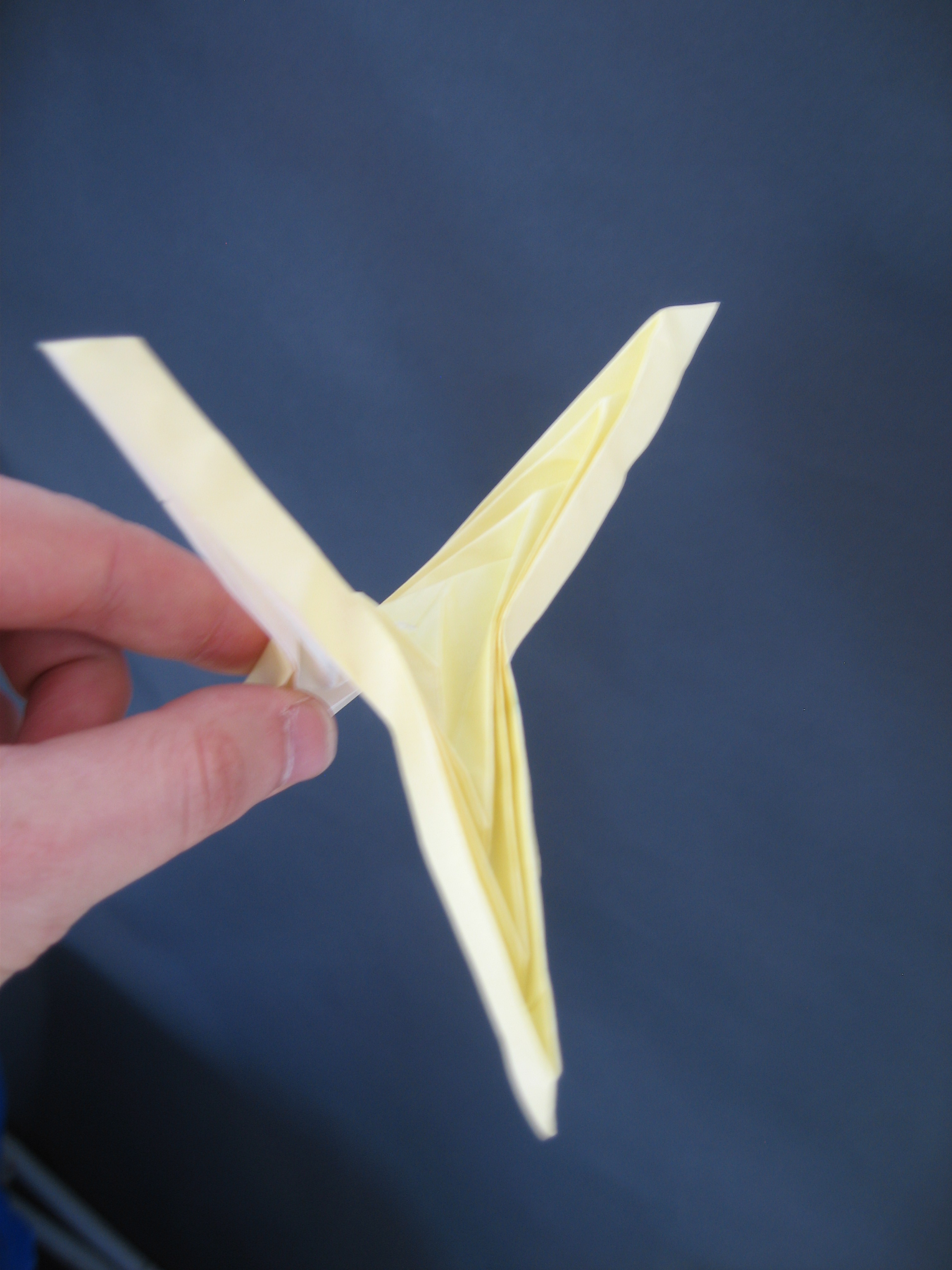
My origami-approximation to the hyperbolic paraboloid.


I stopped by the MAA’s booth long enough to make this origami hyperbolic paraboloid. You can learn to make your own here.


Me and Glen Whitney


Right next to the MAA’s booth was the Math Museum‘s booth. I stopped by to say hi to Glen, our speaker from the previous day. And while I was there I made a tetraflexagon (directions on their website). And I made my own Math Museum logo. Cool! Also, they have this circular laser array that allows you to see slices of solid figures. Check out my slices:


A triangular slice of the dodecahedron.


A pentagonal slice of the dodecahedron.


A slice of Mr. Chase :-).


I played around with the dodecahedron. With it you can get slices that are regular triangles & hexagons (by moving through a vertex), regular pentagons & decagons (by moving through a face), or squares & octagons (by moving through an edge). Remind anyone of Flatland? It made me curious to try some other platonic solids. My intuition is that the dual of each platonic solid would yield the same regular cross sections. But I have no idea. Anyone else know?

Here are some other things I saw:


Giant Newton's Cradle


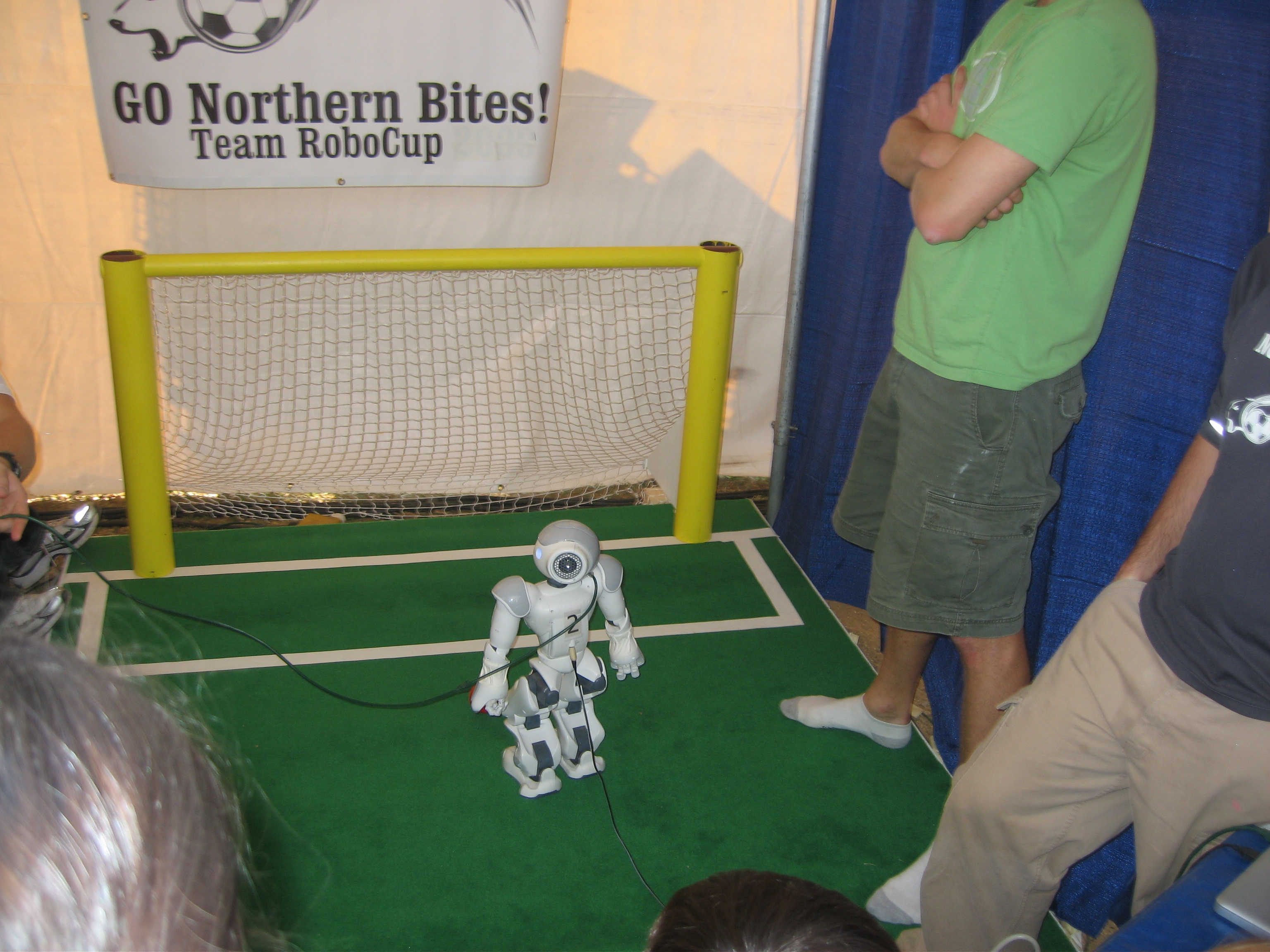
Autonomous robot soccer player.


I also saw this giant person-operated spider robot. Very cool :-).


Mr. Chase is approximately 2 billion nanometers tall.


The last thing I did yesterday was the Nano Brothers Juggling Show. Very cool. I’ve actually seen them perform before. Those of you who know me, know I’m an avid juggler. The juggling was fun, but even more fun was the way they incorporated science into the show.