Sorry, I thought I got it all out of my system in my first post about trapezoids last week :-). Allow me to rant a bit more about trapezoids. First let me remind you of the problem. Many Geometry books, our school district’s book included, state the definition of a trapezoid this way:
“A quadrilateral with one and only one pair of parallel sides.”
In case you didn’t catch the point of my first post: I think this is a poor definition and should be abolished from all Geometry curriculum everywhere. Here are some pictures I recently came across on the internet depicting the hierarchy of quadrilaterals. These picture agree with the above definition. Let me just say once more, I completely and totally disagree with these pictures, and I think you should too. That is to say, all of the following pictures are WRONG.
BAD:


And I could go on and on. Now here are two good ones.
GOOD:
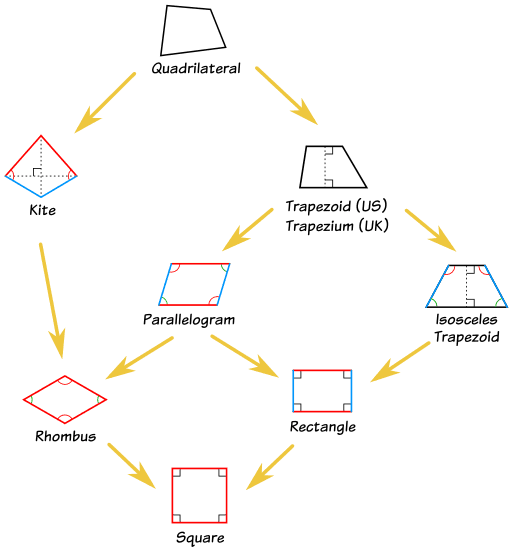

To be fair, the first set of pictures are only partially wrong. They have good intentions. Typically, the first breakdown of quadrilaterals in those pictures is by “number of parallel sides.” The first lines that come off of the word ‘quadrilateral’ divide quadrilaterals into three categories usually:
- No parallel sides (i.e. the kite)
- Exactly one set of parallel sides (i.e. the trapezoid)
- Two sets of parallel sides (i.e. the parallelogram)
So the pictures aren’t wrong, per say. They just depict different information. The problem comes when teachers ask, “Look at this diagram and tell me: Is every rectangle a trapezoid? Is every rhombus a kite?” The answer to both questions is ‘yes.’ But students instinctively answer ‘no’ when using the first set pictures, and you can see why.
The problem is a historic one. If you go back to Euclid’s Elements, Definition 22 in Book 1, you can see the origin of this problem right away (a translation from the Greek):
Of quadrilateral figures, a square is that which is both equilateral and right-angled; an oblong that which is right-angled but not equilateral; a rhombus that which is equilateral but not right-angled; and a rhomboid that which has its opposite sides and angles equal to one another but is neither equilateral nor right-angled. And let quadrilaterals other than these be called trapezia.
In the above definition from Euclid, here are the (not perfect) translations of each figure:
- Euclid’s square –> Our square
- Euclid’s oblong –> Our rectangle
- Euclid’s rhombus –> Our rhombus
- Euclid’s rhomboid –> Our parallelogram
- Euclid’s trapezia –> Our…trapezia/trapezium?
The last definition is a bit confusing, since we don’t have a very well-agreed upon name for this figure. But notice that ALL of Euclid’s definitions are exclusive. A square is never an oblong. A square is never a rhombus. Each of the above quadrilaterals, according to Euclid, is mutually exclusive. These exclusive definitions persisted into the 19th century.
But sorry Euclid, no one likes your definitions anymore. I hate to say it, because everyone loves Euclid.
In his defense, he wasn’t using these names for the same purpose we do. Nothing about his language is very technical and he doesn’t say ANYTHING else substantial about these definitions. He doesn’t use them to make categorical statements about quadrilaterals or to give properties that might be inherited. The names he uses are of little consequence to the rest of his work.
Can we lay this issue to rest yet? A parallelogram is always a trapezoid. Say it with me,
A parallelogram is a trapezoid.
A parallelogram is a trapezoid.
A parallelogram is a trapezoid.
Anything you can say about a trapezoid will be true about a parallelogram (area formulas, cyclic properties, properties about the diagonals). A parallelogram is a trapezoid.
For more posts on this topic, visit here and here.








 Random Walks