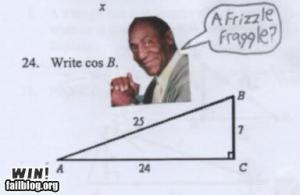
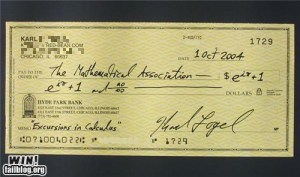
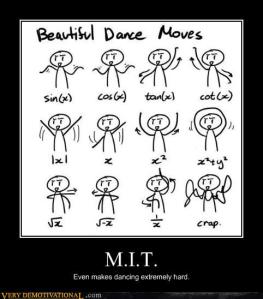
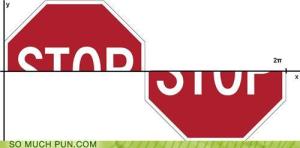
Running out of letters?

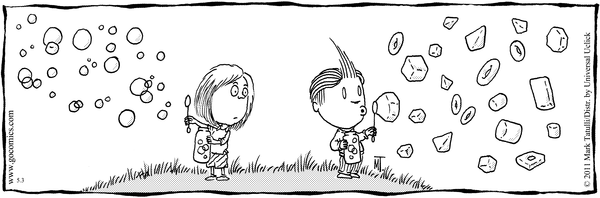
Actually, I have this feeling all the time when I’m doing my grad work. If you’ve dabbled in higher-level math at all, you probably have had this feeling too. That’s why we like Greek letters, capital letters, italic letters, script letters, and even a few Hebrew and Danish letters (can you think of which Danish character I’m thinking of?). I know all my Greek letters, not because I know any Greek, but because I’ve been exposed to every single one of them through mathematics. Do you think you could name them all too? If you think you’ve got what it takes, go ahead and try this sporcle quiz :-).


On a more serious note, I do always take the time to introduce new Greek letters, just like any other new notation students haven’t seen before. We practice drawing the symbol, I discuss the difference between the lowercase and capital version of that letter, and we appropriately name the symbol. I go to great lengths to do this because I’ve been in a lot of grad classes where the teacher assumed you knew what his/her squiggles meant on the board. I think it’s the nice thing to do to stop and explain your notation.

[Hat tip: Gene Chase]

Fibonacci joke

“I feel like this year’s Fibonacci conference will be as big as the last two combined!”

[Hat tip: Tim Chase]

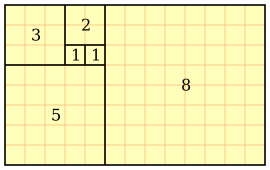
In related Fibonnaci news, here are three recent blog posts having to do with Fibonacci:


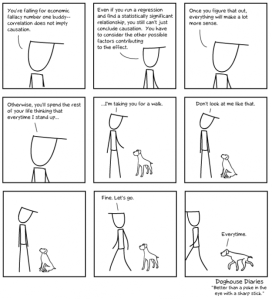
Proving the “obvious”

from graphjam.com

As Eric Temple Bell said, “‘Obvious’ is the most dangerous word in mathematics.” That being the case, it is often true that we have trouble proving statements that seem self-evident. Many times we are indeed tempted to say “clearly” or “obviously” or “it is trivial” or “the details have been left to the reader” or “this easily follows from Theorems 4.8, 5.1, and Definition 5.8”. For a full list of invalid proof techniques, visit this hilarious site. Here are a few samples (it’s a LONG list!), quoted from  full list on their site:

  • Proof by intimidation (“Trivial.”)
  • Proof by example (The author gives only the case n = 2 and suggests that it contains most of the ideas of the general proof.)
  • Proof by vigorous hand waving (Works well in a classroom or seminar setting. )
  • Proof by exhaustion (An issue or two of a journal devoted to your proof is useful. )
  • Proof by importance (A large body of useful consequences all follow from the proposition in question.)
  • Proof by accelerated course (We don’t have time to prove this… )

Choosing the level of rigor for a proof is often difficult–depending on the mathematical context, and the audience. I’m taking a graduate class in Analysis right now, so I definitely think about this a lot! In fact, I might add one more to the list:

  • Proof by beautiful typesetting (Because the proof looks good and is typed in \LaTeX, it must be right.)

At least,  I hope my professor feels that’s a valid technique :-).