As promised, here are a few photos from Glen Whitney’s visit to our school:
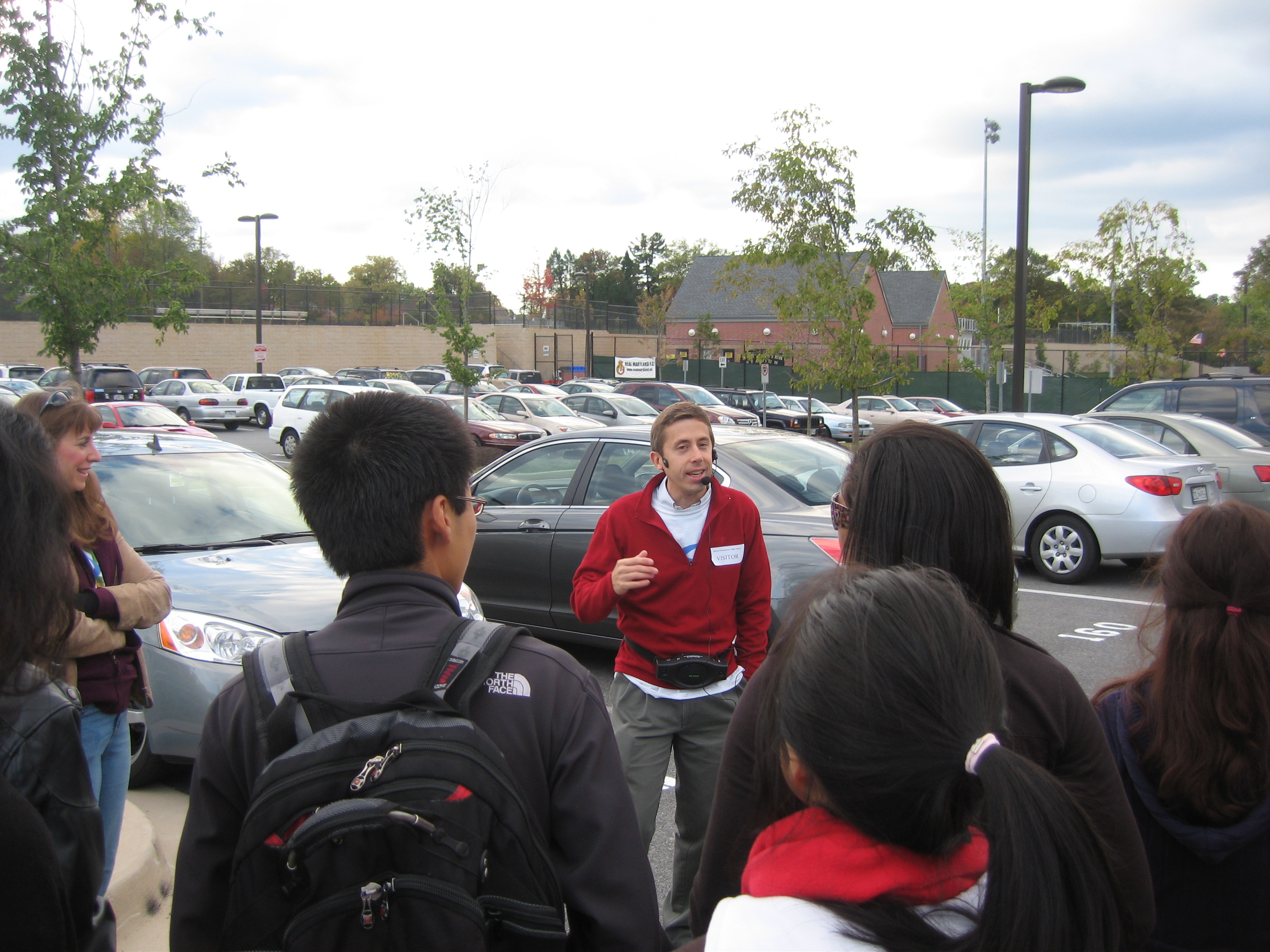
Glen asks us, "where do you see Calculus?"

How does constant acceleration affect a bouncing ball?

Deriving the equation for a hanging wire.

As promised, here are a few photos from Glen Whitney’s visit to our school:
Glen asks us, "where do you see Calculus?"
How does constant acceleration affect a bouncing ball?
Deriving the equation for a hanging wire.
Today we had a real treat. We hosted speaker Glen Whitney at our school. Glen Whitney is the executive director of the Math Museum which will open in the Spring of 2012 in Manhattan, if all goes well. Twenty-three of our students joined Glen for a tour around the neighborhood, looking for math (Calculus, specifically) in the world around us. Thank you, Glen! And thank you to the USA Science & Engineering Festival and its sponsors for making it all possible.
We made four stops on our trip today:

When we came back some of us had lunch with Glen and spoke with him some more. For those that missed him, go visit him on the mall this weekend in DC. Everyone needs to go to the USA Science & Engineering Festival. I’ll be there, so you can come hang out with me :-).
Eventually I’ll post a few photos from our little field trip. So stay tuned.
Many thanks Glen, for all the good times!
As I advertised over a month ago, Glen Whitney will be joining us on Friday, October 22 for a walking math tour of Rockville. I’m excited to hear what he has to say (and to steal all his good ideas!). If you’re a Calculus student, or if you’ve taken it, and you’re not yet signed up for the field trip, stop by my room and we’ll talk. There are currently four slots left.
Reposting some of the info:
Richard Montgomery High School will be hosting mathematician Glen Whitney on Friday, October 22. He will be doing a walking ‘math tour’ of downtown Rockville.

Glen is the executive director of the Mathematics Museum on Long Island NY. For more information about Glen, or about the math museum, here’s an article about him. Or, visit the math museum’s website.
And here’s the article that’s on the RM website.
The first week of school I gave this problem and never came back to it:
Find the range of 

The answer is 
First consider the range of the quadratic in the exponent, 


Now, consider the function 


Do you feel “at home on the range”?
Here are a few more for you to try. In each case, find the range of the function. These aren’t meant to be any harder than the original problem, just different. Though watch out for the third one :-).
A few weeks ago I posted this “powerful” problem:
Solve
Now, allow me to give you a major hint. Consider the simpler equation
What are the possible values of 

 and is anything
 and is any nonzero number
And here’s the tricky one that most people forget:
 and is even
You now have enough information to solve the original equation. I think you’ll be delighted with the solution!
Since this is a math blog, I felt obliged to capitalize on today’s date. I’m sure everyone has noticed, like they do every year when 9/9/9 comes up or whatever else. But today is a bit more special, since 10 is our favorite base to work in. To celebrate powers of 10, head over to the Let’s Play Math blog to see lots of links and a video that will put you in the mood :-). Happy day!
Excerpt from wired.com’s gadget lab:

If you’ve ever looked at the curve of a hill, the cables of a suspension bridge or the arc of a coastline and wondered, “I wonder what function would fit that line?” — congratulations, you’re a nerd. And Casio has a surprising new calculator that will answer your question.
Casio’s new Prizm calculator is to the graphing calculators of my school-days as the iPad is to the slates we scratched on with sticks of chalk. It has a color, 216×384 pixel display, 16MB of memory, a USB-port, and will do all of your math homework for you….
Any graphing calculator will let you input an equation and show you the result. Casio’s Prizm does this in reverse. The color screen will display a picture, and will draw a line over the top of any shape you like. It will then give you an equation for this line.
If that wasn’t amazing enough, that USB port lets you hook the calc up to a compatible Casio projector to show off the results on the big screen….
$130, available now.
That’s pretty amazing. I’m not sure it’s the most important feature of this new calculator, but it does highlight the fact that our TI-83’s haven’t changed significantly in 14 years. It’s surprising, given the advances in every other area of technology. Why isn’t your TI-83 calculator three or four times smaller and 20 times more powerful than the TI-83 of 14 years ago?
I’m kind of kidding (but only kind of!). Can you believe they made this commercial? Unbelievable.
Apparently it’s been pulled off the air, so I think Pizza Hut is somewhat penitent for what they did. Good thing.
I made the claim in a post last week that the set of irrationals of the form 
Theorem. The set of irrationals of the form 
Proof. Consider the set of irrationals of the form 
And also require that 

Now, consider the function
defined
This function is one-to-one since we require 

We know that 
I think I did that right. Any suggestions, math readers?
I asked recently if your (math) teacher could be replaced by video. I was kind of serious. Now, I ask, could your teacher be replaced by the internet?
This TED talk is fascinating. For my students reading this, would you like to learn this way? In some ways, you probably already do. What would you think if I just let you loose and said, “Here are the objectives of the course. Go learn them.”? In what ways would that be better or worse than what I’m doing now?








 Random Walks