America’s never been first

The following is an insightful article, “Debunking Education Myths: America’s Never Been Number One in Math” by Liz Dwyer. It gives a bit of quantitative ammo to support the feeling I’ve always had: America has never had any “good ol’ days” when it was #1 in math. Here’s a taste of her article:

Has America really fallen behind the rest of the world in academic achievement? According to a new report from the nonprofit Brookings Institution, all the doom-and-gloom commentary suggesting that we’ve fallen from the top spot simply isn’t true. And, even more surprising, America’s results are actually on the rise.

National panic ensued last December when data from the Program for International Student Assessment tests revealed our less than stellar international math results. Even worse, high schoolers from our competitor du jour, China, scored the top spot. But the report’s author, Tom Loveless, writes that, “The United States never led the world. It was never number one and has never been close to number one on international math tests. Or on science tests, for that matter.”

Back in 1964, American 13-year-olds took the First International Math Study and ended up ranking in 11th place. Considering that only 12 nations participated, including Australia, Finland, and Japan, our next-to-last performance was pretty abysmal. Other international tests American students have taken over the years have also never showed that we were in the top spot. It’s a myth that we’ve fallen from our glory days.

(more)

Hat tip to Alexander at CTK.


Helping students who are stuck

How do you help a student who is stuck on a problem? A student who can’t seem to find the mistakes s/he makes? I really like this recent idea from Maria Droujkova, shared by Denise of Lets Play Math. Original source here.

When a kid is feel bad about being stuck with a problem, or just very anxious, I sometimes ask to make as many mistakes as he can, and as outrageous as he can. Laughter happens (which is valuable by itself, and not only for the mood – deep breathing brings oxygen to the brain). Then the kid starts making mistakes. In the process, features of the problem become much clearer, and in many cases a way to a solution presents itself.

Maria Droujkova

When will I get my school-issued iPhone?

I’d love to streamline the attendance/homework checking/gradebook procedures. It always seems pointless to me to have to write down homework grades and attendance, then reenter it on the computer. Some of today’s teachers are already using smart-phone applications for such tasks.


One slick app from gradepad.com

From an article on NEA.org by Tim Walker,

It was only a few years ago that cell phones were being banished from classrooms. As far as school districts were concerned, these devices’ reputation as tools for student distraction, mischief, and even harassment easily outweighed any possible benefits in the learning process.

Banning them was—and, in many districts, still is—the easy call to make, but as cell phones have become more sophisticated, powerful, and even more entrenched in students’ daily lives, a growing number of schools have decided to open the door to what are, essentially, mobile computers.

“Educators can’t afford to be behind the 8-ball anymore,” says Mike Pennington, who teaches world history at Chardon Middle School in Chardon, Ohio, and blogs about classroom technology at Teachers for Tomorrow, a website he co-founded with colleague Garth Holman. “Schools need to embrace mobile technology and mobile learning. Students live in this world. These devices belong in the classroom.”

According to some estimates, smart phones, and to a lesser extent tablets like the iPad, will be in the hands of every student in the United States within five years. And as more schools embrace mobile learning, the number of education apps—mobile applications that run on your smart phone—are skyrocketing.

(more)

The article goes on to mention a handful of apps that have classroom potential, including the one above, GradePad. I also liked the looks of Attendance. And one of the commenters mentions that similar apps are available for Android users as well (here). This is all very cool, in my opinion.

In fact, I have a dream…

I can imagine a time in the not-to-distant future when I walk around the room at the beginning of the period checking homework and taking attendance from a mobile device. I’d be able to see the seating chart, do random name calling, see student photos, and control my computer. If students were issued similar devices, I could have them post their work on the board, using their mobile device as a slate to operate the front board. And students would use their devices as calculators and text books as well, perhaps. All my grades, attendance data, student data, and seating charts would be synced with the network and with our online grade reporting system.

We have Promethean (“smart”) boards in the front of our classrooms, and that’s been nice. But I think having mobile devices in the classroom would be far more advantageous, revolutionizing the way we teach more than smart boards ever did.

Most of what I’ve said is already technically possible–the hardware already exists. One hurdle will be cost, of course. But the cost could be significantly offset if there was no need to purchase hard-cover textbooks (very expensive) or smart boards (also very expensive). Another hurdle will be getting networks, software, and network administrators to cooperate. For instance, our district uses multiple vendors and some of our key data systems aren’t linked, like they should be. Allowing mobile devices to connect to the school network and the internet, providing district-approved  & purchased software, and syncing the whole system with existing data systems would be a sizable task.

Three cheers for the future! 🙂

Physics of Angry Birds

A nice projectile motion application, suitable for almost any level of high school math.

Here’s an excerpt of the Wired.com article by Rhett Allain:

You know the game, I know you know. Angry Birds. I have an attraction to games like this. You can play for just a little bit at a time (like that) and each time you shoot, you could get a slightly different result. Oh, you don’t know Angry Birds? Well, the basic idea is that you launch these birds (which are apparently angry) with a sling shot. The goal is to knock over some pigs. Seriously, that is the game.

But what about the physics? Do the birds have a constant vertical acceleration? Do they have constant horizontal velocity? Let’s find out, shall we? Oh, why would I do this? Why can’t I just play the dumb game and move on. That is not how I roll. I will analyze this, and you can’t stop me.


[Hat tip: Tony Sanders]


Why I hate the definition of trapezoids

I should have made this post a long time ago, because it’s a bone of contention I’ve always had with trapezoids. Or…not with trapezoids–I like trapezoids–but a bone of contention I have with the definition of trapezoids. In my humble opinion, it’s a major problem with Geometry as it’s currently taught. Here’s the usual definition of a trapezoid (taken from our school’s Geometry text book, by Holt Rinehart and Winston):

“A quadrilateral with one and only one pair of parallel sides.”

I’ve emphasized the words “one and only one,” which is what I want to comment about in this post. (Here’s another source and another source and another source that say it that way, too.) Sometimes it’s also said, “a quadrilateral with exactly one pair of parallel sides.”

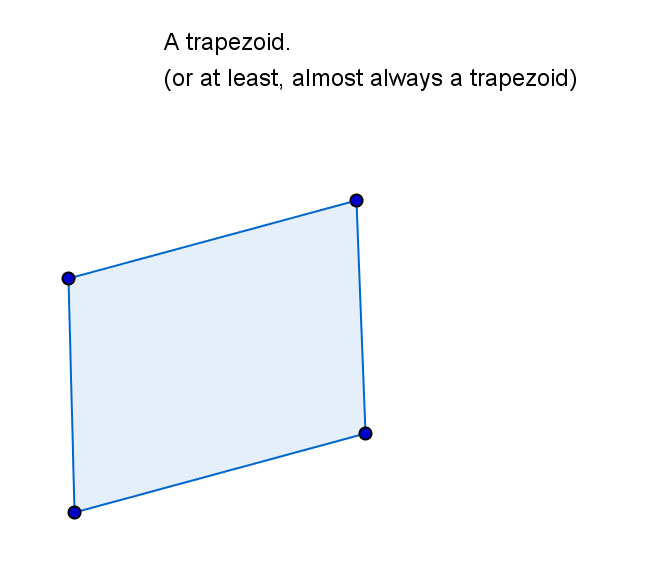
I’ve prepared a simple GeoGebra applet and posted it here. It allows you to play with the trapezoid, moving its vertices and edges. As you drag it around, at all times, one pair of sides will be parallel. But wait, it’s not always a trapezoid, is it? According to the Geometry book, there’s one moment, as you’re dragging it around, that it stops being a trapezoid and for that one second is exclusively a parallelogram. Here’s the moment I’m talking about:

Is this still a trapezoid?

That’s right, using the Geometry textbook’s definition of a trapezoid, if both pairs of opposite sides of the quadrilateral happen to be parallel,  it’s not a trapezoid anymore. At this point, the mathematical reader should be crying, “Foul! How did we ever let this happen? This definition of a trapezoid is so inelegant!!” And I couldn’t agree more.

We don’t do this with the definition of any other quadrilateral. Why do it with a trapezoid? If I were to make another little applet that lets you drag around a rectangle, would we say “it’s not a rectangle” at the moment you make the four sides equal? No! That would be absurd.

The definition of a trapezoid, in my opinion (and thankfully in the opinion of some others) should read:

“A quadrilateral with at least one pair of parallel sides.”

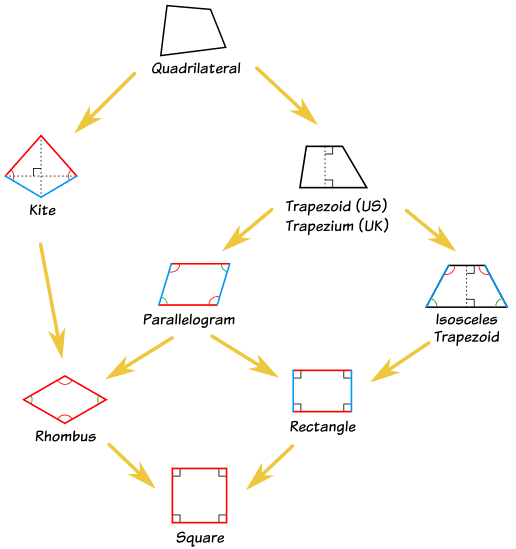
And the hierarchical diagram should look like this one, I found online (taken from a mathematically enlightened author):

from mathisfun.com

Here’s a nice paragraph from the wikipedia entry on trapezoid:

There is also some disagreement on the allowed number of parallel sides in a trapezoid. At issue is whether parallelograms, which have two pairs of parallel sides, should be counted as trapezoids. Some authors[2] define a trapezoid as a quadrilateral having exactly one pair of parallel sides, thereby excluding parallelograms. Other authors[3] define a trapezoid as a quadrilateral with at least one pair of parallel sides, making the parallelogram a special type of trapezoid (along with the rhombus, the rectangle and the square). The latter definition is consistent with its uses in higher mathematics such as calculus. The former definition would make such concepts as the trapezoidal approximation to a definite integral be ill-defined.

This site and this site also get it right. So there’s hope for the Geometry community and for teachers everywhere. But please, let’s work hard to eradicate the “exclusive” definition from ALL the textbooks. It’s hideous.

For more posts on this topic, visit here and here.

PEMDAS Problems

Inspired by this post at Education Week, by David Ginsburg, and a fruitful discussion in the comments, I thought I’d make my own post about the order of operations. I feel the need to do this because of my own experiences teaching Algebra 1 and correcting the habits of Algebra 2, Precalculus, and Calculus students. The problem is often with their misunderstanding of the ubiquitous “PEMDAS” approach to order of operations (parentheses, exponentiation, multiplication, division, addition, subtraction).

The classic example given by those who have discussed this before is an expression like the following. This example shows the problem with instructing students to simply “add then subtract”:

8-4+1

You can easily see that blindly following PEMDAS would give you an answer of 3, not 5. In reality, addition and subtraction can be done in any order, provided that you think of the expression this way:

8+(-4)+1

I have to constantly reinforce in my students the notion that the “-” goes with the 4. It owns it. That’s the right way to think of it, since subtraction (and division) are just shorthand for addition by the additive inverse (and multiplication by the multiplicative inverse). That’s right kids, subtraction is an illusion. The typical Real Analysis approach is to use the field axioms to define the properties of addition. Here they are:

  1. If x and y are in the field, so is x+y (closure).
  2. x+y=y+x (commutativity)
  3. (x+y)+z=x+(y+z)=x+y+z (associativity)
  4. There exists an element 0 such that 0+x=x for all x (identity)
  5. For each x there is an element called -x such that x+(-x)=0 (inverse)

There are almost identical ones for multiplication, and then one more axiom for distribution. Just listing the field axioms for addition  helps us in the discussion of order of operations. As I said above, subtraction is never really mentioned. We only later define x-y to mean x+(-y).

Similarly, division is an illusion. Or more precisely, it is defined in terms of multiplication. We define x/y to mean x\cdot(1/y).

The other important thing to notice is that addition and multiplication are binary operations, meant to be functions of two variables. So the expression x+y+z is defined to mean (x+y)+z=x+(y+z).

But the problems with PEMDAS don’t stop with multiplication and addition. There are many other issues with the order of operations as well. We lie to students when we just tell them they’ll encounter those limited operations in tidy situations. Here’s a perfectly legitimate expression with which PEMDAS would flounder:

-2^{3^2}+\left|\frac{2\sin{0}+3!}{2-\sqrt{9}}\right|\pmod{3}

The reason the expression is so difficult for PEMDAS is because PEMDAS doesn’t acknowledge the existence of other functions or grouping symbols, and ignores the possibility of nested exponentiation.

As another somewhat related example, I often have Calculus students who evaluate the following expression incorrectly (because they misuse their calculator):

e^{(0.05)(10)}

And some high school students at every level still struggle with evaluating these expressions:

  • -2^2
  • Given f(x)=-x^2+x, evaluate f(-2).

The wikipedia article on Order of Operations is very clear on all this, but I wanted to just highlight some of the common misconceptions. For more, feel free to check out that article. I’m in no way recommending that PEMDAS be removed from math curriculum, but that it be used with great care. And by the way, the expression above evaluates to 1.

 

Predicting Partitions

This recent news from the American Institute of Mathematics:

January 20, 2011.   Researchers from Emory, the University of Wisconsin at Madison, Yale, and Germany’s Technical University of Darmstadt discovered that partition numbers behave like fractals, possessing an infinitely-repeating structure.

In a collaborative effort sponsored by the American Institute of Mathematics and the National Science Foundation, a team of mathematicians led by Ken Ono developed new techniques to explore the nature of the partition numbers. “We prove that partition numbers are ‘fractal’ for every prime. Our ‘zooming’ procedure resolves several open conjectures,” says Ono.

Accompanying this result was another achievement developing an explicit finite formula for the partition function. Previous expressions involved an infinite sum, where each term could only be expressed as an infinite non-repeating decimal number.

Counting the number of ways that a number can be ‘partitioned’ has captured the imagination of mathematicians for centuries. Euler, in the 1700s, was the first to make tangible progress in understanding the partition function by writing down the generating series for the function. These new results involve techniques which could have applications to other problems in number theory.

[original article]

Wired.com also just reported on it, and you can find their coverage here.

MathOverflow

I’m sure most of the mathematical community already knows all about  mathoverflow.net, but just in case, thought I’d post a link here. It was news to me…perhaps just because I’m not really in the collegiate academic math community. (Though the wikipedia article says it was created in 2009, so it’s still in its infancy.) But it’s definitely a resource I’ll be using as I do my own mathematical investigations and my grad coursework. I’ve enjoyed the original stackoverflow.com for looking up answers to questions, and in two instances so far, asking my own. StackOverflow and sites like them fill a vital role in the online community–quick, thorough answers to pointed questions.