Reposting this amazing video, without too much comment. It’s visually beautiful and makes me want to try some 3d string constructions myself.

Reposting this amazing video, without too much comment. It’s visually beautiful and makes me want to try some 3d string constructions myself.
What a fascinating question: can you create a sequence without any repetition? Randomness won’t do, since clumping will occur. It turns out that finding non-repeating sequences has important applications to sonar. If there’s any repetition in the sequence of sounds transmitted, when the signal returns, parts of the signal can be confused because there’s internal similarity. Watch the talk for the whole story, and enjoy the ‘ugliest piece of music’ at the end! 🙂
To complete my collection of geeky kids books, I think I’ll need these as well. My wife and I have a baby, due on February 7th. We must be prepared!


This article by Samuel Arbesman came through today on Wired.com
Are There Fundamental Laws of Cooking?
Cooking is a field that has in recent years seen a shift from the artistic to the scientific. While there are certainly still subjective and somewhat impenetrable qualities to one’s cuisine — de gustibus non est disputandum — there is an increasing rigor in the kitchen. From molecular gastronomy to Modernist Cuisine, there is a rapid growth in the science of cooking.
And mathematics is also becoming part of this. For example, Michael Ruhlman has explored how certain ingredient ratios can allow one to be more creative while cooking. Therefore, it should come as no surprise that we can go further, and even use a bit of network science, when it comes to thinking about food.
Yong-Yeol Ahn and his colleagues, in a recent paper titled Flavor network and the principles of food pairing, explored the components of cooking ingredients in different regional cuisines. In doing so, they were able to rigorously examine a recent claim: the food pairing hypothesis. The food pairing hypothesis is the idea that foods that go best together contain similar molecular components. While this sounds elegant, Ahn and his collaborators set out to determine whether or not this is true.
Using recipes from such websites as Epicurious, the researchers examined more than 50,000 recipes. They combined these recipe data with information about the chemical components in each of the ingredients, in order to create a network map of related ingredients. For example, shrimp and parmesan are connected in the network, because they contain the same flavor compounds, such as 1-penten-3-ol. A large flavor network of different ingredients is [above].
He later gives a reference to George Hart’s “Incompatible Food Triad” problem and the associated website:
An example solution would be three pizza toppings — A, B, and C — such that a pizza with A and B is good, and a pizza with A and C is good, and a pizza with B and C is good, but a pizza with A, B, and C is bad. Or you might find three different spices or other ingredients which do not go together in some recipe yet any pair of them is fine.
Has any of this ever crossed your mind? Me neither.

From Incidental Comics, by Grant Snider
I love this comic by Grant Snider–I just came across it today on Pinterest (have you gotten yourself hooked yet?). We’ve been working on some math murals for our hallway, and this is giving me some good ideas. My favorite is definitely the inverse cosine coaster. Thanks for the great comic, Grant!
This article was just posted to wired.com today and is an interesting summary of some research from 2002–but it is new to me. Here’s an excerpt from Samuel Arbesman’s article:
Most objects are made up of smaller parts, combined in complicated and diverse ways… In the wonderfully titled paper Scaling of Differentiation in Networks: Nervous Systems, Organisms, Ant Colonies, Ecosystems, Businesses, Universities, Cities, Electronic Circuits, and Legos,Mark Changizi and his colleagues set out to understand this concept. They found that in every single one of the systems in the wildly interdisciplinary list of the subtitle there was an increase in the number of types of components as the total number of pieces grew. The larger something is, the more types of building blocks it uses.
And this includes, of course, Lego bricks. Using a dataset of 389 Lego sets (this was done back in 2002, so if anyone can download the data easily, I would love to see if the results hold up with a richer dataset), they examined the number of distinct types of pieces in a set versus the total number of pieces in that set (examples of sets include “Air Patrol”, “Spy Boat”, and “Cargo Crane”, and a master list of Lego piece types is here).
They found that the number of piece types to total number of pieces could be fit nicely to a power law. Here it is on a log-log scale:
This curve demonstrates that as the number of pieces in a set grows, so do the number of piece types. However, the number of piece types grows sublinearly: while a larger set uses more piece types, as sets becomes larger, they use progressively fewer additional piece types (so larger sets actually use fewer types per piece). This is similar to other sublinear curves, where larger animals use less energy per cell for metabolism or larger cities actually need fewer gas stations per capita. Essentially, larger sets become more efficient, using the same pieces that smaller sets do, but in a more complex and diverse way.
Now, just for fun, here’s a video of a great LEGO contraption (HT: Tim Chase).
Also, just for fun, here’s a photo of a 4-foot Lego 737 that my friend Matthew and I built. We’ve actually finished most of it, I just don’t have a recent picture. (Notice in this photo the roof, tail, and wings are missing.) But this gives you a taste:

I’ve been motivated by George Hart and Zachary Abel to make my own mathematical sculpture with found objects :-). A few former students dropped by to visit me this afternoon and I put them to work making this (they had no where to be, right!?):
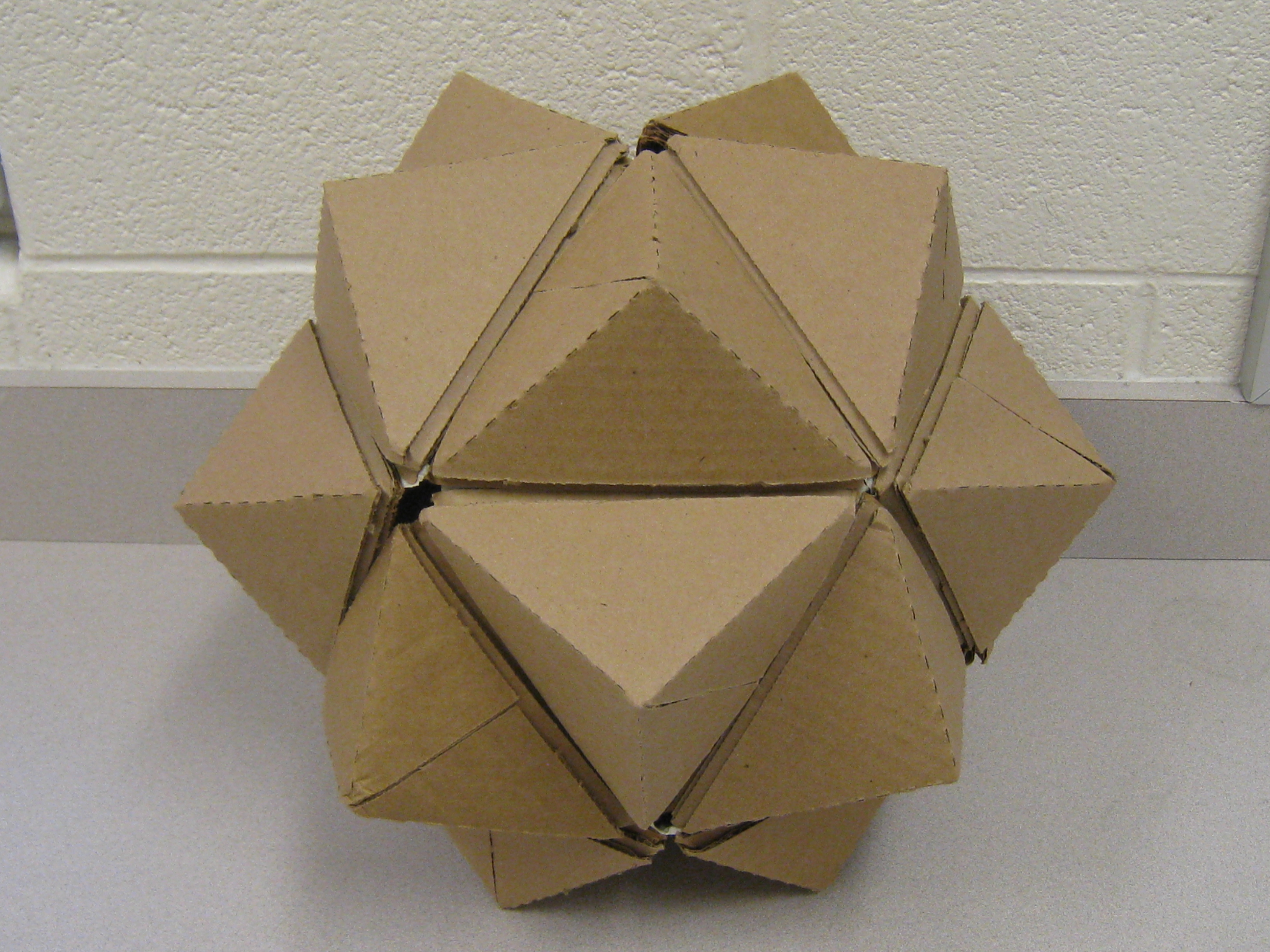
A cardboard stellated icosahedron
It’s a stellated icosahedron, made out of these little triangular pyramids. I did not make the pyramids, they came to me this way. Can you guess what their original purpose was?

Pop quiz: What do you think this is??
My wife and I redid our kitchen a few years ago, and I saved twenty of these from (did you guess it yet?) the packaging our cabinets came in. For each cabinet, there are 8 of these keeping the corners safe. The construction process was pretty straight forward, but here are some photos documenting the event.
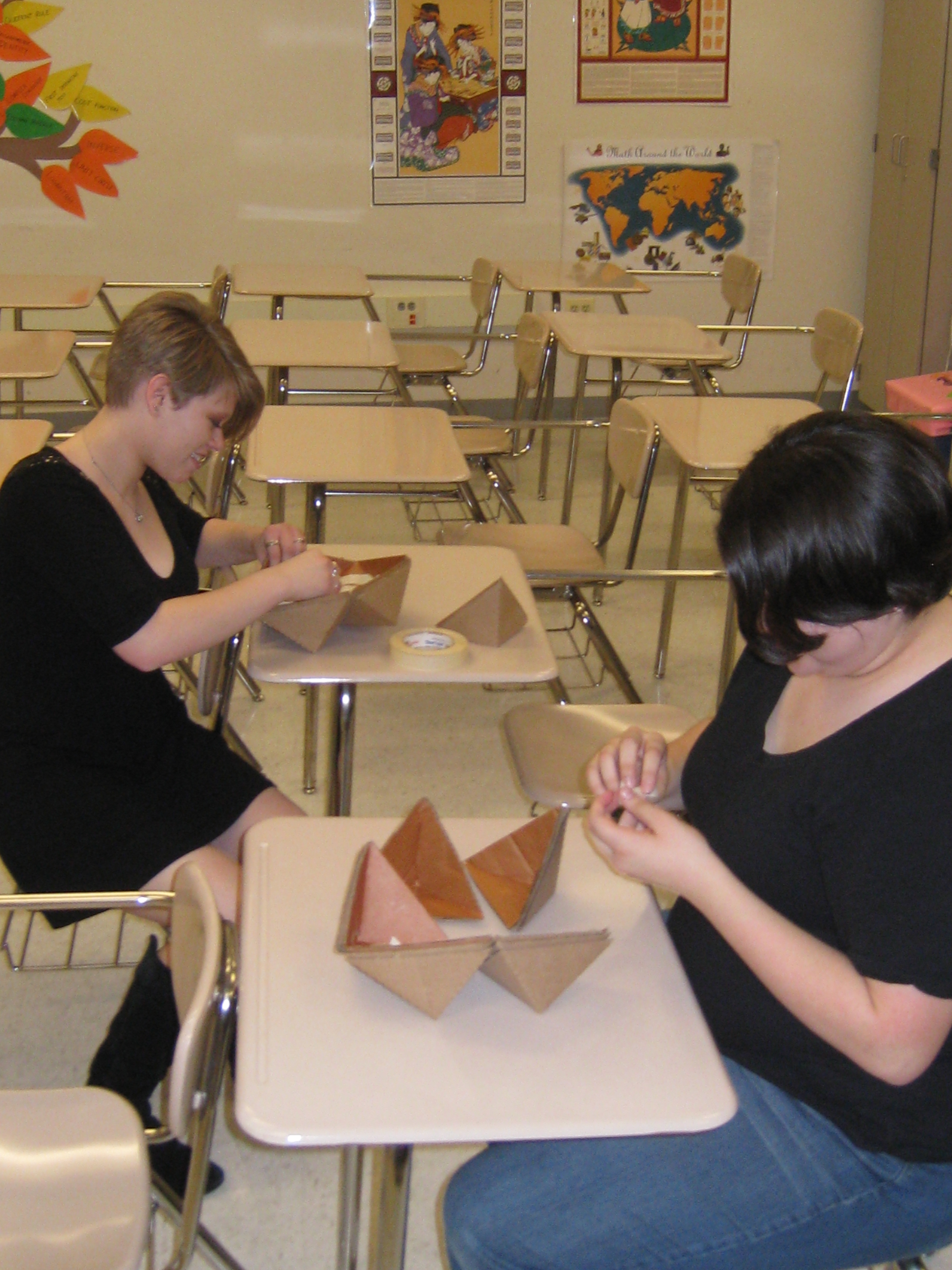
Construction begins

Every vertex looks like this on the inside.

Almost done!

The last piece goes on.
Here are some more views of the icosahedron. The icosahedron has a symmetry group of size 60.
There are 15 pairs of opposite edges, each with 2-fold symmetry (for a total of 15 orientations, not counting the identity)

There are 10 pairs of opposite faces, each with 3-fold symmetry (for a total of 20 orientations, not counting the identity)

There are 6 pairs of opposite vertices, each with 5-fold symmetry (for a total of 24 orientations, not counting the identity)
So (1 identity) + (15 edge symmetries) + (20 face symmetries) + (24 vertex symmetries) = 60 total orientations.
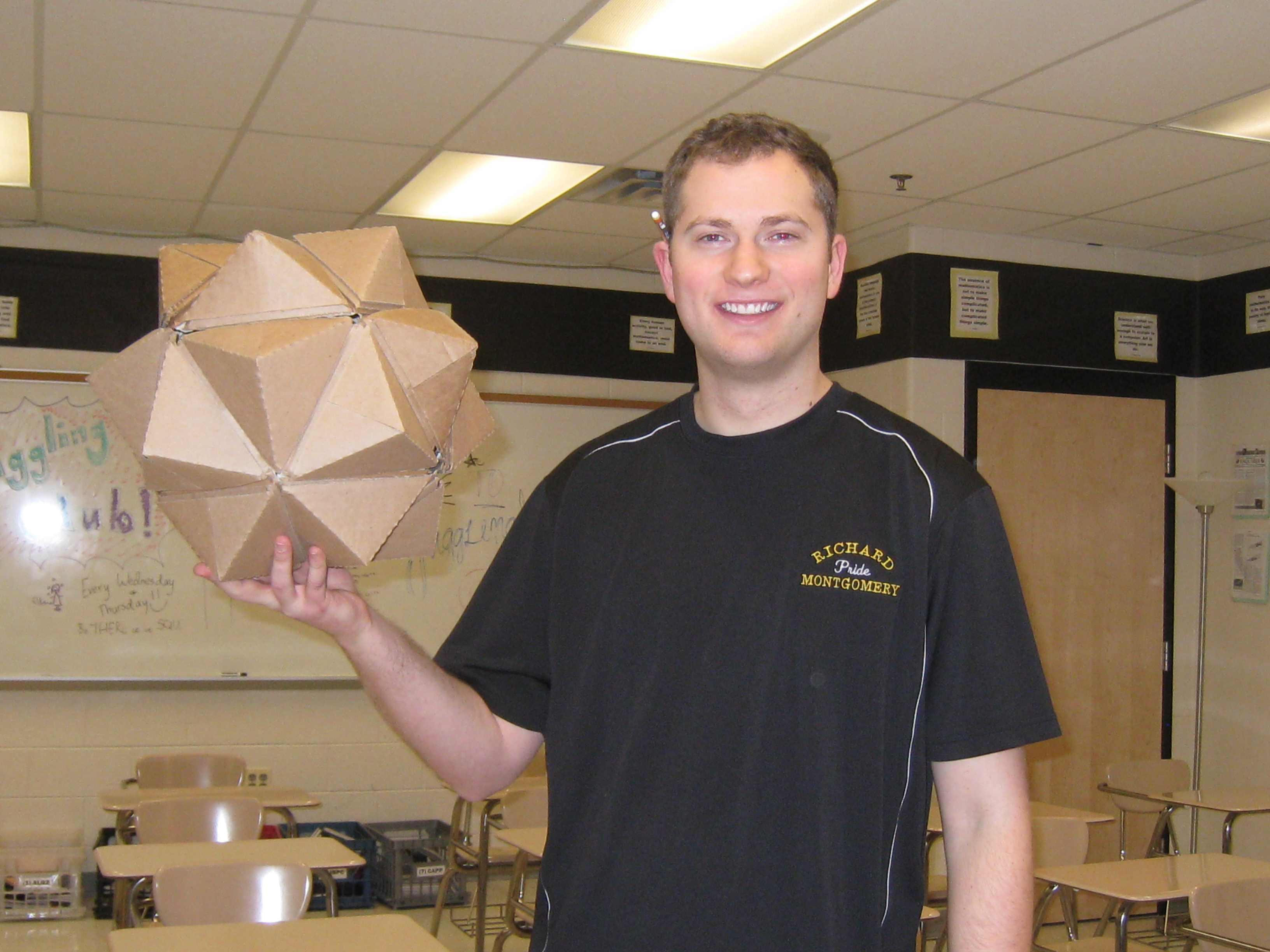
Now I just need to find a large enough Christmas tree upon which to put this giant star!
I was raised on this show, and it’s so fun that you can find clips of it on youtube, including these three gems. At the end of every episode of Square One there was a mathematical music video. I just showed my Precalculus class this first video, but I spared them the other two. If you’ve never seen Square One, these will give you a little bit of a feel for the show, or if you know and loved the show, these will help you take a walk down memory lane.
While daughter Vi Hart is off making crazy videos, including this one she posted today, father George Hart points us to these incredible scupltures with binder clips, by Zachary Abel. (George Hart is also a mathematical scupltor.) Check out this incredible binder clip sculpture by Zachary, a piece called “Impenetraball”:

He has three sculptures with binder clips, and I thought I’d try my hand at making his simplest one, called “Stressful.”

After doing that, I have a HUGE appreciation for his larger binder clip sculptures. This was not easy to make!


These are pretty.

 Random Walks