
 I may not have been very active on my blog recently (sorry for the three-month hiatus), but it’s not because I haven’t been actively doing math. And in fact, I’ve also found other outlets to share about math.
Have you used Quora yet?
Quora, at least in principle, is a grown-up version of yahoo answers. It’s like stackoverflow, but more philosophical and less technical. You’ll (usually) find thoughtful questions and thoughtful answers. Like most question-answer sites, you can ‘up-vote’ an answer, so the best answers generally appear at the top of the feed.
The best part about Quora is that it somehow attracts really high quality respondents, including: Ashton Kutcher, Jimmy Wales, Jermey Lin, and even Barack Obama. Many other mayors, famous athletes, CEOs, and the like, seem to darken the halls of Quora. For a list of famous folks on Quora, check out this Quora question (how meta!).
Also contributing quality answers is none other than me. It’s still a new space for me, but I’ve made my foray into Quora in a few small ways. Check out the following questions for which I’ve contributed answers, and give me some up-votes, or start a comment battle with me or something :-).
- Mathematics Education: Should statistics replace calculus as the most advanced math course in the high school curriculum?
- What does the value of a point on the normal distribution actually represent, if anything?
- Does calculus make you smarter?
- When should you write numbers down using numerals instead of letters and vice versa?
And here are a few posts where my comments appear:

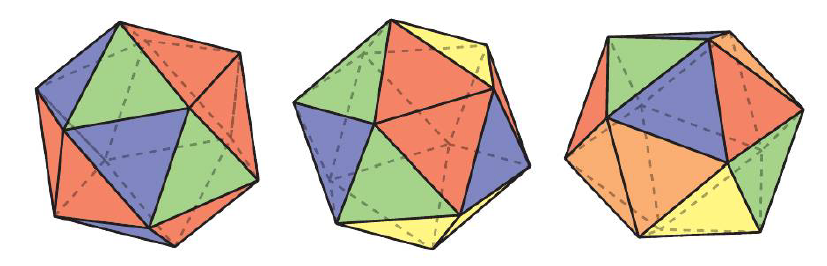
 , that’s a good start–there are
  choices of color for 20 faces, so you just multiply, right?–but that’s not correct. Here we’re talking about an unoriented icosahedron that is free to rotate in space. For example, do the three icosahedra above have the same coloring? It’s hard to tell, right?
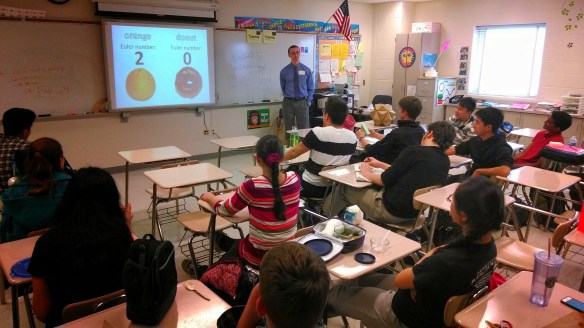 He had our students counting vertices, edges, and faces of various surfaces in order to compute the Euler Characteristic. Students discovered that the Euler Characteristic is a topological invariant.
 In his talk he also walked the students through a proof that there are only five regular surfaces, using the Euler Characteristic. This is more difficult than the typical proof, but elegant because the proof doesn’t appeal to geometry. That is, the proof doesn’t ever require the assumption that the faces, angles, or edges are congruent. In this sense, it is a topological proof.* Very cool indeed!
 Bio: Matthew Wright went to Messiah College and then went on to received his MS and PhD from University of Pennsylvania, where his thesis was in applied and computational topology. He was a professor at Huntington College for two years but is now at the
  Random Walks