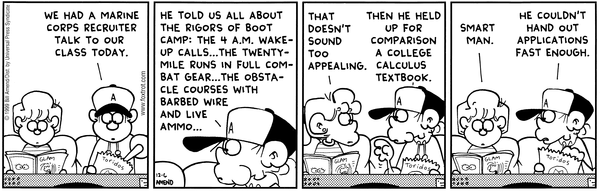
A Calculus textbook should seem like fun, right? I think so!
 [Hat tip: my dad]

A Calculus textbook should seem like fun, right? I think so!
 [Hat tip: my dad]
Another fabulous TED talk on education. I’m inspired.
Here’s a recently posted TED talk by Conrad Wolfram, of Wolfram Research and wolframalpha.com. I was hopeful about this talk, because I find great entertainment value in wolframalpha.com. I was a bit disappointed. I disagree pretty strongly with what he says, even though he makes a few good points. Math, in my opinion, is not at all about solving real world problems. It’s about formal systems that express relationships between “meaningless marks on paper” (Hilbert). And to quote Poincare, “The mathematician does not study pure mathematics because it is useful; he studies it because he delights in it and he delights in it because it is beautiful.” Indeed. Math is beautiful and fun. The way Mr. Wolfram presents math doesn’t sound like very much fun to me.
I think this is good news for our county schools in Montgomery County, Maryland:
Montgomery County schools to push basic math to prepare students for algebra
By Michael BirnbaumWashington Post Staff Writer
Friday, November 5, 2010; 12:00 AMMontgomery County long has pushed its students to take ever-more-challenging math at ever-younger ages. Now educators will back off in the hope that more time and depth with the basics will yield payoffs in high school and beyond, school officials said Thursday.
Elementary and middle school students will no longer skip grade levels in math in large numbers. Instead, they will spend extra time on fundamental mathematical concepts that will better prepare them for Algebra I in the eighth grade and advanced math topics in high school. The school system aims to increase the number of high school students taking courses such as calculus and statistics.
The new direction comes as part of a sweeping set of recommended changes in the math curriculum released Thursday. Some of the recommendations cost money and require school board approval. Others, including the change in math acceleration, do not, and will be implemented quickly, officials said.
“Some students were placed in classes, and perhaps they weren’t as prepared as they should have been,” said Frieda Lacey, deputy superintendent of Montgomery schools, who sat on the work group that wrote the report. She said it was better to tackle topics in greater depth.
And I wonder if this will be a growing trend. Are other math teachers out there sensing a turning of the tide in curriculum? I know the new Common Core standards make this move, toward a more in-depth approach. So perhaps this is a national turning of the tide. On the face, I think this seems like a good direction in which to go.
I just ordered this book. I’m excited to see what it’s like. And of course, I’ll be sure to let you know how it is!

Dr. Robert Ghrist, professor of mathematics at U Penn is writing a Calculus text–the Funny Little Calculus Text (FLCT for short). The FLCT not your typical Calculus text. Check out his incredible, artistic, funny, and mathematically elegant work-in-progress here. He currently has completed these short little chapters, all of which are a delightful read:
Ghrist lectures in a similar style, with a tablet PC. And yes, his handwriting is really awesome.
NOTE: I’m updating this post today (1-10-2013) because I’ve just noticed that Ghrist has placed these files behind a (very low) pay-wall. They are STILL worth checking out!! Pay for them for goodness sake! 🙂
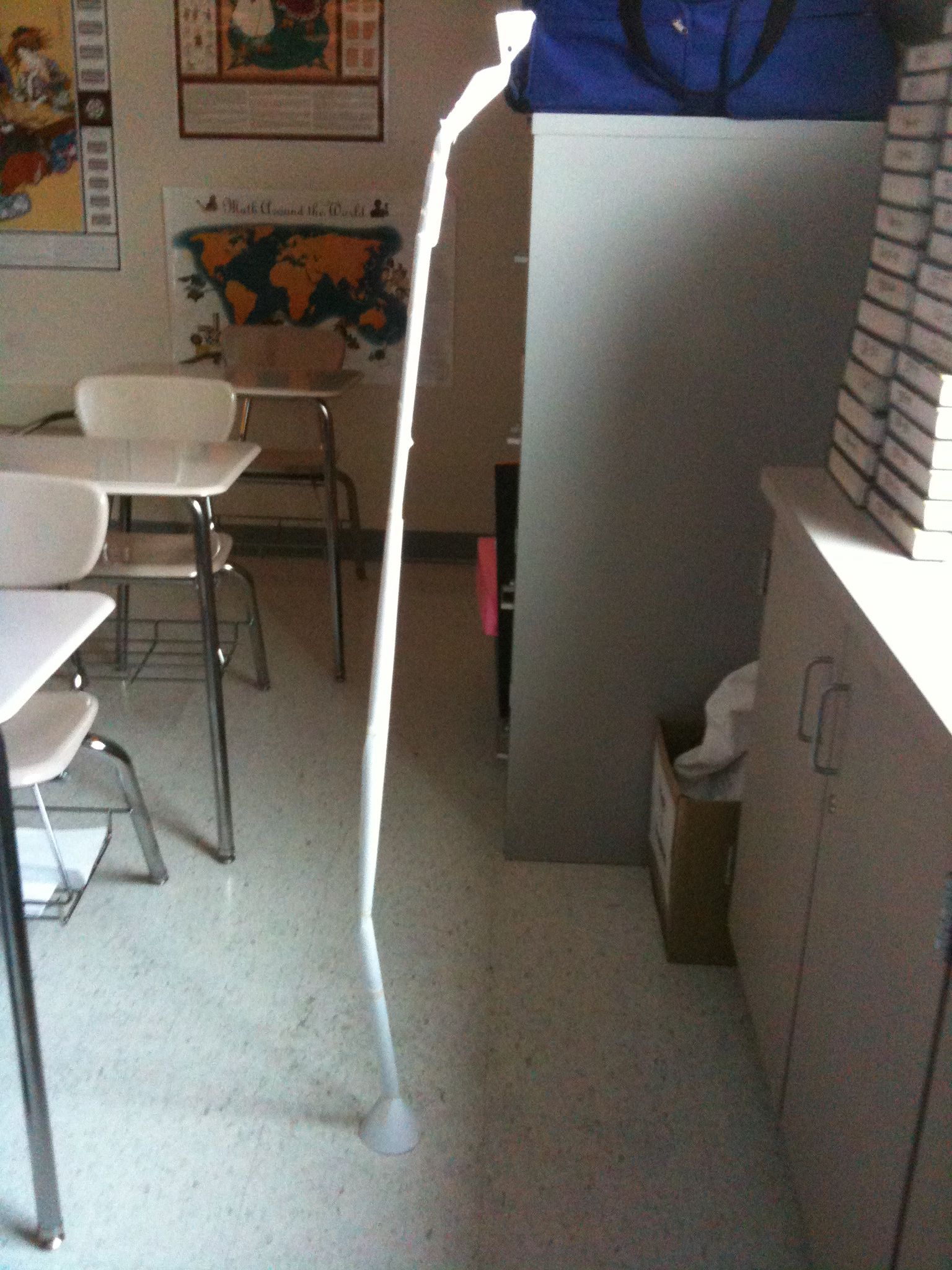
Today we had a “Tower of Terror” competition in our Calculus classes (just for Halloween fun :-)). The rules are: You get 5 pieces of 8.5″x11″ paper and 8″ of masking tape. The goal is to build the tallest free-standing tower.
Here’s a photo of the best tower from all the classes, standing at an amazing 57″. Great job, ladies!
Check this well-produced rap by Montgomery Blair math teacher Jake Scott. Cool!
Good job, Mr. Scott! We’ll look forward to more videos!
Anyone interested in education needs to watch this talk by Ken Robinson. Education will almost certainly change in fundamental ways in the next few decades–our current educational system is based on some faulty assumptions, as Ken Robinson points out.
On a related note, I recommend you check out this recent op-ed piece by G.V. Ramanathan, published last weekend. Here’s an excerpt:
How much math do we really need?
Twenty-seven years have passed since the publication of the report “A Nation at Risk,” which warned of dire consequences if we did not reform our educational system. This report, not unlike the Sputnik scare of the 1950s, offered tremendous opportunities to universities and colleges to create and sell mathematics education programs.
Unfortunately, the marketing of math has become similar to the marketing of creams to whiten teeth, gels to grow hair and regimens to build a beautiful body.
There are three steps to this kind of aggressive marketing. The first is to convince people that white teeth, a full head of hair and a sculpted physique are essential to a good life. The second is to embarrass those who do not possess them. The third is to make people think that, since a good life is their right, they must buy these products.
So it is with math education. A lot of effort and money has been spent to make mathematics seem essential to everybody’s daily life. There are even calculus textbooks showing how to calculate — I am not making this up and in fact I taught from such a book — the rate at which the fluid level in a martini glass will go down, assuming, of course, that one sips differentiably. Elementary math books have to be stuffed with such contrived applications; otherwise they won’t be published.
 Random Walks