There’s a nice article on the foundations of mathematics in the NY Times this week. It’s a series by Steven Stragatz that will continue over the next couple weeks. I may post again as other articles come out.
Author Archives: Mr. Chase
Who am I? (hint)
I posted the following problem back on December 3. I thought I’d post the solution, but then I decided maybe to just give you a hint. I’ve emboldened each true statement. The other statement in each pair is false. I did a lot of trial and error, making lists of numbers and crossing things off, narrowing it down. I didn’t have a great strategy, so see if you can do better. Can you figure out the number now?
There are five true and five false statements about the secret number. Each pair of statements contains one true and one false statement. Find the trues, find the falses, and find the number.
1a. I have 2 digits
1b. I am even2a. I contain a “7”
2b. I am prime3a. I am the product of two consecutive odd integers
3b. I am one more than a perfect square4a. I am divisible by 11
4b. I am one more than a perfect cube5a. I am a perfect square
5b. I have 3 digits
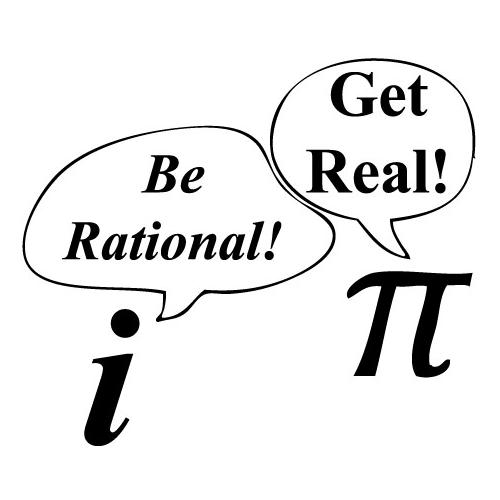
Be Rational, Get Real
One present I got for my dad this Christmas was a t-shirt with this funny image on it. Perhaps you’ve seen this on a poster or t-shirt before. It’s very amusing. But my dad pointed out a bit of the irony I hadn’t noticed before.
For to tell
to “be rational” is a bit like the pot calling the kettle black. Can you think why? If you remember what a rational number is, you’ll remember it’s a subset of the real numbers. No imaginary number is “rational” in the typical sense. So
could just as easily say “be rational” to
.
You might have an intuitive sense for what might make a complex number “rational” though. You might say, if the real and imaginary part are both rational, then the complex number is “kind of” rational. Mathematicians call these “Gaussian Rationals.”
That’s your interesting thought for the day. Happy new year!
Caption Contest
There’s a great caption contest going on at the Wild About Math blog. I submitted a caption. Check it out and contribute your own witty submission :-). I’ve copied the photo here (click for the larger version):
Awesome Illusion
Soda Mixing Problem
Here’s a good puzzle for you!
Two jars contain an equal volume of soda. One contains Sprite, the other Coca Cola. You take a small amount of Coca Cola from the Coca Cola jar and add it to the Sprite jar. After uniformly mixing this concoction, you take a small amount out and put it back in the Coca Cola jar, restoring both jars to their original volumes. After having done this, is there more Coca Cola in the Sprite jar or more Sprite in the Coca Cola jar? Or, are they equally contaminated?
This problem has been stated in many different ways, with various liquids. I’ve phrased it in my own way. If you search around the internet, you can find the solution. But I want you to think it through. Give an answer and see if you can justify it! (I’ll post my solution later.)
More Math on NPR: Babbage’s Difference Engine
This 5 minute segment was a part of yesterday’s All Things Considered, on NPR. Go listen to it! Charles Babbage invented the computer in the 19th century, long before vacuum tubes or transistors were even invented. He called it the “Difference Engine.” He drew plans for an intricate machine — a large and powerful (but purely mechanical) computer but his plans were never fully executed.
This was also the subject of a WIRED magazine interview in 2008:
So next time you want to evaluate a 7th degree polynomial, why not give Babbage’s difference engine a spin? 🙂
Derivative Books
Allow me to introduce you to my Calculus class! Here, they show you a few of their “Derivative Books.” As a fun reference guide, students made small origami books and wrote derivative rules on each page. On the front, they made enticing covers, a few of which you see here:
I encourage you to keep a book like this in your back pocket, or in your wallet. You never know when you might need to take a derivative!
RadioLab is Speaking our Language
Here’s a great episode on Numbers, produced by NPR’s RadioLab. It’s an hour long, but you can download a podcast, or listen to it as you work. I learned some interesting stuff!

One new mathematical fact I learned was that the locus of points 1 unit away from an elipse is not an elipse. I’m going to work on the proof. Fascinating!
(Thanks, Drew, for pointing this out to me!)
Elegant Puzzles on TED
Another great TED talk, this one on the art of making puzzles. Bon appetit!