Designing a good roller-coaster loop is a balancing act. The coaster will naturally slow down as it rises, so it has to enter the loop fast enough to make it up and over the top. The curving track creates a centripetal force, causing the cars to accelerate toward the center of the loop, while momentum sweeps them forward. Loose objects like riders are pinned safely to their seats. The acceleration gives the ride its visceral thrill, but it also puts stress on the fragile human body—and the greater the velocity, the greater the centripetal acceleration.
Coney Island’s Flip-Flap Railway, built in 1895, reached a neck-snapping 12 times the force of gravity at the bottom of its loop—more than enough to induce what pilots call G-LOC, or gravity-induced loss of consciousness. In other words, riders often passed out. In fact, any vehicle trying to get around a perfectly circular loop has to hit at least 6 g’s—enough to render most people unconscious.
To solve the problem, modern designers adopted an upside-down teardrop shape called a clothoid, in which the track curves more sharply up top than at the bottom. Then most of the turn happens at the peak, when the coaster is moving the slowest and the acceleration is least. Result: no G-LOC, just screams. The formula that helped them do it? ac = v2⁄ r.
On October 21, W3C (the governing body responsible for web standards) recommended a new version of its Mathematical Markup Language for use on the web. Here’s an article about it from ComputerWorld:
The W3C has updated its MathML standard for rendering mathematical notation on Web pages to better portray basic math symbols, as well as render mathematic symbols in more languages.
The World Wide Consortium (W3C) is hoping that this new version of MathML will be rolled into the other group of standards being incorporated in browsers with the HTML5 Web page markup specification, such as CSS (Cascading Style Sheets) and SVG (Scalable Vector Graphics).
The new standard represents basic symbols such as for multiplication, long division, subtraction, and the carries and borrows addition symbols.
The new markup will allow educational Web page designers to add these symbols onto the pages instead of going through the cumbersome process of embedding small images of the symbols or formulas into the pages. The symbols will also help assistive technology such as screen readers interpret the mathematical material.
Before seeing this, I didn’t even realize such a thing existed. I read through some of the standards (here) and I wasn’t too impressed. For instance, check out this convoluted tagging that must be used to render the quadratic formula.
This is incredible! I hadn’t heard of this paradox. It reminds me of Gabriel’s horn. But I like it better, in fact, because it doesn’t require any Calculus knowledge. You know I like the harmonic series. I’ve blogged about it twice before, here and here.
I know this is old news, but I wanted to make sure and acknowledge that mathematical great, Benoit Mandelbrot passed away twelve days ago on October 14. There’s a nice set of videos on the TED blog if you care to check them out, including this TED talk that Benoit just gave in February of this past year:
At some point I’ll have to post more about fractals, for my own sake. I’d like to research them a bit more and make some of my own. For some beautiful fractals that appear in nature, you can see this post.
Anyone interested in education needs to watch this talk by Ken Robinson. Education will almost certainly change in fundamental ways in the next few decades–our current educational system is based on some faulty assumptions, as Ken Robinson points out.
On a related note, I recommend you check out this recent op-ed piece by G.V. Ramanathan, published last weekend. Here’s an excerpt:
How much math do we really need?
Twenty-seven years have passed since the publication of the report “A Nation at Risk,” which warned of dire consequences if we did not reform our educational system. This report, not unlike the Sputnik scare of the 1950s, offered tremendous opportunities to universities and colleges to create and sell mathematics education programs.
Unfortunately, the marketing of math has become similar to the marketing of creams to whiten teeth, gels to grow hair and regimens to build a beautiful body.
There are three steps to this kind of aggressive marketing. The first is to convince people that white teeth, a full head of hair and a sculpted physique are essential to a good life. The second is to embarrass those who do not possess them. The third is to make people think that, since a good life is their right, they must buy these products.
So it is with math education. A lot of effort and money has been spent to make mathematics seem essential to everybody’s daily life. There are even calculus textbooks showing how to calculate — I am not making this up and in fact I taught from such a book — the rate at which the fluid level in a martini glass will go down, assuming, of course, that one sips differentiably. Elementary math books have to be stuffed with such contrived applications; otherwise they won’t be published.
I went down to the USA Science & Engineering Festival yesterday. There were thousands of people there, including our science teacher Mr. Martz at the QuarkNet booth, and our distinguished guest Glen Whitney with the Math Museum exhibit. (I also saw a few of you, too!)
A kid tries to build an unsupported arch of overlapping rectangular bricks.
At the Rockville Science Center‘s booth (the Rockville Science center doesn’t exist yet), I stopped because I immediately recognized an application of the harmonic series! The goal is to stack thin 8″ rectangular bricks in such a way that they span a gap of 22″. This girl needed a bit of my help to get started, but as you can see in the photo, now she’s doing marvelously. As I remember, the literature at the table gave instructions to overlap the top brick by half, the next by a quarter, the next by an 8th and so on. But the mathematicians in the crowd know that this overlapping strategy would limit us to a spanning distance of 16″, even given an infinite number of bricks (do you remember why?). It actually turns out that you can build this kind of stack with an infinite overlap. The overlaps are proportional to the harmonic series, which is divergent. Here’s a nice paper about it.
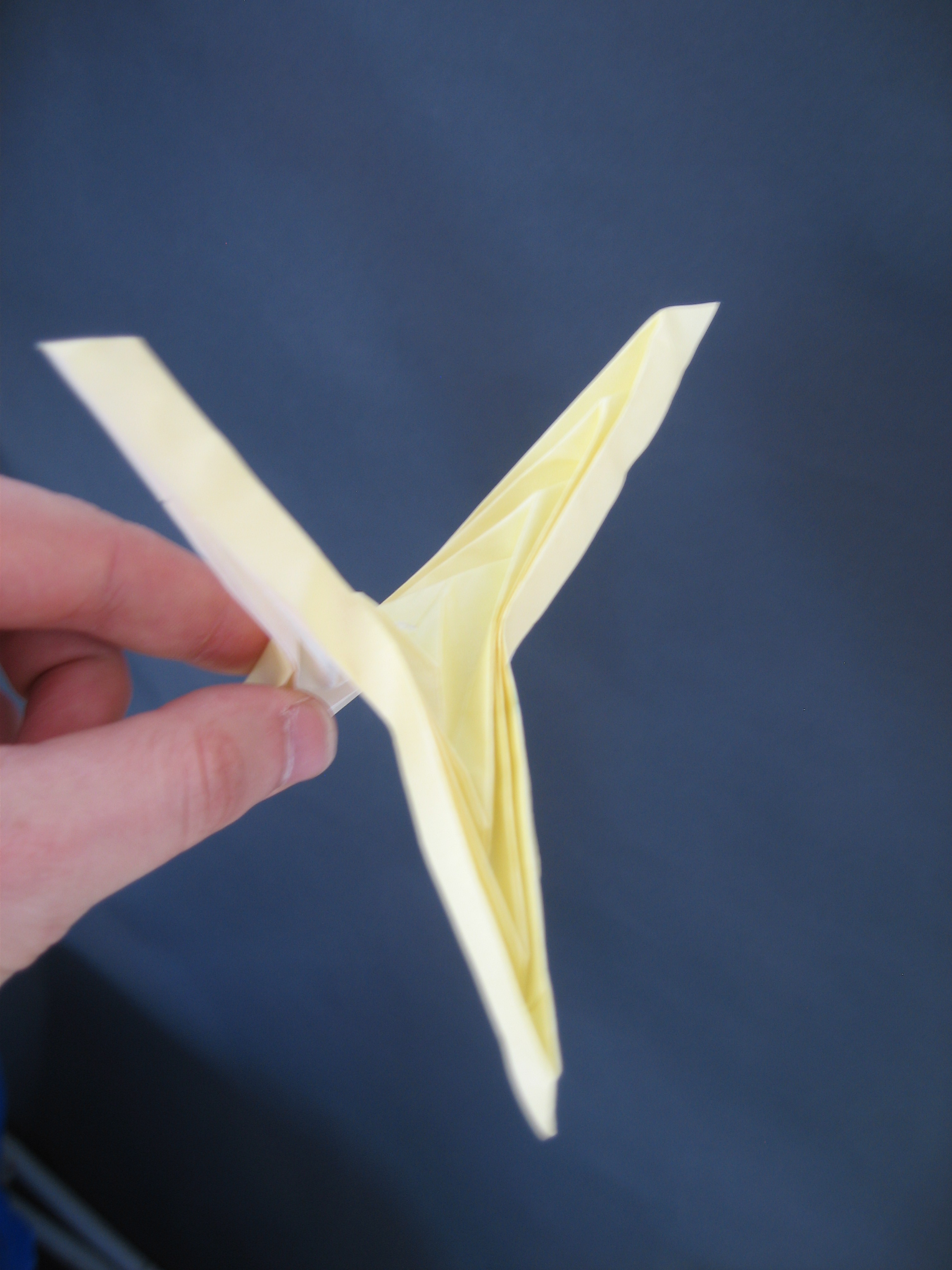
My origami-approximation to the hyperbolic paraboloid.
I stopped by the MAA’s booth long enough to make this origami hyperbolic paraboloid. You can learn to make your own here.
Me and Glen Whitney
Right next to the MAA’s booth was the Math Museum‘s booth. I stopped by to say hi to Glen, our speaker from the previous day. And while I was there I made a tetraflexagon (directions on their website). And I made my own Math Museum logo. Cool! Also, they have this circular laser array that allows you to see slices of solid figures. Check out my slices:
A triangular slice of the dodecahedron.
A pentagonal slice of the dodecahedron.
A slice of Mr. Chase :-).
I played around with the dodecahedron. With it you can get slices that are regular triangles & hexagons (by moving through a vertex), regular pentagons & decagons (by moving through a face), or squares & octagons (by moving through an edge). Remind anyone of Flatland? It made me curious to try some other platonic solids. My intuition is that the dual of each platonic solid would yield the same regular cross sections. But I have no idea. Anyone else know?
Mr. Chase is approximately 2 billion nanometers tall.
The last thing I did yesterday was the Nano Brothers Juggling Show. Very cool. I’ve actually seen them perform before. Those of you who know me, know I’m an avid juggler. The juggling was fun, but even more fun was the way they incorporated science into the show.


 , which allows you to render it with this very simple code:




 Random Walks