Longest mathematical proof

Here’s a recent article from NewScientist.com, Prize awarded for largest mathematical proof by Stephen Ornes:

The largest proof in mathematics is colossal in every dimension – from the 100-plus people needed to crack it to its 15,000 pages of calculations. Now the man who helped complete a key missing piece of the proof has won a prize.

In early November, Michael Aschbacher, an innovator in the abstract field of group theory at the California Institute of Technology in Pasadena will receive the $75,000 Rolf Schock prize in mathematics from the Royal Swedish Academy of Sciences for his pivotal role in proving the Classification Theorem of Finite Groups, aka the Enormous Theorem.

(more)


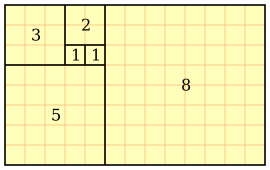
Fibonacci joke

“I feel like this year’s Fibonacci conference will be as big as the last two combined!”

[Hat tip: Tim Chase]

In related Fibonnaci news, here are three recent blog posts having to do with Fibonacci:


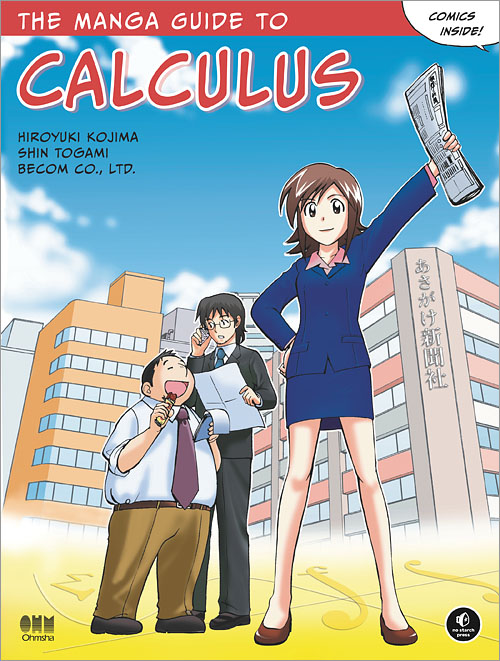
The Manga Guide to Calculus

This summer I finally finished reading the Manga Guide to Calculus by Hiroyuki Kojima and Shin Togami. Here are my two cents:

The Manga Guide to Calculus is chocked full of great mathematics and lots of quality comic art (the author went to great lengths to ensure it was authentic manga, with illustrations by popular artist Shin Togami).

That being said, I don’t think anyone could ever learn Calculus using this book. In fact, I think Kojima must know that. He never claims this can be used as a textbook replacement. The math isn’t presented in a very systematic way, and there are very few real exercises for the reader. Right from the beginning he puts heavy emphasis on linear approximation. He takes a very different approach to presenting Calculus than a math book would. It is a story most of all. Kojima, in his preface, says its a great book for those who already have Calculus knowledge–both for those who love Calculus and for those who have been “hurt by it.” I tend to agree.

As for the story, well, it’s a bit contrived. But what story that tries to smuggle in some math doesn’t seem a little contrived? Sometimes it’s a bit of a stretch and the story suffers. You should still give it a chance, though.

So to those looking for a Calculus textbook, you need to look elsewhere. For instance, I was looking for things I might be able to use in the Calculus class I teach, but couldn’t find much usable content. But for those interested in math and are looking for a fun read, I would recommend picking it up.

First Day of School!

interestingly, I wore almost the identical outfit as this guy for our first day of school :-)

I just wanted to let everyone know that I’m back, and excited for the new school year.  I took a little summer break from blogging, just like I did from teaching :-).

Today was our first day of school at Richard Montgomery High School, where I teach. (And we actually did have school today, even though we had both a 5.8 earthquake and an ‘historic’ hurricane in the last week.) So welcome back to all my current and former students!

Proving the “obvious”

from graphjam.com

As Eric Temple Bell said, “‘Obvious’ is the most dangerous word in mathematics.” That being the case, it is often true that we have trouble proving statements that seem self-evident. Many times we are indeed tempted to say “clearly” or “obviously” or “it is trivial” or “the details have been left to the reader” or “this easily follows from Theorems 4.8, 5.1, and Definition 5.8”. For a full list of invalid proof techniques, visit this hilarious site. Here are a few samples (it’s a LONG list!), quoted from  full list on their site:

  • Proof by intimidation (“Trivial.”)
  • Proof by example (The author gives only the case n = 2 and suggests that it contains most of the ideas of the general proof.)
  • Proof by vigorous hand waving (Works well in a classroom or seminar setting. )
  • Proof by exhaustion (An issue or two of a journal devoted to your proof is useful. )
  • Proof by importance (A large body of useful consequences all follow from the proposition in question.)
  • Proof by accelerated course (We don’t have time to prove this… )

Choosing the level of rigor for a proof is often difficult–depending on the mathematical context, and the audience. I’m taking a graduate class in Analysis right now, so I definitely think about this a lot! In fact, I might add one more to the list:

  • Proof by beautiful typesetting (Because the proof looks good and is typed in \LaTeX, it must be right.)

At least,  I hope my professor feels that’s a valid technique :-).

The Arc Cotangent Controversy

I love this discussion at squareCircleZ. All my readers should check it out. Which is the graph of arccot(x)?

from squarecircleZ

from squarecircleZ

I especially like this controversy because some big players have weighed in on each side. Mathcad and Maple prefer the first interpretation, Mathematica and Matlab prefer the second.

For a more thorough treatment, check out the original post here. Three cheers for great math blogging! 🙂