Arithmetic/Geometric Hybrid Sequences

Here’s a question that the folks who run the NCTM facebook page posed this week:

Find the next three terms of the sequence 2, 8, 4, 10, 5, 11, 5.5, …

Feel free to work it out. I’ll give you a minute.

Done?

still need more time?

..

give up?

Okay. The answer is 11.5, 5.75, 11.75.

The pattern is interesting. Informally, we might say “add 6, divide by 2.” This is an atypical kind of sequence, in which it seems as though we have two different rules at work in the same sequence. Let’s call this an Arithmetic/Geometric Hybrid Sequence. (Does anyone have a better name for these kinds of sequences?)

But a deeper question came out in the comments: Someone asked for the explicit rule. After a little work, I came up with one. I’ll give you my explicit rule, but you’ll have to figure out where it came from yourself:
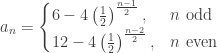
a_n=\begin{cases}6-4\left(\frac{1}{2}\right)^{\frac{n-1}{2}}, & n \text{ odd} \\ 12-4\left(\frac{1}{2}\right)^{\frac{n-2}{2}}, & n \text{ even}\end{cases}

More generally, if we have a sequence in which we add d, then multiply by r repeatedly, beginning with a_1, the explicit rule is

a_n=\begin{cases}\frac{rd}{1-r}+\left(a_1-\frac{rd}{1-r}\right)r^{\frac{n-1}{2}}, & n \text{ odd} \\ \frac{d}{1-r}+\left(a_1-\frac{rd}{1-r}\right)r^{\frac{n-2}{2}}, & n \text{ even}\end{cases}.

And if instead we multiply first and then add, we have the following similar rule.

a_n=\begin{cases}\frac{d}{1-r}+\left(a_1-d-\frac{rd}{1-r}\right)r^{\frac{n-1}{2}}, & n \text{ odd} \\ \frac{rd}{1-r}+\left(a_1-d-\frac{rd}{1-r}\right)r^{\frac{n}{2}}, & n \text{ even}\end{cases}.

And there you have it! The explicit formulas for an Arithmetic/Geometric Hybrid Sequence:-).

(Perhaps another day I’ll show my work. For now, I leave it the reader to verify these formulas.)

The Mathematics of Juggling and more from George Hart

[Dr. Chase guest blogging again]

The Mathematics of Juggling You’re probably familiar with Vi Hart’s math videos. Less well-known are her father’s math videos. Although I was aware of his mathematical sculpture, I was not aware until today that since August 2012, he has been producing a mathematical video series called mathematical impressions for the Simons Foundation. The 10th in the series is The Mathematics of Juggling. Check it out!

Progress Toward Twin-Prime Conjecture

This nice article came through on wired today:

Unknown Mathematician Proves Surprising Property of Prime Numbers

By Erica Klarreich, Simons Science News

Image: bwright923/Flickr

On April 17, a paper arrived in the inbox of Annals of Mathematics, one of the discipline’s preeminent journals. Written by a mathematician virtually unknown to the experts in his field — a 50-something lecturer at the University of New Hampshire named Yitang Zhang — the paper claimed to have taken a huge step forward in understanding one of mathematics’ oldest problems, the twin primes conjecture.

Editors of prominent mathematics journals are used to fielding grandiose claims from obscure authors, but this paper was different. Written with crystalline clarity and a total command of the topic’s current state of the art, it was evidently a serious piece of work, and the Annals editors decided to put it on the fast track.

Just three weeks later — a blink of an eye compared to the usual pace of mathematics journals — Zhang received the referee report on his paper.

“The main results are of the first rank,” one of the referees wrote. The author had proved “a landmark theorem in the distribution of prime numbers.”

(more)

This is very exciting news, and the whole story has a fantastic David & Goliath feel–“little known mathematician delivers a crushing blow to a centuries old problem” (not a fatal blow, but a crushing one). It’s such a feel-good story, almost like Andrew Wiles and Fermat’s Last Theorem. Here’s my favorite part of the article:

…during a half-hour lull in his friend’s backyard before leaving for a concert, the solution suddenly came to him. “I immediately realized that it would work,” he said.

Just chillin’ in his friend’s backyard…and it came to him! Anyone who has worked on math problems or puzzles has had this experience, right? It seems like an experience common to all people. This has definitely happened to me lots of times–an insight hits me out of nowhere and unlocks a problem I’ve been working on for weeks. It’s one of the reasons we do mathematics!
